How One Explosives Detection Dog Changed a Federal Officer’s Life Forever
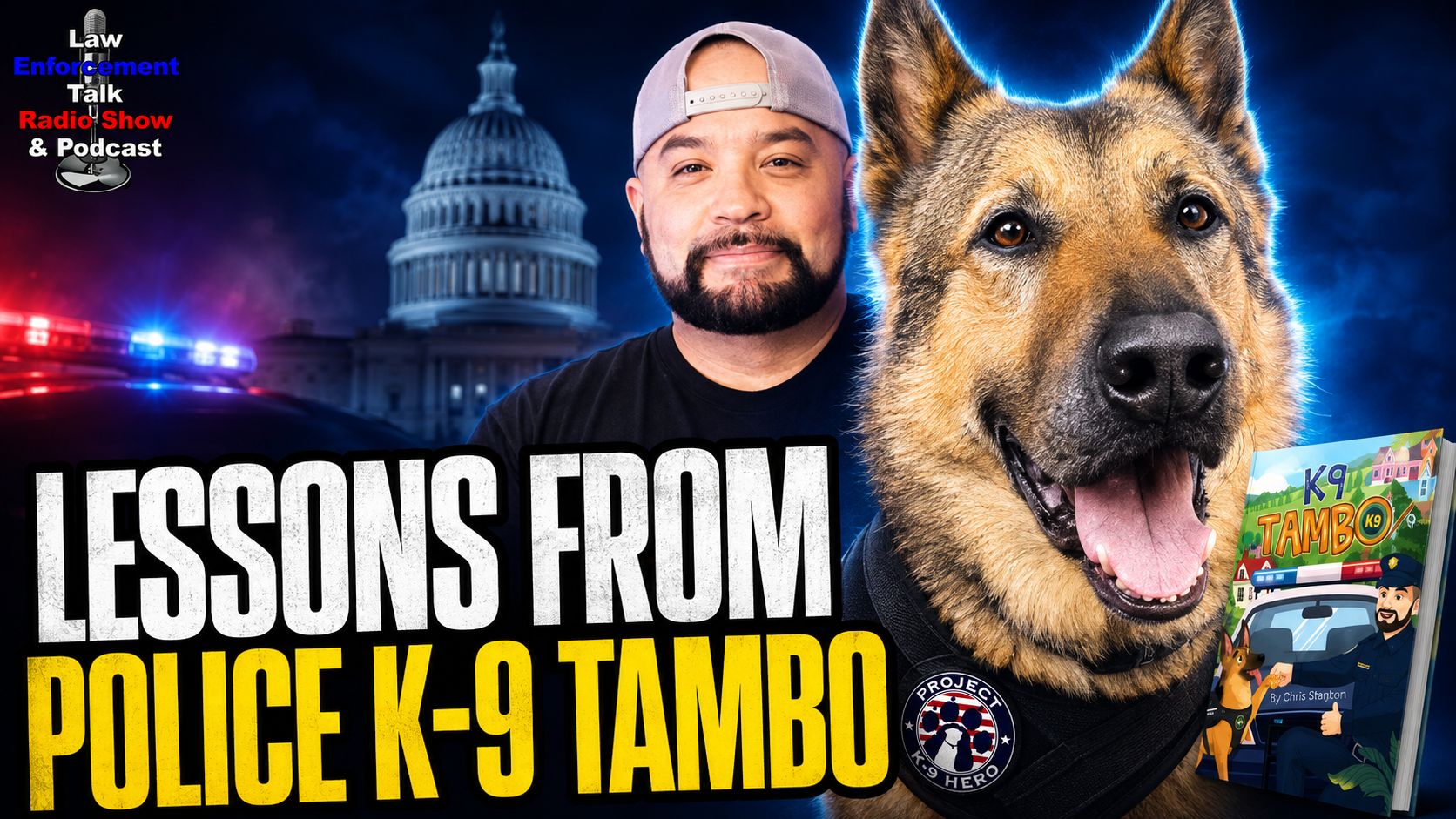
How One Explosives Detection Dog Changed a Federal Officer’s Life Forever. The most important lessons of Federal Police Officer Chris Bingham’s law enforcement career did not come from a training manual, a classroom, or an experienced supervisor.
They came from a police K-9 named Tambo.
Tambo could not explain courage, loyalty, resilience, or unconditional love with words. He demonstrated those qualities every day through his actions. Listen to the free podcast here.
For many law enforcement officers, the bond they share with a K-9 partner becomes one of the most important relationships of their career. Years of training, demanding assignments, daily companionship, and mutual dependence create a level of trust that is difficult to describe to anyone who has never experienced it.
A K-9 handler does not simply report to work with a dog. The handler and K-9 train together, travel together, work together, and often live together. They learn to recognize each other’s smallest movements and changes in behavior.
In dangerous situations, their lives may depend on that understanding.
Bingham experienced this extraordinary partnership while working in Maryland with Tambo, an explosives detection K-9 whose service helped protect fellow officers and members of the public.
“Tambo wasn’t just my K-9 partner,” Bingham said. “He was my teammate, my protector, and one of the best friends I’ve ever had.”
Their partnership ultimately became about far more than police work. Tambo changed the way Bingham viewed loyalty, adversity, family, service, and the limited time people are given with those they love.
During an interview on the nationally syndicated Law Enforcement Talk Radio Show and Podcast, Bingham shared the story of their service together, Tambo’s unexpected retirement, a devastating cancer diagnosis, and the lessons that continued long after the K-9’s law enforcement career ended.
The Special Relationship Between a Police K-9 and Handler
Police K-9 partnerships are built upon extraordinary trust.
A handler must learn how a dog communicates through posture, breathing, movement, focus, and subtle behavioral changes. The K-9 must trust that the handler will provide direction, protection, and care in unpredictable environments.
That connection is developed through repetition and time. It is reinforced during long training sessions, routine patrols, urgent deployments, difficult searches, and quiet moments away from work.
Handlers frequently spend more time with their K-9 partners than they do with friends or family. The dog becomes part of the officer’s daily routine both on and off duty.
The partnership does not end when a shift is over.
For Bingham, Tambo was never simply a piece of police equipment or another resource assigned to an agency. He was a living, breathing partner with intelligence, personality, instincts, and a powerful desire to work.
Their relationship was professional, but it was also deeply personal.
Trust eventually became second nature.
Bingham understood Tambo’s signals. Tambo recognized Bingham’s commands and emotions. Each knew what the other was expected to do when circumstances changed.
“He simply showed up every day ready to work,” Bingham recalled. “There was never a complaint, never a bad attitude. He just gave everything he had.”
That consistency became one of Tambo’s defining qualities.
The Work of an Explosives Detection K-9
Explosives detection dogs perform a highly specialized role in public safety.
Through extensive training, they learn to recognize odors associated with explosive materials. Their abilities can be used to search vehicles, buildings, packages, public areas, and locations where officers suspect a potential threat.
The work requires intense concentration and discipline.
An explosives detection K-9 may be asked to search a busy environment filled with distracting sounds, unfamiliar people, food, vehicles, and countless competing odors. Despite those distractions, the dog must remain focused on the task.
The K-9 does not understand politics, public recognition, or career advancement. He does not seek a promotion or expect to receive praise on social media.
He works because he has been trained to perform a mission and because he trusts his handler.
Throughout their years together, Tambo helped search for potential threats and safeguard the people around him. His work carried serious consequences. A single discovery could prevent an explosion, protect a crowded facility, or allow officers to respond before innocent lives were placed in danger.
The public might never know how many tragedies a trained police K-9 helped prevent. Successful security work is often invisible because the desired outcome is that nothing happens.
Tambo performed that work with the same enthusiasm and determination he brought to every day.
For Bingham, watching Tambo work became a daily lesson in dedication.
More Than a Working Dog
The strongest police K-9 partnerships extend far beyond assignments and training.
After the uniform and equipment come off, the dog remains beside the handler. He becomes part of the home and family. He is present during ordinary moments that never appear in official records: rides in the car, evenings at home, meals, walks, and time spent relaxing after difficult days.
Those moments strengthen a bond already forged through demanding work.
Tambo became family to Bingham.
He was a source of companionship after stressful assignments and a constant presence during the routine parts of life. He did not need to understand the details of a difficult day to recognize when his handler needed him.
“His loyalty was unconditional,” Bingham said. “It didn’t matter what kind of day I was having. Tambo was always there.”
That kind of loyalty can be especially meaningful in law enforcement, a profession in which officers routinely confront conflict, danger, trauma, and human suffering.
A police K-9 does not judge an officer for feeling exhausted, frustrated, or emotionally overwhelmed. The dog remains present.
Tambo demonstrated that loyalty during his working years, throughout retirement, and eventually during the greatest physical challenge of his life.
An Injury Unexpectedly Ends Tambo’s Career
Police K-9 careers do not last forever.
The demands of training, repeated deployments, physical exertion, and age eventually affect even the most motivated working dogs. Sometimes an illness or injury brings that career to an end earlier than expected.
Tambo’s law enforcement service ended after he suffered an injury.
The transition into retirement brought mixed emotions. Bingham felt relief that his partner could step away from the physical demands and dangers of the job, but retirement also created uncertainty.
Working dogs are accustomed to structure, activity, and a sense of purpose. The daily routine changes dramatically when their careers end.
For handlers, retirement can also be emotional. The partner who once prepared for each shift is suddenly no longer part of the officer’s operational life.
Bingham and Tambo remained inseparable. Tambo adjusted to a slower pace while continuing to enjoy life with the person who had stood beside him throughout his career.
Retirement offered them a chance to spend time together without the demands of deployments and security operations. They could look back on years of service while beginning a quieter chapter.
Then everything changed.
Listen to the free podcast here.
A Devastating Cancer Diagnosis
After retiring, Tambo was diagnosed with hemangiosarcoma, an aggressive cancer that frequently affects dogs.
The diagnosis was devastating.
Tambo underwent emergency surgery and continued receiving chemotherapy treatments. Despite the medical care, the prognosis was grim.
Bingham had spent years protecting and guiding his K-9 partner. Now he was confronting an enemy that could not be detected during a search, controlled through training, or stopped with traditional police tactics.
Watching a loyal partner face a terminal illness became one of the most painful experiences of Bingham’s life.
It also revealed another side of Tambo’s character.
The same dog who had approached law enforcement assignments with discipline and courage faced illness with remarkable resilience. His body was struggling, but his desire to remain close to the people he loved did not disappear.
“As strange as it sounds, Tambo was still teaching me every day,” Bingham said. “Even when he was sick.”
The lessons Tambo taught during his illness would become some of the most powerful of their entire partnership.
Learning to Live in the Present
One lesson stood above the others: the importance of living in the moment.
People frequently spend their time replaying past mistakes or worrying about events that have not happened. They sacrifice the present while mentally living in a past they cannot change or a future they cannot control.
Dogs approach life differently.
They focus on the people around them, the experiences directly in front of them, and the moments they have been given.
Tambo did not understand the statistics surrounding his cancer. He did not wake up worrying about test results or how much time remained.
He greeted another day.
“He never felt sorry for himself,” Bingham explained. “Even when he was struggling physically, he greeted every day with excitement. He wanted to be with his family. He wanted to enjoy life.”
Watching Tambo continue to find happiness caused Bingham to reevaluate his own perspective.
“Tambo showed me that we often waste too much energy worrying about things we can’t control,” he said. “He taught me to appreciate what is right in front of me.”
The lesson was simple but profound.
There will always be uncertainty. People cannot control every diagnosis, injury, loss, or unexpected change. They can, however, decide how fully they will live the time in front of them.
Listen to the free podcast here.
Loyalty as a Way of Life
If one quality defined Tambo, it was loyalty.
His commitment did not depend on convenience or circumstances. It remained constant during dangerous assignments, ordinary days at home, retirement, medical treatments, and physical decline.
Tambo’s loyalty was not expressed through grand gestures. It appeared through his daily presence.
He stayed close.
He remained engaged with his family.
He continued offering affection even while his own body was failing.
For Bingham, that unwavering devotion became a reminder of the qualities that matter most in relationships: faithfulness, compassion, reliability, and love.
People often measure success through income, titles, awards, or public recognition. Tambo had no understanding of those things. He measured life through connection, service, and the people he trusted.
His example challenged Bingham to consider how humans treat the people closest to them.
Are they present when someone is suffering? Do they remain loyal when circumstances become difficult? Do they show appreciation while there is still time?
Tambo answered those questions through the way he lived.
True Strength Can Be Quiet
Police culture often associates strength with physical ability, command presence, courage under pressure, and the willingness to move toward danger.
Tambo possessed those qualities during his working career.
Yet his battle with cancer demonstrated another form of strength.
True strength is not always loud or dramatic. Sometimes it is found in the determination to face another difficult day without surrendering the ability to experience joy.
“He taught me that strength isn’t about never suffering,” Bingham said. “It’s about how you carry yourself when you are suffering.”
Tambo could not control his diagnosis. He could not reverse the injury that ended his career or stop the cancer affecting his body.
But illness did not erase his spirit.
He continued loving his family. He remained grateful for time with the people around him. He faced adversity with the same steady courage that had defined his police work.
“The biggest lesson wasn’t about being a better police officer,” Bingham reflected. “It was about being a better human being.”
Tambo taught resilience.
He taught gratitude.
He taught compassion.
Most importantly, he demonstrated that courage is not the absence of suffering. Courage can also be the decision to keep loving and living while suffering is present.
Listen to the free podcast here.
Project K9 Hero Helps Continue Tambo’s Care
The retirement of a police or military working dog can create significant financial challenges for the handler’s family.
Once these animals leave government service, access to agency-funded veterinary care may end. The responsibility for medical expenses can shift to the handler, even when an injury or illness emerges after years of demanding public service.
Advanced veterinary procedures, emergency surgery, cancer treatments, medications, and follow-up care can cost thousands of dollars.
In Tambo’s case, the nonprofit organization Project K9 Hero helped fund his cancer treatments, allowing him to continue receiving needed medical care.
Organizations such as Project K9 Hero recognize a difficult reality: retired working dogs may no longer wear an official badge, but their service and needs do not disappear when their careers end.
Supporting these animals is one way of honoring the years they spent protecting others.
Tambo had given everything he had to his work. During his time of need, people came together to give something back.
Preserving Tambo’s Story Through a Children’s Book
Bingham wanted Tambo’s impact to continue reaching people beyond the law enforcement community.
He shared the K-9’s story with a new generation through the children’s book "K9 Tambo", available through Amazon and other booksellers.
The book introduces young readers to the service of a police K-9 while preserving the values Tambo represented.
“Tambo’s legacy isn’t just about what he did as a working dog,” Bingham said. “It’s about the example he set every single day through loyalty, courage, and unconditional love.”
Children can learn that heroes are not always human. They can also learn about service, responsibility, friendship, and the special roles working animals perform.
By sharing Tambo’s story, Bingham ensured that his partner’s influence would continue long after their final law enforcement assignment.
Listen to the free podcast here.
A Police K-9’s Enduring Legacy
The true measure of a life is not always found in awards, promotions, or public accomplishments.
It may be found in loyalty, kindness, courage, and the lives touched along the way.
Tambo’s work as an explosives detection dog helped protect officers and members of the public. That service alone deserves recognition.
Yet his greatest impact may have come from the lessons he taught without ever speaking a word.
He taught Chris Bingham how to appreciate the present.
He demonstrated loyalty without conditions.
He showed that strength can exist alongside suffering.
He proved that purpose does not disappear when a career ends.
And he reminded everyone who heard his story that love is often expressed most powerfully through presence.
For K-9 handlers across America, their partners are never simply dogs.
They are teammates.
They are protectors.
They are family.
They are heroes.
Even after their service ends, the lessons they leave behind continue shaping the people fortunate enough to have worked beside them.
Chris Bingham shares the complete story of his partnership with explosives detection K-9 Tambo on the Law Enforcement Talk Radio Show and Podcast.
The free episode is available on the Law Enforcement Talk Radio Show and Podcast website, Apple Podcasts, Spotify, YouTube, iHeartRadio, and most major podcast platforms.
Listeners can also find episode highlights, supporting articles, law enforcement news, and stories of courage, trauma, survival, and healing through the show’s Facebook, Instagram, LinkedIn, Medium, Blogspot, X, Pinterest, and other social media channels.
Tambo’s legacy was never limited to the explosives he detected or the assignments he completed.
His greatest achievement may have been teaching one federal police officer and countless other people what it truly means to live with loyalty, courage, gratitude, and purpose.
Attributions
Amazon

Radio Show Host and Producer
Retired from the Baltimore Police Department at the rank of Sergeant. He was retired early due a permanent line of duty injury that occurred during an act of violence. The injury resulted in 3 surgeries, two steel plates and a fusion of his right wrist and thumb.
About 8 years after retiring from police work, he began a career in the audio broadcasting space. Starting with "audio-blogs" in 1999. Which progressed into a brokered once a week radio show and then led to broadcasting school.
After graduating he has been a full time FM radio personality and launched the Law Enforcement Today Show as a podcast in March of 2017. This was in a partnership with Law Enforcement Today's Robert Greenberg. The show was quickly recruited by radio and is a nationally syndicated radio show, broadcasting weekly on many US Radio Stations to millions of people.
The partnership with them ended in the Summer of 2023 and the show was renamed the Law Enforcement Talk Radio Show and Podcast.
The radio show is syndicated by Talk Media Network. Go to the Radio Page of the site for more information.

When the Badge Is Gone: Navigating Career Termination After Line-of-Duty Trauma