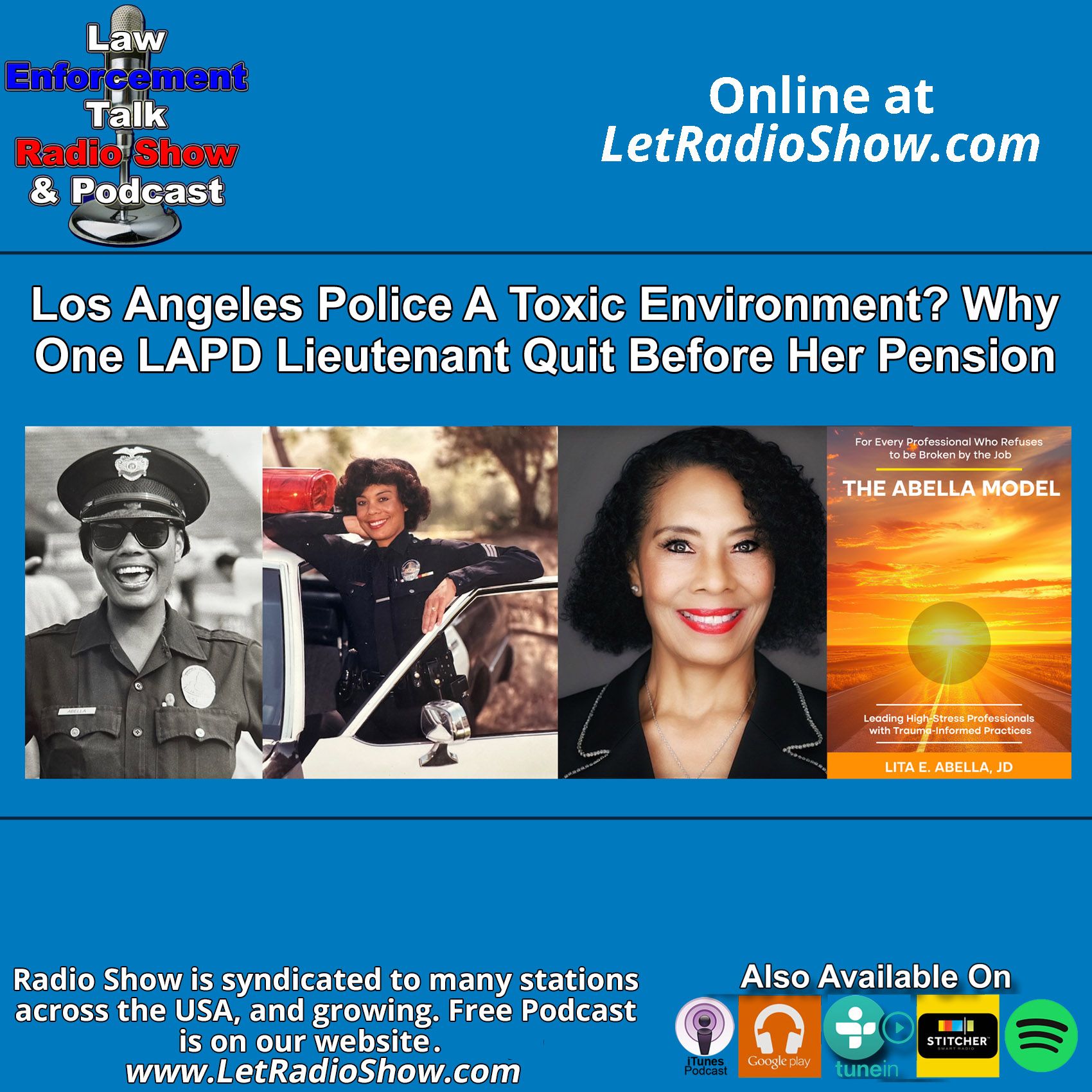
A Toxic Environment? Why One LAPD Lieutenant Quit
A Toxic Environment? Why One LAPD Lieutenant Quit Just Months Before Her Pension. For decades, the Los Angeles Police Department has been one of the most recognizable law enforcement agencies in the world.
Listen to the Free Podcast here.
Its officers patrol a vast and diverse city, responding to violent crime, fatal crashes, domestic disputes, public demonstrations, mental health emergencies, and countless other calls. Their work unfolds under intense media attention, political pressure, and public scrutiny.
Yet former LAPD Lieutenant Lita Abella says it was not the violence on the streets that ultimately caused her to walk away from policing.
According to Abella, the environment inside the department became more damaging than the dangers she encountered outside it.
She left the Los Angeles Police Department only months before becoming eligible for her pension, a decision that would seem almost unthinkable to many career officers. Retirement benefits often represent the finish line after years of dangerous calls, missed holidays, family sacrifices, physical exhaustion, and accumulated trauma.
Abella says remaining in the department was no longer worth the emotional and psychological cost.
During an interview on the nationally syndicated Law Enforcement Talk Radio Show and Podcast, she spoke about traumatic calls, chronic stress, racial and gender discrimination, internal politics, and what she describes as a toxic workplace culture within the LAPD.
Her account reflects her personal experiences and allegations, but it also raises broader questions about leadership, officer wellness, discrimination, and the hidden pressures affecting police officers throughout the United States.
How much stress comes from the streets, and how much originates inside an officer’s own agency? What happens when those sworn to protect the public feel unprotected at work? How many officers remain silent because they fear damaging their careers?
Abella’s story offers a rare look at why one experienced police lieutenant chose her well-being over the pension she was only months away from earning.
The Trauma Began Almost Immediately
Most police officers can remember their first truly horrific call.
It may have been a fatal accident, a shooting, a suicide, an abused child, or a death notification delivered to an unsuspecting family. Even decades later, an officer may still remember the sights, sounds, and emotions associated with that moment.
For Abella, the trauma began early in her career.
She recalled responding to the death of a toddler who had fallen from a balcony. It was the kind of tragedy no academy scenario could fully prepare a new officer to handle.
Police training teaches recruits how to preserve a scene, gather evidence, interview witnesses, write reports, and follow department procedures. It cannot completely prepare someone to stand near a child who has died or to witness a family’s overwhelming grief.
That call became one of Abella’s earliest introductions to the emotional reality of police work.
Like officers across California and the rest of the country, she learned that policing often means meeting people during the worst moments of their lives.
Officers encounter fatal crashes, violent assaults, domestic abuse, shootings, suicides, homicides, and unexpected deaths. They may leave one traumatic scene only to be dispatched immediately to another emergency, with little time to process what they have just witnessed.
The public sees flashing lights and crime-scene tape. Officers may carry the memories for years.
Abella said another case that remained with her involved a 16-year-old shooting victim who died in front of her.
Those experiences became part of her life with the LAPD. She found ways to continue working despite the emotional effects of tragedy, as police officers are expected to do.
What she eventually found more difficult to manage, she says, was the pressure coming from within the organization.
When Internal Politics Feel Worse Than the Streets
One of the most striking elements of Abella’s story is her assertion that the trauma of police calls became easier to handle than the internal politics she experienced.
Police officers are trained to anticipate threats from suspects. They wear protective equipment, practice defensive tactics, qualify with firearms, study criminal behavior, and learn how to make decisions under pressure.
They may be far less prepared for conflict within their own departments.
According to Abella, pressure from command staff, departmental politics, and City Hall contributed to an environment she experienced as toxic and emotionally destructive.
Her allegations raise difficult questions that extend beyond one agency.
Can a police department’s internal culture become more damaging than the calls officers handle? What happens when employees believe promotions, discipline, or assignments are influenced by politics? How does fear of retaliation affect an officer’s willingness to report problems?
Large law enforcement agencies must manage complicated operational and administrative demands. Leaders answer to elected officials, oversight bodies, the courts, the media, and the public. Policies can change as political priorities shift.
Officers and supervisors are then expected to carry out those policies while maintaining public safety and protecting their careers.
That pressure does not automatically make an organization toxic. Strong supervision and accountability are necessary in policing. But when employees perceive leadership as unfair, retaliatory, discriminatory, or indifferent to their well-being, trust can deteriorate quickly.
For Abella, the accumulated internal pressure eventually became overwhelming.
Listen to the Free Podcast here.
Gender Discrimination in a Male-Dominated Profession
Abella also alleges that gender discrimination affected her LAPD career.
Women have served in American law enforcement for generations, yet policing has historically remained a male-dominated profession. Female officers have repeatedly described facing added scrutiny, unequal treatment, sexual harassment, isolation, and assumptions about their physical or leadership abilities.
Many women earn respect through years of effective service and advance into supervisory or command positions. Their success, however, does not necessarily mean that discriminatory attitudes have completely disappeared.
A female officer may feel pressure to prove herself repeatedly. Behaviors considered assertive in a male officer may be judged differently when displayed by a woman. Women can also face criticism for being either too forceful or not forceful enough.
Those pressures may become even more complicated as an officer rises through the ranks.
As a lieutenant, Abella had reached a leadership position that required her to manage personnel, make difficult decisions, and operate within the LAPD’s command structure. Her claims suggest that professional advancement did not shield her from what she viewed as unequal treatment.
Discrimination can create more than career frustration. Over time, it can contribute to anxiety, anger, exhaustion, self-doubt, and a persistent sense of isolation.
An officer may be told to remain mentally strong while also feeling unsupported by the very organization demanding that strength.
That conflict can become emotionally devastating.
Race, Identity, and Claims of Unequal Treatment
Abella also says racial and minority discrimination were part of the problems she faced.
Race remains one of the most difficult subjects surrounding policing in America, especially in a diverse city such as Los Angeles. Public debates often focus on how law enforcement officers treat different communities, but minority officers may also confront questions about how they are treated inside their departments.
Police agencies across the country have invested in diversity recruitment and community representation. Recruiting a diverse workforce, however, is only one part of the challenge.
Retention, promotion, mentoring, fair discipline, and equal access to specialized assignments also matter.
Some minority officers say they have faced subtle bias, unequal opportunities, exclusion from informal networks, or higher standards than their peers. Others report positive careers and supportive leadership.
Abella’s account represents her experience, but it adds to a broader conversation about whether law enforcement agencies are creating environments in which officers from different backgrounds can succeed without facing unfair barriers.
When race and gender intersect, the pressure may become even more complicated. A woman from a minority background may feel that she is confronting multiple layers of expectation, bias, or isolation.
Those experiences can be difficult to document and even harder to discuss within an organization where reputation and personal relationships can influence future opportunities.
Listen to the Free Podcast here.
The Hidden Weight of Police Trauma
Abella’s story also highlights how trauma in policing can come from more than exposure to violence.
Police trauma is often associated with shootings, serious crashes, assaults, dead children, and other disturbing scenes. Those experiences can contribute to post-traumatic stress, depression, anxiety, substance misuse, sleep problems, and emotional detachment.
Workplace conflict can add another form of chronic stress.
Unlike one traumatic call, organizational stress may continue every day. An officer might feel watched, targeted, ignored, or trapped. The employee may worry that speaking honestly will result in discipline, a poor evaluation, an unwanted transfer, or the loss of a promotion.
When street trauma and workplace stress combine, the result can be devastating.
An officer may finish a shift after responding to violence, only to return to an environment perceived as hostile or unsupportive. There may be no safe place to process either source of stress.
The culture of policing can make seeking help difficult.
Some officers fear being viewed as weak. Others worry that admitting to anxiety, depression, or trauma will affect their fitness-for-duty status or career. Supervisors may encourage wellness programs while employees remain skeptical about confidentiality.
As a result, many officers continue working while silently struggling.
Why Walking Away Before a Pension Was So Significant
Abella’s decision to leave shortly before pension eligibility may be the clearest indication of how serious the situation had become for her.
A police pension represents more than money. It is often viewed as compensation for years of sacrifice and risk. Officers may structure their entire careers around reaching retirement eligibility.
They work nights, weekends, holidays, and unpredictable schedules. They miss birthdays and family events. Their spouses and children live with the knowledge that an ordinary shift can suddenly become dangerous.
Walking away just months before securing those benefits can carry enormous financial consequences.
For many officers, the usual advice is simple: hold on until retirement.
Abella concluded that she could not.
She says she resigned to save her own life.
That statement changes the conversation. It suggests that remaining employed had become, in her view, a threat to her mental and emotional survival.
Leaving may have cost her benefits, status, and the career identity she had built over many years. Staying, however, appeared to carry a greater cost.
Her choice demonstrates how severe occupational stress can become. A person may reach a point where financial security no longer outweighs the need to escape an unhealthy environment.
Listen to the Free Podcast here.
The Identity Loss That Can Follow the Badge
Leaving law enforcement is rarely just a job change.
Police work can become central to an officer’s identity. The profession influences friendships, daily routines, family life, communication style, and a person’s sense of purpose.
An officer who leaves unexpectedly may struggle with questions that go far beyond employment.
Who am I without the uniform? What happens to the relationships built inside the department? Was leaving a failure, an act of survival, or both? How can civilian friends understand what happened?
These questions may be especially difficult for a supervisor who spent years advancing through the ranks.
Abella had become an LAPD lieutenant. That title represented experience, leadership, and substantial professional investment. Walking away meant leaving not only a paycheck but also a role that had shaped much of her adult life.
Yet stepping away can also create the space needed to heal.
Former officers sometimes discover that recovery begins only after they are removed from the environment contributing to their distress. With distance, they may be able to process traumatic calls, evaluate workplace experiences, and rebuild an identity that does not depend entirely on the badge.
Police Mental Health Can No Longer Be Ignored
Conversations about police trauma have become more public in recent years.
Retired officers and law enforcement families increasingly discuss PTSD, depression, suicide, alcoholism, broken relationships, anger, and emotional numbness. Podcasts, books, documentaries, and social media have helped bring these experiences into the open.
Many agencies now provide peer-support teams, confidential counseling, wellness programs, chaplains, and trauma-informed training.
Those resources are important, but they cannot succeed without trust.
Officers must believe that asking for help will not destroy their careers. Supervisors must recognize warning signs and respond with more than slogans. Leadership must also examine whether workplace practices are adding unnecessary stress to an already demanding profession.
Mental health support should not focus only on helping officers tolerate harmful conditions. It should also identify and correct organizational problems when they exist.
Abella’s account suggests that officer wellness and leadership culture cannot be separated.
Listen to the Free Podcast here.
Questions Police Leaders Should Be Asking
Her story raises questions that deserve serious consideration from police executives, elected officials, supervisors, unions, and officers:
Are employees able to report misconduct or discrimination without fearing retaliation?
Are promotions and discipline applied consistently?
Do female and minority officers receive meaningful mentoring and equal opportunities?
Can officers access confidential mental health support without damaging their careers?
Are supervisors trained to recognize burnout, trauma, and emotional distress?
Does the organization respond to criticism defensively, or does it investigate concerns fairly?
No police department will eliminate every disagreement or stressful situation. Law enforcement is inherently demanding, and accountability can sometimes feel uncomfortable.
The goal should not be to create a workplace without standards or consequences. It should be to create an environment in which those standards are clear, fair, lawful, and applied consistently.
A Different Kind of Police Story
Most public conversations about policing focus on arrests, crime rates, shootings, misconduct, budgets, or political disputes.
Lita Abella’s story focuses on the emotional survival of the officers themselves.
Her breaking point was not one violent suspect or one horrific call. According to her account, it was the accumulation of street trauma, workplace stress, internal conflict, alleged discrimination, and emotional exhaustion.
Her experience reminds people that the deepest wounds in policing are not always physical.
Some injuries cannot be seen on an X-ray.
They appear as sleepless nights, anxiety, depression, anger, isolation, or the growing belief that entering the workplace has become unbearable.
Those invisible wounds can follow officers long after they remove the uniform for the final time.
Former LAPD Lieutenant Lita Abella shares her complete story on the Law Enforcement Talk Radio Show and Podcast.
The free episode explores trauma, stress, race, gender discrimination, internal politics, leadership, and why she walked away from the Los Angeles Police Department only months before becoming eligible for her pension.
Listeners can hear the interview on the Law Enforcement Talk Radio Show and Podcast website, Apple Podcasts, Spotify, YouTube, iHeartRadio, and most major podcast platforms.
Additional interviews, episode highlights, and supporting articles are available through the show’s Facebook, Instagram, LinkedIn, Medium, Blogspot, and other social media channels.
Abella’s allegations represent her perspective and should be considered in that context. Still, the questions raised by her story reach far beyond one person or one department.
If police agencies expect officers to protect the public under extraordinary pressure, those agencies must also examine how well they protect the people behind the badge.
Attributions
Amazon

Radio Show Host and Producer
Retired from the Baltimore Police Department at the rank of Sergeant. He was retired early due a permanent line of duty injury that occurred during an act of violence. The injury resulted in 3 surgeries, two steel plates and a fusion of his right wrist and thumb.
About 8 years after retiring from police work, he began a career in the audio broadcasting space. Starting with "audio-blogs" in 1999. Which progressed into a brokered once a week radio show and then led to broadcasting school.
After graduating he has been a full time FM radio personality and launched the Law Enforcement Today Show as a podcast in March of 2017. This was in a partnership with Law Enforcement Today's Robert Greenberg. The show was quickly recruited by radio and is a nationally syndicated radio show, broadcasting weekly on many US Radio Stations to millions of people.
The partnership with them ended in the Summer of 2023 and the show was renamed the Law Enforcement Talk Radio Show and Podcast.
The radio show is syndicated by Talk Media Network. Go to the Radio Page of the site for more information.

When the Badge Is Gone: Navigating Career Termination After Line-of-Duty Trauma