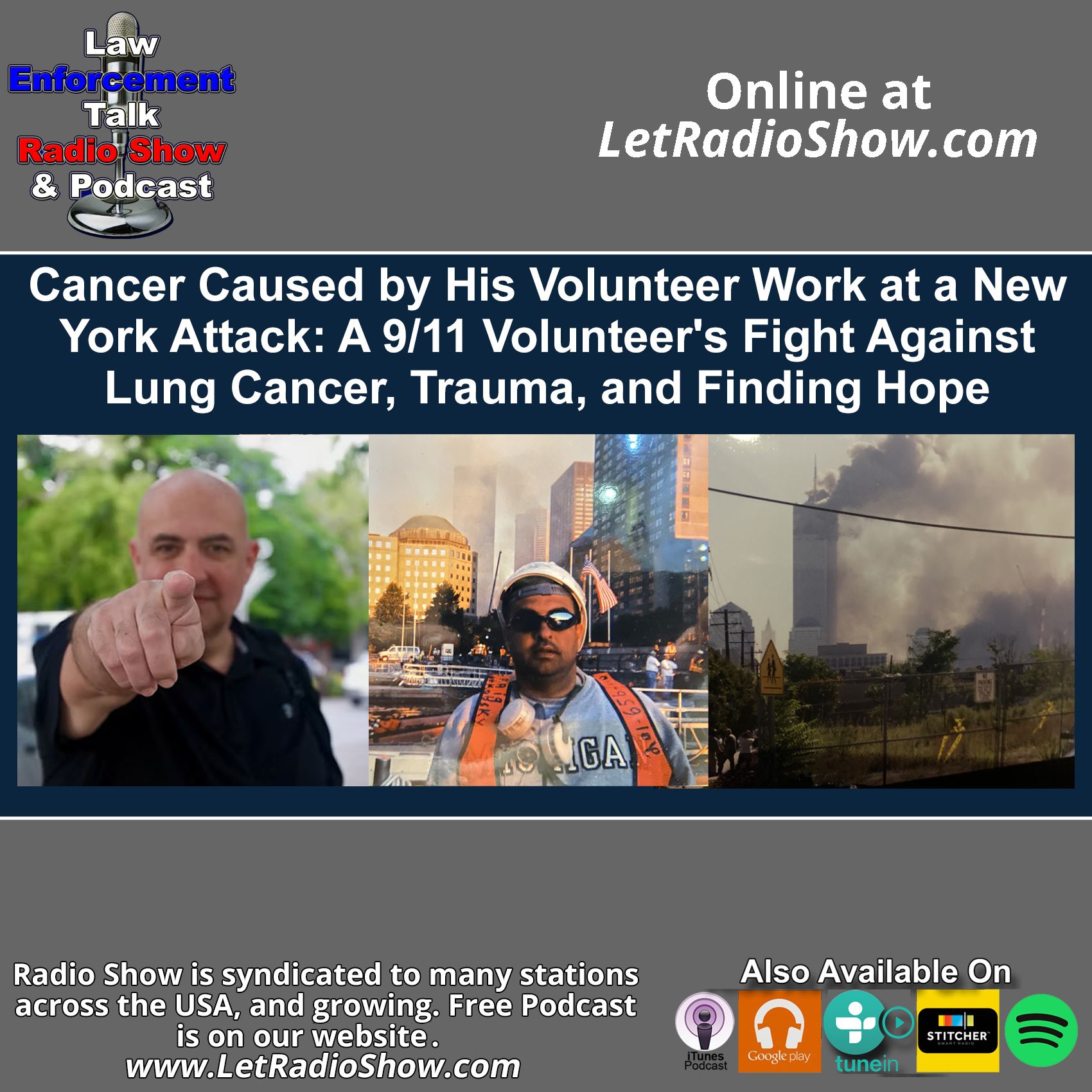
Cancer caused by his volunteer work at a New York attack. Those words summarize a journey that began with selfless service and evolved into a decades-long battle for survival. Twenty-five years after volunteering at Ground Zero following the September 11 terrorist attacks, Craig Sotkovsky continues fighting a different enemy, an aggressive form of lung cancer linked to toxic exposure at the World Trade Center.
 Apple Podcasts Apple Podcasts
  Spotify Spotify
  Amazon Music Amazon Music
  Audacy Audacy
  Audible Audible
  Castbox Castbox
  Castro Castro
  Deezer Deezer
  Fountain Fountain
  Goodpods Goodpods
  iHeartRadio iHeartRadio
  PocketCasts PocketCasts
  Podcast Addict Podcast Addict
  Podchaser Podchaser
  Podverse Podverse
  Spreaker Spreaker
  Podurama Podurama Apple Podcasts Apple Podcasts Spotify Spotify Amazon Music Amazon Music Audacy Audacy Audible Audible Castbox Castbox Castro Castro Deezer Deezer Fountain Fountain Goodpods Goodpods iHeartRadio iHeartRadio PocketCasts PocketCasts Podcast Addict Podcast Addict Podchaser Podchaser Podverse Podverse Spreaker Spreaker Podurama Podurama
 Cancer Caused by His Volunteer Work at a New York Attack: A 9/11 Volunteer's Fight Against Lung Cancer, Trauma, and Finding Hope. Those words summarize a journey that began with selfless service and evolved into a decades-long battle for survival. Twenty-five years after volunteering at Ground Zero following the September 11 terrorist attacks, Craig Sotkovsky continues fighting a different enemy, an aggressive form of lung cancer linked to toxic exposure at the World Trade Center. The Law Enforcement Talk Radio Show and Podcast social media like their Facebook , Instagram , LinkedIn , Medium and other social media platforms.
His remarkable story is featured on the Law Enforcement Talk Radio Show and Podcast website, available on Apple Podcasts, Spotify, and shared across Facebook, Instagram, LinkedIn, X, and other major News and podcast platforms. The episode is available to listen to Free. The Podcast is available for free on the Law Enforcement Talk Radio Show and Podcast website, also on Apple Podcasts, Spotify, YouTube, iHeartradio and most major podcast platforms. #LawEnforcementTalk #Free #Podcast #Radio
One Decision Changed Everything
On September 11, 2001, Craig Sotkovsky watched history unfold from his home in Jersey City, New Jersey. Supporting articles about this and much more from Law Enforcement Talk Radio Show and Podcast in platforms like Medium , Blogspot and Linkedin.
Like millions of Americans, he watched in disbelief as the Twin Towers collapsed after terrorists hijacked commercial airliners and carried out one of the deadliest attacks in U.S. history.
But unlike most Americans, Craig didn't remain a spectator.
A skilled carpenter and mason, he volunteered to help.
He joined the bucket brigade at Ground Zero and spent two of the first five days working in the debris field following the collapse of the World Trade Center. Cancer Caused by His Volunteer Work at a New York Attack: A 9/11 Volunteer's Fight Against Lung Cancer, Trauma, and Finding Hope. The episode is available across major platforms including their website, Apple Podcasts, Spotify, YouTube, with highlights shared across their Facebook, Instagram, and LinkedIn profiles.
At the time, he believed he was simply helping his country.
He had no idea the toxic dust surrounding him would follow him for the rest of his life.
"Twenty-five years ago, I answered a call for help."
The Hidden Cost of Being a Volunteer
Ground Zero contained a dangerous mixture of pulverized concrete, asbestos, glass fibers, lead, fuel residue, and countless other hazardous materials released when the towers collapsed. Available for free on the Law Enforcement Talk Radio Show and Podcast website, also on Apple Podcasts, Spotify, Youtube and most major Podcast networks.
Years later, Craig received devastating news.
He had developed a rare and aggressive lung cancer connected to his exposure at the World Trade Center.
The diagnosis transformed every part of his life.
He underwent multiple cancer surgeries.
He endured physical pain, emotional trauma, and overwhelming financial hardship.
The illness eventually cost him nearly everything.
"Cancer changed everything."
More Than a Medical Battle
Craig explains that surviving cancer became more than simply recovering from surgery.
It became a complete rebuilding of his identity.
He describes losing financial security, emotional stability, and the life he once knew. The Podcast is available for free on the Law Enforcement Talk Radio Show and Podcast website, also on Apple Podcasts, Spotify, YouTube, iHeartradio and most major podcast platforms.
Yet amid tremendous hardship, he discovered something unexpected.
Purpose.
"Growth can come from pain."
That philosophy became the foundation for what Craig now calls "Gro-Win Through Pain," a message encouraging others to find strength through life's darkest moments. Cancer Caused by His Volunteer Work at a New York Attack: A 9/11 Volunteer's Fight Against Lung Cancer, Trauma, and Finding Hope.
Trauma Doesn't Always End When the Crisis Is Over
Many people associate September 11 with the horrific events of that single morning.
Craig reminds listeners that for thousands of responders, recovery workers, and volunteers, the disaster never truly ended.
For many, the effects emerged years later through chronic illness, cancer, respiratory disease, and lasting emotional trauma. The Law Enforcement Talk Radio Show and Podcast continues bringing listeners real conversations from the front lines of crime, policing, trauma, survival, and healing.
His story highlights the reality that some of the greatest wounds are invisible for years.
Research Continues to Show Elevated Cancer Risks
Craig's experience reflects what researchers have documented for years.
Studies examining World Trade Center responders have found elevated rates of several cancers among those exposed to Ground Zero dust.
One study published in JAMA followed more than 12,000 World Trade Center responders. Researchers found that participants reporting heavier exposure experienced nearly three times the incidence of lung cancer compared with responders reporting minimal exposure, even after accounting for smoking history and other demographic factors. Cancer Caused by His Volunteer Work at a New York Attack: A 9/11 Volunteer's Fight Against Lung Cancer, Trauma, and Finding Hope. The complete interview is available as a Free Podcast on Facebook, Instagram, YouTube, Apple Podcasts, Spotify, LinkedIn, and major podcast platforms.
While every individual's medical history is unique, Craig's diagnosis illustrates the very real health consequences many volunteers and first responders continue to face decades later.
A Mission Across America
As the 25th anniversary of September 11 approaches, Craig is preparing for another mission.
He plans to travel across America in an RV to honor those who lost their lives, recognize responders and volunteers still living with the consequences of that day, and share stories of resilience, perseverance, and hope.
His journey is no longer defined by cancer.
It is defined by purpose.
An Inspiring Conversation
On the Law Enforcement Talk Radio Show and Podcast, Craig Sotkovsky shares the emotional details of witnessing the attacks, volunteering at Ground Zero, developing lung cancer, enduring repeated surgeries, and learning how to move forward despite overwhelming adversity. Cancer Caused by His Volunteer Work at a New York Attack: A 9/11 Volunteer's Fight Against Lung Cancer, Trauma, and Finding Hope. Listeners can hear the complete interview on Facebook, Instagram, YouTube, Apple Podcasts, Spotify, iHeartRadio, and other major Podcast, Radio, News, and Media platforms.
His story serves as a reminder that true courage often continues long after the cameras disappear.
Sometimes the greatest heroes are those who quietly keep fighting years after the world has moved on.
Listen Free Today
Hear Craig Sotkovsky's incredible story on the Law Enforcement Talk Radio Show and Podcast.
The episode is available Free on the Law Enforcement Talk Radio Show and Podcast website, also on Apple Podcasts, Spotify, and is promoted across Facebook, Instagram, LinkedIn, X, and other major podcast and News platforms. Cancer Caused by His Volunteer Work at a New York Attack: A 9/11 Volunteer's Fight Against Lung Cancer, Trauma, and Finding Hope.
This powerful conversation explores sacrifice, resilience, recovery, and the lasting impact of trauma from one of America's darkest days. The podcast is available on Facebook, Instagram, YouTube, Apple Podcasts, Spotify, LinkedIn, and other major podcast platforms.
If Craig's story inspires you, please share this article so more people understand the sacrifices made not only on September 11, but for decades afterward.
Listen to the full story on the Free Podcast, available on the Law Enforcement Talk Radio Show and Podcast Website, on Facebook, Instagram, YouTube, Apple, Spotify, and more.
Be sure to follow us on X , Instagram , Facebook, Pinterest, Linkedin and other social media platforms for the latest episodes and news.
Learn and get access to money saving tips and how to increase your net worth at www.LetSavings.com
Listen to this powerful #Free Podcast episode featuring Marci Hopkins on Facebook, Instagram, Youtube, Apple Podcasts, Spotify, and major Podcast platforms nationwide.
Download the Free Ebook about ways and tips to improve your health. You can get the ebook for free at www.LetHealthy.com
Get the Free Clubhouse App, it is Drop In Social Audio. Think of it as your own talk radio show on your phone, and best of all it is free. Be sure to look for me and follow me, that’s John J Wiley or @letradioshow you can do all that here.
The Law Enforcement Talk Radio Show and Podcast social media like their Facebook , Instagram , LinkedIn , Medium and other social media platforms.
You can contact John J. “Jay” Wiley by email at Jay@letradio.com , or learn more about him on their website .
Find a wide variety of great podcasts online at The Podcast Zone Facebook Page , look for the one with the bright green logo.
Be sure to check out our website .
Cancer Caused by His Volunteer Work at a New York Attack: A 9/11 Volunteer's Fight Against Lung Cancer, Trauma, and Finding Hope.
Attributions
Wikipedia
Hosted by Simplecast, an AdsWizz company. See pcm.adswizz.com for information about our collection and use of personal data for advertising.
John Jay Wiley (0:00): He was a volunteer at nine eleven, the World Trade Center. He was there for two days. He developed lung cancer, had multiple cancer surgeries. He's here to talk about that incident and his life after. Welcome to the law enforcement talk radio show.
John Jay Wiley (0:16): In the law enforcement talk radio show, we are joined by special guest talking about their experiences, their realities of investigating crimes, plus those who have experienced horrendous trauma, police, first responders, military, and victims of crime share their stories. Hi. I'm John Jay Wiley. In addition to being a broadcaster, I'm also a retired police sergeant. Be sure to check out our website, letradio.com, and also like us on Facebook.
John Jay Wiley (0:43): Search for the law enforcement talk radio show. Of all the radio stations in The United States, there are no other shows like the law enforcement talk radio show. On Facebook, there's only one official page. Do a search on Facebook for the law enforcement talk radio show, and be sure to like the law enforcement talk radio show Facebook page. From Mexico, we have Craig Satofsky on the law enforcement talk radio show.
John Jay Wiley (1:07): Craig was a nine eleven volunteer, worked at the World Trade Center and developed lung cancer as a result of working in the POL. He was there for two days. He had multiple cancer surgeries, and we'll talk about that. His website is craigsotovsky.com. I'll spell the last name for you, s o t k o v s k y dot com.
John Jay Wiley (1:25): Craig, thanks for being guest on law enforcement talk radio show. We're gonna talk about it. Both very much appreciate it.
Craig Satofsky (1:31): Thanks. I greatly appreciate the opportunity to tell my story.
John Jay Wiley (1:34): It's it's good to have you here. And we were talking earlier that it is not lost on me that a lot of people died that day. Lots of people died since then, even more so I think from cancers, more so. So the fact that you are alive and talking about this is not lost on me.
Craig Satofsky (1:54): Well, yeah, I'm one of tens of thousands that are sick and dying right now. And, you know, just finding my way, navigating through the surgeries, and and putting my life back together is paramount in my life right now.
John Jay Wiley (2:09): Let's talk about the physical recovery is one thing, mental I'm sure is another. And if I'm to be totally honest, I put people treat mental health as if it's some sort of foreign entity in their body. And I look at this way, your brain is an organ treated like your heart, treated like your lungs, treated like anything else. And if you're not doing well mentally, you're probably not doing well physically.
Craig Satofsky (2:36): That's true. I mean, you know, I've been an entrepreneur my whole life, and I believe that that helped me battle cancer. I believe beating cancer made me a better entrepreneur just because I understood the mindset and how you have to build a resilience to yourself.
John Jay Wiley (2:54): Well, in a way, you've and back when I was a kid, and I'm showing my age now, cancer was a death sentence. And even the nine 11 related cancers, it seems to be a lot of people, a lot more people are getting sick and dying.
Craig Satofsky (3:07): Yeah. Mine was one of the rare cancers. It's one of the 68 or 69 that is directly linked. And, you know, just understanding that it was more of a mental health issue after beating it.
John Jay Wiley (3:28): Oh, I bet it was. And we're we're playing time to talk about it. You you moved to Mexico for health reasons. Am I correct?
Unknown Speaker (3:34): Yeah. Absolutely.
Unknown Speaker (3:35): How long have you been there?
Unknown Speaker (3:36): Two years.
John Jay Wiley (3:38): Okay. Is it helping you physically? Yes. Yes. That's a I I lived in South Florida.
John Jay Wiley (3:45): The main reason I moved to South Florida, well, was financial, but it's I have steel plates in my right hand. I I I thought I sprained my wrist in the line of duty injury when I was 33. Had multiple surgeries. And when those steel plates get cold, it goes right into the bone, and it's just no good. There's nothing you can do about it.
John Jay Wiley (4:03): So I understand having to relocate. My injury was not life threatening now.
Craig Satofsky (4:09): Well, they took my mid and lower lobe and my right lung out, and it it was a challenge in The United States because we had lost everything. You know, bankruptcies, selling multiple things. When you get sick in The United States, it's definitely a life altering experience to say the least, but you get financially drained as well.
John Jay Wiley (4:35): Yeah. A lot of people don't talk about that aspect. I I know a lot of people that literally have lost everything. And this is one thing, and we're go to your story in a moment. I've had former retired police on my show that that they were put on Social Security.
John Jay Wiley (4:51): They were shot. One one they were shot multiple times by a serial rapist, almost died, and he was he lost everything. He lost everything, houses, you name it, as a result of these injuries.
Unknown Speaker (5:03): Yeah. It's it's devastating. And like you said, a lot of people don't talk about it because there's a stigma attached to it or they're embarrassed or no. I'm just using my voice.
John Jay Wiley (5:14): Yeah. I don't know what it is, Craig, to be honest with you, but because it look. To be totally honest with you, and we'll get to your story in a moment, you got sick as a result of going there. You didn't do you didn't ask for this. You didn't ask to be hurt.
John Jay Wiley (5:28): And it's not like someone did something wild, crazy, irresponsibly, and monetarily wise and paid the price.
Craig Satofsky (5:36): Well, you know, it it was all about, saying that everything was good. The air quality was good, and it was about opening up Wall Street.
John Jay Wiley (5:46): That's what they said. I I do remember. I'm old enough to remember when this occurred, and they're saying that it's okay to breathe. And, really, the I I saw a commercial on TV about someone that there's a nineeleven cancer fund for people that weren't even on the pile, that they just worked there. They lived there for a while and moved out of the state, moved out of the city, whatever it might be, and came back and developed cancer, and they're they're qualifying for that stuff.
Craig Satofsky (6:10): Sure. There's there's a victim's compensation fund, which which I got, but it it doesn't do anything. I mean, your bills. I mean, I was on Medicaid for such a long time, and that still bankrupted us because it's the everyday expenses. It's the per it's the caretakers.
Craig Satofsky (6:32): And, I mean, it's devastating on both ends because it's the caretakers that feel it as well. And, you know, when you're financially burdened and you're battling cancer, this is a big problem. It's a huge problem.
John Jay Wiley (6:45): It is. And we'll get to some of the circumstances. I want to your circumstances. I want to change the the folks a little bit. You were, and I'm quoting my notes.
John Jay Wiley (6:56): You were a mason, a carpenter, and you saw this disaster occur, and you took action.
Unknown Speaker (7:02): Yes. I I was living in, Downtown Jersey City at the time on the river, and, I walked off my stoop in the morning, and one of the towers was on fire. So I went I ran around the corner to get my, fiance at the time, told her she to grab her camera equipment, and she was like, what's going on? And I was like, I don't know, but one of those towers is on fire. By time we got down to the river, both of them were on fire.
Craig Satofsky (7:28): And, you know, doing the pandemonium and the cops on their loudspeakers and stuff. We actually watched the first one come down. And as we were backing up going to Liberty State Park, because there's a little cut off downtown Jersey City where you can go through, the second one came down. And she's got all of these pictures as they were coming down.
John Jay Wiley (7:54): And if you're like me, you felt like and I was in Florida when this occurred. I was watching on TV, and I was devastated. I I couldn't understand this, and I felt like I need to do something. But you obviously felt like you need to do something. You did something about it.
Craig Satofsky (8:08): Well, I've been a carpenter in Mason my life, and then, as the people it was funny because not Konya but, as the people were coming off boats, they were completely disheveled, covered in, dust. And I was like you know, I looked at my fiancee, and I was like, I have to get there. I've been in construction my whole life. I'd rather I'd rather go there than have, the average person down there, you know, possibly getting hurt or whatever. And
John Jay Wiley (8:40): How devastating was the scene for you?
Unknown Speaker (8:43): Oh, man. When I got there, I was like, what am I doing here exactly?
John Jay Wiley (8:50): I I I I'm still and I asked that question to just about everybody that responded to nine eleven, the World Trade Center, because everything about it, what I watched on television, it was a foreign concept to me. I still see photos of people walking around covered in dust. I see there's a a firefighter on a police on a motorcycle riding the scene, and it's just it seems like a foreign t made for TV movie. Doesn't seem real. This is the Law Enforcement Talk Radio Show.
John Jay Wiley (9:17): We're talking with Craig Satofsky. Craig was a volunteer at 9 11 World Trade Center and developed cancer result. We're gonna talk about those a little bit more about the cancer surgeries, his diagnosis, all that stuff, and much more. His website is craigsotovsky.com. It's spelled sotkovsky.com.
John Jay Wiley (9:35): This is law enforcement talk radio. Don't go anywhere. We'll be right back.
Speaker 2 (9:42): They say that it's not about how much you earn, it's about how much you save. And that is partially true. If you can take some of that savings and turn it into high yield investments, you are way ahead of the game. Get more details on how you can get started at letsavings.com. Letsavings.com.
Speaker 2 (10:01): Again, that's letsavings.com.
John Jay Wiley (10:11): Returning conversation with Craig Sutkowski on the law enforcement talk radio. Craig is in Mexico, and the reason why is health related. We'll talk about that more a little bit later on. He was a nine eleven volunteer, bricklayer, carpenter, mason. He had multiple cancer surgeries, developed lung cancer, severe cancer.
John Jay Wiley (10:29): He's here to talk about that. His website is craigsotovsky.com. That's sotkovsky.com. Craig, I wanna go back to 09:11. You saw the towers.
John Jay Wiley (10:41): If you're like me, I'm trying to to to put this as nicely as possible. I'm thinking, well, maybe the first one was an accident. And then then I realized, oh, it's on purpose. And I remember seeing people jumping out from buildings, and I I'm like, this is just devastating. I couldn't I could not not watch it.
Unknown Speaker (11:02): Yeah. It's it's definitely attraction TV. Right? Made for the box.
John Jay Wiley (11:08): Yeah. It is. And but the thing is when the towers came down, and I'm not one of these people that disputes all that stuff. When the towers came down and I saw people on the scene, number one, and this is off topic. Several years later, I wind up going to to d to New York City.
John Jay Wiley (11:26): And they were doing construction of the pit, and they had some NYPD officers there. And I just wanted to say that I'm a retired Baltimore police, and I couldn't imagine losing that many people one day. And, I'm thinking of you. And I made it, like, three steps from them, and I started crying. And but they knew right away.
John Jay Wiley (11:43): I didn't have to explain. But the devastation still and I I didn't lose anybody I knew there.
Craig Satofsky (11:51): Well, I I was downtown Jersey City, and and a lot of the people, there was stories. You know? Who who didn't make it back? Who, you know, missed their train? Who got sick and didn't go to didn't go to work that day?
Unknown Speaker (12:07): There was a there was a lot of there was a lot of stories.
John Jay Wiley (12:10): And by the way, Jersey City is where my father was born. And I I've only been there a couple times, but you've got a straight shot view of New York City from that from Jersey City, don't you?
Unknown Speaker (12:22): Yeah. You're right on a river.
John Jay Wiley (12:24): And by the way, Jersey City is not an exactly or didn't used to be a it's a tough town.
Unknown Speaker (12:34): Now it's it's
John Jay Wiley (12:36): Kinda Yuppieville now, but back when I was a kid, oh, you didn't play with Jersey City.
Craig Satofsky (12:41): Well, in 02/2001, I I was down there, and that's when the construction just started. You know? So they were building. They were just starting to build along the river. Like, you could have shot a cannon in, exchange plates and never hit anybody.
Unknown Speaker (12:56): Right. Right. Now now there's so much movement.
John Jay Wiley (12:59): That whole area, Jersey City, Hackensack. I was born in Passaic. My family settled there from from Ireland. Rutherford, Patterson, you name it. We know that area very well, and it is a totally different area today than it was, say, thirty, forty years ago.
Craig Satofsky (13:18): Oh, yeah. There's there's towers everywhere now. I mean, there there's the the building like, the whole I'm surprised the riverfront hasn't sunk yet with all the, commercial towers and
John Jay Wiley (13:27): I hear you. And and by the way, it seems that I'm not gonna belabor this point, but it seems like it's lost some of the ethnic feel. That's just my, my interpretation. I remember when the World Trade Centers were built and they became part of the the landscape. And it was, for me, a very important part of the landscape.
Craig Satofsky (13:49): Sure. I remember I was I was a kid at the time, and I remember walking along, Boulevard East overlooking New York City. And we used to watch, you know, one one segment go up at a time. And, I used to ask my father all the time, like, what is that gonna be? And he used to be like, it's gonna be the most amazing towers in the world.
John Jay Wiley (14:12): And they're full of really great people. When you saw this disaster happening and you said to your fiancee, Tom, grab your camera, we'll take some photos. At what point did did it become a situation where I gotta do something about this?
Craig Satofsky (14:27): When when the people were coming off the boat, you know, because we were at Liberty State Park, and that's when that's when people started to, to, come off the boats. And I was, you know, like, had so many emotions going through me, and it was more I was more jacked about getting there, and that's that's where everything changed.
John Jay Wiley (14:51): I hear people talk, and I've I've had many guests on. They say they drove. They saw the the incident. They drove to the scene, and it's like they drove into another world.
Craig Satofsky (15:01): It reminded me of that scene from planet of the apes. And when I I I was on a bucket brigade, and I had to bring I had to bring buckets to the scene when we when we got off the boat. And I was walking through the atrium, I remember this vividly. There was guys sitting there smoking cigarettes at the restaurant, and there was a room with a whole bunch of bags. I didn't even wanna know what those were.
Craig Satofsky (15:33): And when I took my buckets, like, I couldn't see in front of me. I can only see left and right. I went over this knee wall, and when I put the buckets down, I looked and I was like, oh my god. And just as I said that, there was a siren that went off, and there was bunch of people screaming run. And we had to run around the building, and the front facade of the building fell on my buckets, and that was my introduction to Ground 0.
John Jay Wiley (16:03): When you say your introduction, were you I I hate to ask this, were you expecting something different?
Craig Satofsky (16:12): Yes. I was not expecting I was not expecting that.
Unknown Speaker (16:16): Is it safe to say
Unknown Speaker (16:17): what I was expecting.
John Jay Wiley (16:18): I know. I I realized that. That's why I didn't wanna ask that question, but I have my mind. It's gonna be this. I'm gonna do that, and I I tend to play things out in my head.
John Jay Wiley (16:28): So and so say this. I'll say that, and boom. I'll win the argument. It'll be whatever it's gonna be. It's gonna be great.
John Jay Wiley (16:33): It's gonna be awesome. And the reality oftentimes is not that way. Most of the time, it's not. So when we walk into you going to 09:11, you're thinking you're gonna do something heroic. Did you did you think it was gonna be as bad as it was?
Craig Satofsky (16:52): No. Like I said, I I had had no idea what it was going to be, but that being said, I did not think it was going to be what I saw.
John Jay Wiley (17:03): When did you get there? Was it the next day?
Craig Satofsky (17:06): No. The next day, I tried to get over on a boat, and, we went down to Battery Park City, Battery Park, and, we got turned around by the coast guard. And that was pretty profound because there was a baby carriage at the end of the park, and, honestly, I was like, man, what was that person thinking about when they snatched the baby up and ran?
John Jay Wiley (17:28): I know. None of this makes sense to me. I I to this day, my hats off to people that that helped, that were there, that saw this, and that lost loved ones because I'll be honest with you, Craig, I don't know how I deal with that.
Unknown Speaker (17:43): It took a while process.
Unknown Speaker (17:46): Alright. I do
Unknown Speaker (17:47): definitely did.
John Jay Wiley (17:47): Do you feel this not including the health stuff, which we'll talk about in a few moments. Do you feel like you're in a better place mentally with all this that you went through?
Unknown Speaker (17:56): Yes.
Unknown Speaker (17:58): Well, that's a really short answer to a long winded question.
Unknown Speaker (18:02): I've done a lot of I've done a lot of mental work.
John Jay Wiley (18:05): That's the thing I wanted to get at. And one of the things that I I say this about this show and a reason why I started it in 2017. And if you go to the Law Enforcement Talk Radio Show and podcast Facebook page, you'll see a lot of the posts. I want people to take that no matter what they've been through, no matter what the cause of the trauma, no matter what kind of mental health issues they got going on, things can get better. And there's light at the end of the tunnel.
John Jay Wiley (18:33): We're talking with Craig Satofsky. He was a nine eleven volunteer, developed lung cancer, which we'll talk about a few moments. He was a carpenter at Mason, had multiple cancer surgeries, and his website is craigsotovsky.com. That's sotkovsky.com. This is Law Enforcement Talk Radio.
John Jay Wiley (18:49): Don't go anywhere. We will be right back.
Speaker 3 (18:54): How would you like a free ebook on tips to improve your health? We're talking about tips you can use for free to add years to your life. Best of all, the ebook is free to download at lethealthy.com. When we say free, we mean free. So you can download the free ebook to improve your physical health all while preserving your financial health.
Speaker 3 (19:14): Get the ebook for free today at lethealthy.com. That's at lethealthy.com. Again, the website is lethealthy.com.
John Jay Wiley (19:30): We're doing a conversation with Craig Satowski, contact us from Mexico. Craig was a nine eleven volunteer. He was a carpenter and mason, developed bricklayer. He was he developed cancer. There's no polite way of saying it.
John Jay Wiley (19:46): Had multiple cancer surgeries, and he moved to Mexico for health reasons. His website is craigsotovsky.com. It's spelled sotkovsky.com. Craig, I want to wrap up the conversation about nine eleven, there's so much about this to unpack. But as a volunteer, a lot of people felt like they should do something.
John Jay Wiley (20:07): You obviously did. You were on scene at the pile for how many days?
Unknown Speaker (20:12): Two days.
John Jay Wiley (20:13): And during those two days, we were told it's safe to breathe. There's nothing going on?
Unknown Speaker (20:19): Yeah. That's what they had said.
John Jay Wiley (20:21): Turns out that's the furthest thing from the truth, which we'll get to in a few moments. What did you do at the pile?
Unknown Speaker (20:29): So I was on the bucket brigade, and I ran a bobcat.
John Jay Wiley (20:34): And at that point, it's about and we forget a lot of times. It's not just first responders that that that showed up there. It was a lot of construction workers, and they paid a heavy price mentally and physically as well. One of the things I would imagine is your role was a rescue role at that point, or it shifted from rescue to retrieval.
Unknown Speaker (20:53): I believe it was more retrieval.
Unknown Speaker (20:56): And that's gotta be a tough tough blow for anybody.
Unknown Speaker (21:00): Yeah. It was it was devastating for a while.
John Jay Wiley (21:03): And we'll talk about the mental health aspects. I wanna talk about your physical health. So you returned home. You went back to work. When did you start noticing that there were some health issues?
Unknown Speaker (21:15): Actually, when I moved down here, because I raised my daughter down here with my ex wife. In 2012, I had gotten sick, pneumonia, and then I had a collapsed lobe of my right lower my right lower lobe, sorry, of my right lung.
John Jay Wiley (21:32): So you're developing some breathing problems?
Unknown Speaker (21:35): Yes.
John Jay Wiley (21:36): And you were aware of the the various cancers at that time?
Unknown Speaker (21:41): No. No? No. I I I had did my I had didn't done my time at 09:11 and never looked back because I was in the process of moving to Florida in October because I was getting married down there and we were moving our life. And I never looked back.
Craig Satofsky (21:55): It wasn't until 2012 when people started telling me, well, you're sick. You should start looking into this 09:11, call the lawyers and stuff. I had no idea that that even existed.
John Jay Wiley (22:07): When when you contacted, did did you contact the lawyers first, or did you go to a doctor first?
Unknown Speaker (22:14): I had gotten to a doctor first.
Unknown Speaker (22:17): And what did they say?
Craig Satofsky (22:20): After 2012, I was sick all of 2015 no. All of 2016, and there was an eclipse in 2017 that my ex and my daughter, we want to Helen Georgia and walked up the hill and I couldn't walk up the hill and I'm an avid hiker and it felt like my it felt like my heart was going to explode. It was pounding in my chest and I went back to the car when they came back. We went to the ER and that's when the doctor told me had a malignant tumor in my chest in my lung, and my first instinct was to throat punch him because he said it in front of my 11 year old daughter.
John Jay Wiley (23:04): Right. And but did you react the way a lot of people do? I I've been fortunate, but my dad died thirty some odd, almost thirty five years ago from lung cancer. And it was a horrible thing to watch, but my first response to people that saw the word cancer around is to think the worst.
Craig Satofsky (23:25): Yeah. I don't mean to laugh, but I mean, you know, you I was told that I had a malignant tumor, and that just didn't sit well.
John Jay Wiley (23:37): No. Nor should it. I look. Part of me deep down inside, I don't consider myself to be a fighter, but I'm a fighter. I'm gonna give I'm not gonna I'm gonna keep on going till I can anymore.
John Jay Wiley (23:49): It is an old saying that I came in this world screaming, kicking, covered in someone's blood and I'm ready to leave that way too. Am not giving up freely voluntarily. When you've got this diagnosis of malignant cancerous tumor and you I've been by the way, I've been to Helen, Georgia twice and it is hilly, but it's nothing that you can't accomplish. If a guy like me can walk it, you could walk it too. So the fact that you couldn't is like, that's pretty devastating.
Craig Satofsky (24:21): Yeah. It was. And and to be honest with you, I mean, when you're when you're diagnosed in front of your child, I was concentrating more on that than the cancer. It was like, how dare you tell my in front of my child and my wife,
Unknown Speaker (24:40): right?
Unknown Speaker (24:41): Instead of pulling me aside. And I thank God every day to my kids, you know, she's on top of her stuff and she realized that it was a conversation we're gonna have at home.
Unknown Speaker (24:53): How old was she when this occurred?
Unknown Speaker (24:55): 11.
John Jay Wiley (24:56): Yeah. That's that's still very young, and it's it's very, very young. First of all, I I I as a man, I can understand wanna protect the the family members. I I understand all that, but right away, the first thing is I'm gonna get angry because I I don't exhibit fear very well, but I exhibit anger very, very well. And it sounds to me like that's kind of what you did.
John Jay Wiley (25:22): And it might be justified, but were did you get angry over fearful?
Unknown Speaker (25:28): Yes.
Unknown Speaker (25:29): How long did that last?
Unknown Speaker (25:31): Months. Months.
Unknown Speaker (25:33): Are you over that now?
Unknown Speaker (25:35): Oh, yeah. I have no emotional attachment to anything that I've been through.
Unknown Speaker (25:38): Did you ever think you could say that? The that I've got no emotional attachment to this at all?
Craig Satofsky (25:44): No. I never thought in a million years that I would be able to alchemize everything I've ever been through.
John Jay Wiley (25:52): And here's the last question before we go into more of your story. Do you ever look back and go that was a different guy, or do you think that that was just a a different lifetime ago for you?
Craig Satofsky (26:03): Oh, man. I've had 30 different lives in this life. Yeah. That's just a different guy. And now I'm I'm this guy that is resilient.
Craig Satofsky (26:15): Everything that comes into my life, I alchemize, and I'm ready to take on the world.
John Jay Wiley (26:20): And you said earlier that you think this made you a better entrepreneur. I know the reason why. Would you elaborate on that?
Craig Satofsky (26:29): Sure. Because, you know, as an entrepreneur, you have to worry about everything. Insurance and and and and and, you know, problem solving, putting out fires, no pun intended, putting out fires, and and that is nothing compared to cancer.
John Jay Wiley (26:49): It's kind of tough to it's kind of tough to not be the resilient guy you are and still be here. A lot of people can get I've I've known some that seem to get stuck, and I'm not blaming them, but they seem to get stuck in that. You're obviously not that guy.
Craig Satofsky (27:06): I was stuck for a while. I was definitely stuck for a while self isolating self sabotaging, not feeling less than especially in front of my kid. I feel like I gypped her out of her life. My ex. I mean, we had to sell everything multiple times just to keep me alive.
Craig Satofsky (27:26): It it wears on you. It does.
John Jay Wiley (27:28): When you say the financial burden, that's something you don't talk about. How how bad was bad?
Unknown Speaker (27:34): I was a high achiever and I couldn't pay the electric bill. I didn't know where the rent was coming from. I was on Medicaid, looking for charity from others.
John Jay Wiley (27:47): Humiliating. And look, I don't I don't know you obviously, but you strike me as being somewhat old school. I'm gonna take care of myself. And I'm I'm in the mindset, look, I'm not gonna let you help me. And I'll be there to help other people, but I'm gonna stick my hand out and ask for help from you.
Craig Satofsky (28:06): I've learned I really have. Like, all of this stuff that I've been through, I've learned that it's okay to raise your hand.
Unknown Speaker (28:17): Yeah. It is okay, but that doesn't mean it's easier to do. And I'm not laughing. This is the
Unknown Speaker (28:23): law No. No.
John Jay Wiley (28:24): This is the law enforcement talk radio show. We'll turn our conversation with Craig Satowski in a moment. He was a nine eleven volunteer, developed lung cancer, which we'll talk a little bit more about. And his life now, his website is craigsatowski.com. That's sotkovsky.com.
John Jay Wiley (28:41): This is law enforcement talk radio show. Don't go anywhere. We'll be right back.
Speaker 4 (28:49): Someone asked, what's the catch? What's the cost? There is no cost for anything on the law enforcement talk radio show and podcast website. Letradio.com? Letradio.com.
Speaker 4 (29:01): Again, that's letradio.com.
John Jay Wiley (29:11): During conversation with Craig Satowski and the law enforcement talk radio show, Craig was a nine eleven volunteer, from based in Jersey City, New Jersey at the time. He's now contacts from Mexico. He moved there for health reasons. He was there for two days, developed lung cancer, had multiple cancer surgeries, which we'll talk about in a few moments. His website is craigsotovsky.com.
John Jay Wiley (29:30): That's spelled sotkovsky.com. Craig, it's almost as if we're talking about something that happened to someone else. This happened to you. And the the 09:11 thing is one thing. I I cannot even I I'm I'm as old as I ever thought I'd be.
John Jay Wiley (29:50): I never thought I'd be this old, Trevor, ever in my life. If you ask me when I was 18 or be like to be 67, like, are you kidding me? I'm not talking about that. It's a foreign concept. So but a lot of what I went through in 18 and thirties is a reason why I am today.
John Jay Wiley (30:07): The whole concept of 911, the World Trade Center, Pennsylvania, the Pentagon, I cannot wrap my head around it. I cannot wrap my head around the devastating diagnosis of cancer. But you said earlier the conversation that you pretty much lost everything and you were stuck for a long time. How bad was bad?
Unknown Speaker (30:29): How bad was bad?
Unknown Speaker (30:30): Yeah.
Craig Satofsky (30:30): We didn't know how the electricity bill was gonna be paid. We didn't have access to rent money. And I I used to be a 7 figure earner and, you know, self isolating and feeling less than and not being productive. I used to speak at national conventions on real estate, owner financing, and I used to have, like, this this thing I would play back over and over in my head like I was an impostor. I was not dealing with what I was doing.
Unknown Speaker (31:09): And, yeah, it made me it made me madder, made me mad that I was gypping my kid out of her life and financially being a burden. And there was there was days when I when I would wake up, and I wish that I was dead just so my family can move on with their life.
John Jay Wiley (31:30): I I hear you. I understand that feeling 180%. I I know that's more than a 100%, but I understand it. And the reality is I'm glad you're here. I'm glad we're having this conversation, but obviously, you didn't get from point a, which was really bad days, to point b where you're at today by yourself and without some sort of help.
Craig Satofsky (31:51): Well, the thing is it's like, you know, 09:11, it it's gonna sound callous, but 09:11 wasn't wasn't as devastating to me as the rest of my life before.
Unknown Speaker (32:06): Right.
Craig Satofsky (32:06): Now I was molested as a kid. I was a drug addict in my teens. I've been bankrupt, divorced. Nine eleven is just part of my story. Everything that I've been through, I understand why I was I was through it and went through it.
Unknown Speaker (32:24): And now I see the guy at the other end and, you know, the light at the end of the tunnel isn't a train anymore.
John Jay Wiley (32:32): Right. It's not gonna run you over. Thank god. How old of a guy are you now?
Unknown Speaker (32:37): I'm gonna be 61 in September.
John Jay Wiley (32:39): You're a young pup. I I can barely remember being 61 so long ago. Here here's the thing. Look. I don't believe that anybody goes through life unscathed.
John Jay Wiley (32:54): And I always say about police work, you're gonna get dinged up. But your story doesn't involve police work. You're you're you went through life, and life quite often is never pretty.
Unknown Speaker (33:05): No. It's not. Life lives.
Unknown Speaker (33:07): Whether you wanna
Unknown Speaker (33:08): participate or not, it's coming for you.
John Jay Wiley (33:10): And you were how old when you decided, like, you were stuck in this anger zone?
Unknown Speaker (33:18): Oh god. I started thinking about stuff differently in my thirties?
Unknown Speaker (33:29): Yeah.
Unknown Speaker (33:30): Thirties, forties. I started thinking about things different.
Unknown Speaker (33:35): One of the things I always
Unknown Speaker (33:36): felt different, John.
John Jay Wiley (33:37): One one of the things I I tell people is that you know, I was never a bad guy. I was never I wasn't that good at being bad, and I really was not that bad at being good. But I was never a bad guy. However, there's a saying that I learned from someone else. I can't take credit for it that, every day, I thank God I'm not the guy I used to be.
John Jay Wiley (33:56): I'm not where I wanna be yet, but I'm thank God I'm not where I used to be.
Unknown Speaker (34:00): Yeah. I have one too. You wanna hear? God laugh telling me plans.
John Jay Wiley (34:04): Oh my God. You tell me. Yeah. You're gonna hear them laugh, especially my plans because they're they're really and by the way, life is for me a lot better than I ever thought it could be. I'm doing things today that I never thought I'd do.
John Jay Wiley (34:17): And I guess I'm gonna rephrase this as question. Are you doing what you thought you'd do at this point in your life?
Craig Satofsky (34:24): Oh, god. No. Ego ego and pride thought, that I'd be famous in something in business, and now I'm the nine eleven cancer guy.
John Jay Wiley (34:34): Yeah. Well, it's a pretty significant thing, by the way.
Unknown Speaker (34:37): Believe so.
Unknown Speaker (34:38): Yeah. And you
Unknown Speaker (34:39): Took me a while to embrace that role.
John Jay Wiley (34:40): One of the things that and that I remember a time in my life where I was, and this goes back to your conversation earlier. I remember a time in my life where I felt like a dismal failure, and then my my family better off without me. And I couldn't imagine my life getting better, and people were telling me that your life can get better. I didn't believe it, but I want people to understand that no matter what you've been through, there is light at the end of tunnel, and your life can get better, but it's gonna require this thing called work. And a lot of people honestly are allergic to that.
John Jay Wiley (35:11): They treat it like a four letter word.
Unknown Speaker (35:13): Yeah. You you know, I put the sweat equity in. There was there was six years where I sat in my living room and I had to learn how to alchemize the pain because, to be honest, my ex and my daughter used to be like, you're a person when you're on pain med. You know? I I was on Dilaudid and and morphine, and it did nothing for the pain.
John Jay Wiley (35:34): No. All you did is made me a jerk. I'll be honest with you. Yeah. All I did was I fell asleep after shoulder surgery.
John Jay Wiley (35:42): It wasn't a big deal compared to what you went through, but after shoulder surgery, they gave me Dilaudid and Percocet and all the stuff. And for like three or four days, all I did was sit in my chair and I was I couldn't eat. I couldn't go to the bathroom. I didn't do nothing well.
Unknown Speaker (35:55): Yeah. I did that for three or four years.
John Jay Wiley (35:57): What you feel like you were, like, popping chemical after chemical?
Unknown Speaker (36:02): Yeah. Have this picture of me standing in front of a pyramid of pill bottles.
Unknown Speaker (36:08): Uh-huh.
Craig Satofsky (36:09): And it it's don't don't take drugs unless it's theirs.
John Jay Wiley (36:13): Yeah. Yeah. And by the way, get off and get off them as soon as you can. I I wanna focus on what you're doing today. What how would you describe your life today?
Craig Satofsky (36:22): I'm at peace, and I never thought in a million years I would be at peace. So now I'm going to shake it up a little bit.
John Jay Wiley (36:31): Gotcha. And being peaceful is a good thing. I look. I strive for peace, and I don't want any trauma or trauma or he said, she said BS in my life.
Unknown Speaker (36:40): Yeah. I can I can understand that? I really can. I got a buddy of mine, Kirk Ashley. He says people are stuck to their drama glue.
John Jay Wiley (36:48): Yeah. They are. And sometimes they can't find a way out. You've got this website, craigsotovski.com. I I peered at it very quickly before I did the interview.
Unknown Speaker (36:57): What are you doing today?
Craig Satofsky (37:00): I'm helping people alchemize their pain, misery, and suffering. I started a a project, and I'm going around The United States. I'm going to 18 cities. I reduced it to interview cancer patients, responders, war veterans to understand the the process of cancer and mental health because I think it's hugely important, and it's gonna end at September 11 in New York.
John Jay Wiley (37:32): By the way, I noticed they're they're warmer months. You're not going up there when it's cold.
Unknown Speaker (37:37): No. I
John Jay Wiley (37:37): don't play this. My daughters live in South Buffalo, New York, and, like, I love to visit you in the summer for three weeks in summertime. I'm not coming there wintertime. No.
Craig Satofsky (37:48): Yeah. No. This project ends September 12, and then I'm heading back down to Mexico.
John Jay Wiley (37:54): Gotcha. And that's can people get details about this on your website, craigsotovsky.com?
Unknown Speaker (37:59): Yes. Actually, it's on the homepage.
John Jay Wiley (38:02): And by the way, that's spelled Craig, common spelling, s o t k o v s k y dot com. Craig, last question. Can people reach out to you and contact you via your website?
Unknown Speaker (38:14): Yes. Absolutely. Give them they can leave their information. I give everybody fifteen minutes to give them give them a takeaway, whatever they're dealing with in their life, because you you you can heal.
John Jay Wiley (38:27): And life does get better. Craig, thank you so much for being guest on the law enforcement talk radio show, and, keep on keeping on. It's very much appreciated.
Unknown Speaker (38:35): Thanks, brother. I appreciate it.
John Jay Wiley (38:37): I'd like to thank our guests for coming on the law enforcement talk radio show. The law enforcement talk radio show is a nationally syndicated weekly radio show broadcast on numerous AM and FM radio stations across the country. We're always adding more affiliate stations. If you enjoyed the podcast version of the show, which is always free, please do me a favor and tell a friend or two or three. I'll be back in just a few days with another episode of the law enforcement talk radio show and podcast.
John Jay Wiley (39:05): Until then, this is John Jay Wiley. See you.