 Apple Podcasts Apple Podcasts
  Spotify Spotify
  Amazon Music Amazon Music
  Audacy Audacy
  Audible Audible
  Castbox Castbox
  Castro Castro
  Deezer Deezer
  Fountain Fountain
  Goodpods Goodpods
  iHeartRadio iHeartRadio
  PocketCasts PocketCasts
  Podcast Addict Podcast Addict
  Podchaser Podchaser
  Podverse Podverse
  Spreaker Spreaker
  Podurama Podurama Apple Podcasts Apple Podcasts Spotify Spotify Amazon Music Amazon Music Audacy Audacy Audible Audible Castbox Castbox Castro Castro Deezer Deezer Fountain Fountain Goodpods Goodpods iHeartRadio iHeartRadio PocketCasts PocketCasts Podcast Addict Podcast Addict Podchaser Podchaser Podverse Podverse Spreaker Spreaker Podurama Podurama
 The Interview and Investigating Serial Violent Crimes: Canada Police. Behind the Badge: How One Canadian Police Leader Interviewed Serial Child Predators, Murderers, and Faced the Hidden Trauma of Investigating Canada's Most Horrific Crimes. The Law Enforcement Talk Radio Show and Podcast social media like their Facebook , Instagram , LinkedIn , Medium and other social media platforms.
Every day, millions of people consume true crime stories on Facebook, Instagram, YouTube, streaming television, and major News websites. Podcasts dominate the charts on Apple Podcasts and Spotify, while documentaries about serial killers and violent offenders attract enormous audiences around the world. The Podcast is available for free on the Law Enforcement Talk Radio Show and Podcast website, also on Apple Podcasts, Spotify, YouTube, iHeartradio and most major podcast platforms. #LawEnforcementTalk #Free #Podcast #Radio
People are fascinated by criminal investigations. Supporting articles about this and much more from Law Enforcement Talk Radio Show and Podcast in platforms like Medium , Blogspot and Linkedin.
They want to know how detectives solve impossible cases.
They want to understand what motivates serial offenders.
They wonder what it feels like to sit across the table from someone capable of unimaginable violence.
What most people never consider is the person asking the questions.
The investigator.
The police officer.
The detective whose job requires entering the darkest corners of humanity, not once, but repeatedly over an entire career. The Interview and Investigating Serial Violent Crimes: Canada Police. The episode is available across major platforms including their website, Apple Podcasts, Spotify, YouTube, with highlights shared across their Facebook, Instagram, and LinkedIn profiles.
For retired Canadian police executive Jenn Hyland, that wasn't entertainment.
It was her life.
In this compelling Podcast Audio Interview, Hyland takes listeners behind the interrogation room door to reveal the emotional, psychological, and professional realities of investigating serial violent criminals, interviewing child predators, and leading major criminal investigations throughout Canada.
Her remarkable policing career spans three major law enforcement organizations and some of the country's most difficult criminal investigations. Along the way she learned that solving crimes is only part of the story. Available for free on the Law Enforcement Talk Radio Show and Podcast website, also on Apple Podcasts, Spotify, Youtube and most major Podcast networks.
Living with what investigators witness is often the greater challenge.
A Career Built on Service
Jenn Hyland began her policing career with the New Westminster Police Department in British Columbia.
New Westminster is one of the oldest cities in western Canada and once served as the largest community on British Columbia's mainland before Vancouver experienced explosive growth.
Like many young officers, she started learning the fundamentals of policing.
Every call was different.
Domestic disputes.
Traffic collisions.
Mental health emergencies.
Violent assaults.
Missing children.
Deaths.
Every shift brought uncertainty.
Those early experiences laid the groundwork for a career that would eventually place her among Canada's most respected investigative leaders. The Podcast is available for free on the Law Enforcement Talk Radio Show and Podcast website, also on Apple Podcasts, Spotify, YouTube, iHeartradio and most major podcast platforms.
Joining the Royal Canadian Mounted Police
Hyland later joined the Royal Canadian Mounted Police (RCMP), one of the world's most recognizable law enforcement organizations.
Known internationally as the Mounties, the RCMP provides federal policing throughout Canada while also serving many provinces, municipalities, Indigenous communities, airports, and specialized investigative units. The Interview and Investigating Serial Violent Crimes: Canada Police. The Law Enforcement Talk Radio Show and Podcast continues bringing listeners real conversations from the front lines of crime, policing, trauma, survival, and healing.
The organization handles responsibilities that extend far beyond traditional policing.
Its officers investigate organized crime, terrorism, border security, financial crime, cybercrime, international investigations, and violent criminal offenses spanning multiple jurisdictions.
Working within the RCMP exposed Hyland to increasingly complex criminal investigations.
She developed specialized interviewing skills that eventually made her one of Canada's leading investigators in serious violent crime.
The Art of the Interview
Television often portrays police interviews as dramatic confrontations where detectives yell at suspects until they confess.
Reality couldn't be more different.
Professional interviewers spend countless hours preparing before a suspect ever enters the room.
They study evidence.
Analyze timelines.
Review witness statements.
Understand behavioral patterns.
Develop strategies.
Prepare follow-up questions.
Plan for deception.
Every interview begins long before the recorder is turned on.
Success often depends on patience rather than intimidation.
Listening rather than talking.
Understanding psychology instead of relying on pressure.
Hyland explains that every interview is unique because every person brings a different personality, background, motivation, and emotional state into the room.
Listen to this powerful episode of the Law Enforcement Talk Radio Show and Podcast, available on Facebook, Instagram, YouTube, Apple Podcasts, Spotify, LinkedIn, and all most major podcast platforms.
The investigator's job is to discover the truth, not simply obtain a confession.
Hunting a Serial Child Predator
One investigation would remain unforgettable.
A serial child rapist.
The offender had preyed upon dozens of children over an extended period.
Cases involving crimes against children are among the most emotionally devastating assignments in law enforcement.
Every interview with a victim carries enormous responsibility.
Investigators must obtain critical evidence while minimizing additional trauma to survivors.
At the same time, they must prepare for the eventual interview with the offender.
For Hyland and her investigative team, that meant understanding the offender's behaviors, identifying patterns, corroborating evidence, and patiently assembling a case capable of surviving intense courtroom scrutiny. The Interview and Investigating Serial Violent Crimes: Canada Police. The episode is available across major platforms including their website, Apple Podcasts, Spotify, YouTube, with highlights shared across their Facebook, Instagram, and LinkedIn profiles.
The work demanded extraordinary attention to detail.
One overlooked fact could jeopardize justice for every victim.
One successful interview could help provide answers for dozens of families.
Looking Evil in the Eye
Investigators rarely describe suspects as monsters.
That may surprise many people.
Professional investigators know the danger of allowing emotion to interfere with objectivity.
Instead, they focus on facts.
Evidence.
Behavior.
Statements.
Contradictions.
Even when interviewing someone responsible for horrific crimes, investigators must remain composed.
Their professionalism often becomes their greatest investigative tool.
Hyland explains that understanding criminal behavior does not mean sympathizing with criminals.
It means learning how they think in order to expose deception and uncover the truth.
The Investigation That Hit Closest to Home
Perhaps no investigation challenged Hyland more than interviewing a mother accused of murdering her own child. Available for free on the Law Enforcement Talk Radio Show and Podcast website, also on Apple Podcasts, Spotify, Youtube and most major Podcast networks.
By that point in her life, Hyland was raising children herself.
The emotional weight became impossible to ignore.
Police officers are trained to remain objective.
But they are also parents.
Spouses.
Children.
Neighbors.
Human beings.
Walking into an interview room knowing the victim was a child while looking across the table at the child's own mother creates emotional conflicts few careers ever demand. The Podcast is available for free on the Law Enforcement Talk Radio Show and Podcast website, also on Apple Podcasts, Spotify, YouTube, iHeartradio and most major podcast platforms.
Still, investigators cannot allow personal emotion to influence the facts.
Justice depends upon objectivity.
That balance becomes one of the greatest challenges investigators face.
Trauma Doesn't End When the Shift Ends
One of the recurring themes throughout Hyland's career is the accumulation of Trauma.
Television rarely shows investigators driving home after interviewing grieving parents.
It rarely shows detectives lying awake replaying crime scene photographs.
It doesn't show birthdays interrupted by homicide calls.
Family dinners cut short.
Vacations canceled.
Sleep disrupted.
The emotional toll builds slowly.
Many investigators continue performing at exceptionally high levels while privately carrying years of accumulated trauma.
By retirement, many discover those experiences never truly disappeared.
Building a New Police Service
Following her distinguished RCMP career, Hyland accepted another historic challenge.
She became part of the leadership team helping establish the Surrey Police Service, a milestone in Canadian policing. The Law Enforcement Talk Radio Show and Podcast continues bringing listeners real conversations from the front lines of crime, policing, trauma, survival, and healing.
For decades, Surrey relied upon the RCMP for municipal policing.
As one of Canada's fastest-growing cities, Surrey eventually made the decision to establish its own municipal police department. The Interview and Investigating Serial Violent Crimes: Canada Police.
Creating an entirely new police organization required vision, planning, recruitment, training, community engagement, and extraordinary leadership.
It represented one of the most significant policing transitions in modern Canadian history.
On November 29, 2024, the Surrey Police Service officially assumed responsibility for policing the city.
Hyland helped guide that transformation.
From Police Leader to Author
After retiring, Hyland continued serving others through writing.
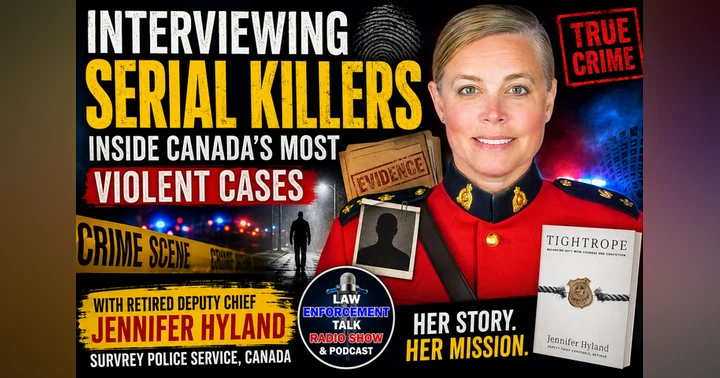
Her Book, "Tightrope: Balancing Duty with Courage and Conviction," explores the difficult decisions leaders face throughout policing and public service.
The title reflects the constant balancing act required of police leaders.
Compassion versus accountability.
Leadership versus friendship.
Duty versus family.
Conviction versus convenience.
The lessons extend far beyond law enforcement and resonate with anyone responsible for leading others during difficult times.
Why This Podcast Interview Matters
Today's true crime audience often focuses on criminals.
Jenn Hyland reminds us that every investigation also includes victims, families, police officers, forensic specialists, prosecutors, and entire investigative teams whose lives are forever changed by the cases they work. The Interview and Investigating Serial Violent Crimes: Canada Police. The complete interview is available as a Free Podcast on Facebook, Instagram, YouTube, Apple Podcasts, Spotify, LinkedIn, and major podcast platforms.
This compelling Audio Interview provides listeners with rare insight into:
Investigating serial violent offenders in Canada.
Interviewing serial child predators.
Building homicide cases.
Crimes against children.
Investigative interviewing techniques.
Leadership under extraordinary pressure.
Police wellness and cumulative trauma.
The creation of the Surrey Police Service.
Life inside the Royal Canadian Mounted Police.
Lessons from an accomplished Author and police executive.
Whether you're interested in policing, criminal investigations, psychology, leadership, or true crime, this conversation offers an honest and unforgettable perspective from someone who has lived it.
Listen to the Complete Podcast Interview
If you enjoy thoughtful conversations about policing, criminal investigations, leadership, and the human side of law enforcement, you won't want to miss this episode. The Interview and Investigating Serial Violent Crimes: Canada Police.
Listen to the Podcast on Apple Podcasts, Spotify, YouTube, and other major audio platforms.
After listening, please share this story on Facebook, Instagram, LinkedIn, X, and your favorite social media channels.
Every share helps people better understand the sacrifices made by investigators who spend their careers protecting children, seeking justice for victims, and confronting the worst crimes imaginable.
Behind every headline is an investigator carrying memories the public will never see.
Jenn Hyland is one of those investigators, and her story is one every listener should hear.
The Law Enforcement Talk Radio Show and Podcast social media like their Facebook , Instagram , LinkedIn , Medium and other social media platforms.
You can contact John J. “Jay” Wiley by email at Jay@letradio.com , or learn more about him on their website .
Find a wide variety of great podcasts online at The Podcast Zone Facebook Page , look for the one with the bright green logo.
Be sure to check out our website .
Be sure to follow us on X , Instagram , Facebook, Pinterest, Linkedin and other social media platforms for the latest episodes and news.
Learn and get access to money saving tips and how to increase your net worth at www.LetSavings.com
Download the Free Ebook about ways and tips to improve your health. You can get the ebook for free at www.LetHealthy.com
Get the Free Clubhouse App, it is Drop In Social Audio. Think of it as your own talk radio show on your phone, and best of all it is free. Be sure to look for me and follow me, that’s John J Wiley or @letradioshow you can do all that here.
The Interview and Investigating Serial Violent Crimes: Canada Police.
Attributions
Amazon
Wikipedia
Hosted by Simplecast, an AdsWizz company. See pcm.adswizz.com for information about our collection and use of personal data for advertising.
John Jay Wiley (0:00): Best thing that's ever happened to you financially. Go.
Carvana Ad Speaker (0:02): Easy. Sold my car on Carvana. Amazing offer.
Carvana Ad Speaker (0:06): Really? I hit 200 on the scratcher.
Carvana Ad Speaker (0:08): Did the scratcher come to your house and hand you a check? No. How many scratchers did you hit to get that?
Carvana Ad Speaker (0:13): I hit a button
Unknown Speaker (0:13): on carvana.com once.
Carvana Ad Speaker (0:16): Okay. That's fair.
Unknown Speaker (0:17): It's like the lottery except you always win.
Carvana Ad Speaker (0:20): Not like the lottery at all, actually.
Carvana Ad Speaker (0:22): Exactly. Inexplicably good. Offers worth bragging about. Sell your car today on Carvana. Pickup fees may apply.
Jen Hyland (0:30): She's a retired police officer. During her police career, she arrested a serial child rapist with dozens of victims. She also investigated interviewed a woman, a mother who murdered a child, and she's a parent at the time. She's here talking about how that affected her, the traumas of police work, more. Welcome to the law enforcement talk radio show.
Jen Hyland (0:52): In the law enforcement talk radio show, we are joined by special guest talking about their experiences, their realities of investigating crimes, plus those who've experienced horrendous trauma, police, first responders, military, and victims of crime share their stories. Hi. I'm John Jay Wiley. In addition to being a broadcaster, I'm also a retired police sergeant. Be sure to check out our website, letradio.com, and also like us on Facebook.
Jen Hyland (1:19): Search for the law enforcement talk radio show. Do you wanna be a guest on law enforcement talk radio show and podcast? It's really quite simple. And before you get into this notion that I'm not a cop, I wasn't a cop, I don't have something contribute. Well, the show is about investigating crime.
Jen Hyland (1:39): That's one aspect of it from the real life perspective of those who did it. And then it's also about trauma, how trauma impacted them often crime based, but not always. Our guests quite often are law enforcement officers, other first responders, military, victims of crime, their spouses or survivors talking about how trauma impacted them, what happened, how it affected their lives and how they rebuilt their lives after. If you wanna be a guest, just contact me. It's really simple.
Jen Hyland (2:10): Send email to jay@letradio.com. That's jay@letradio.com or go to letradio.com and the contact us page and you can get me right there as well. From Canada, we have Jen Highland on the law enforcement talk radio. Jen is retired police officer. I'll let her explain which agencies work for because I'll be honest with you.
Jen Hyland (2:32): I don't know all those Canadian law enforcement agencies. They got a bunch of them. And for an American, I know very little about Canada, to be honest with you. She is retired from a police department up there, the Surrey Police Department or Surrey Police Service. And during her career, she caught a serial child rapist, had dozens of victims.
Jen Hyland (2:51): We'll talk about that. Also, a mother that she interviewed that murdered her own child, and, she had children at time, which is always tough, and, we'll talk about that as well. She's author of the webs author of the book, Bouncing Duty with Courage and Conviction, and her website is jenhylandhyland.com. That's spelled jennhyland.com. Jen, thanks for your service, and thanks for being a guest on the Law Enforcement Talk Radio Show.
Jen Hyland (3:16): Both very much appreciated.
Unknown Speaker (3:18): Oh, thanks for having me, John.
Jen Hyland (3:20): A pleasure to here. It's it really is a good pleasure to have you. And I'll be honest with you. I think in the history of the show I've had, you might be the third person or fourth person from Canada on the show. And it's amazing how little, and I I guess I'm gonna phrase this in a poor question.
Jen Hyland (3:37): I know I don't know a lot about Canada. Do Canadians know a lot about America?
Jen Hyland (3:43): You know, it's a good question. I I don't think that this is meant to be an insult in any way, but I think because we're sort of the neighbors to the north and maybe often seen as the little brother, little sister to The United States, I think as Canadians, we tend to pay a bit more attention to what is going on in The United States and what life is like for you down south. And I I I think that's not a bad thing that you don't necessarily know as much about us. But, yeah, I I think we we do pay attention to what it is that's going on in your neck of the woods for sure.
Jen Hyland (4:20): Well, one thing's and I don't mean this as a a negative thing, but I don't think about Canada that much. I think of North America. And I think I know there's two different countries. We we can Central America, there's a bunch more countries. South America, there's even more countries.
Jen Hyland (4:33): But I don't think there's a whole lot of difference in Canadians and Americans other than some country issues. Other than that, I really don't see a big difference.
Jen Hyland (4:43): No. I agree. And I think that's actually one of the things, especially when it comes to law enforcement or people that are in the first responder world, it's actually something that I feel like when it comes to whether you're Canadian American or Australian or anywhere in the world, there's a certain connection that we all go through in that certain line of work that it doesn't really matter which country you're from. And because that's been such a big part of my life and actually getting to know people around the world that I agree with you. I don't really see the types of differences between Canada and The United States, and I often have my law enforcement lens on when I'm meeting people anyway.
Jen Hyland (5:23): Yeah. I I agree. And by the way, we'll talk about that lens a little bit later on. This will show my ignorance. When I was a much, much younger guy, I used to sit there and think, man, I don't know where that Bob Newhart show was filmed with Daryl and Daryl and Larry and all those guys, but I wanna move there because nothing bad happens there.
Jen Hyland (5:40): And that's what I think of Canada, and I know it's not true.
Jen Hyland (5:43): Well, I mean, I would like ultimately, at the end of the day, we have human beings living in all of our countries. And in human beings, there are good people, and then there are bad and evil people. And so bad things happen everywhere, and I I guess that's why I've had a long career in Canada, and you probably had a very lengthy career in The United States. So that you know, we we have lovely places, and so do you. You have some very lovely places as well.
Jen Hyland (6:11): And and some lovely people. And it's it's off the my police part of me is I I lose track of that sometimes. I forget that there's a lot of great people doing great things, and but I focus on the threats and the the the dangers and all that stuff, and I don't wanna be that guy.
Jen Hyland (6:28): Yeah. I totally agree. It's it and we said we'll talk about the lens, but there are it is it is a thing you have to both learn to do when you start the job, and then it's almost impossible to unlearn it when you leave the job. And, you know, they they did studies on when they asked people, okay. What do you think of when you hear that there is a a boy scout boy scout leader?
Jen Hyland (6:52): And police officers will put up their hand, and they'll say, oh, we're pedophile. And it's just like there are millions of scout leaders that are great people. And just because a handful of them were abusers, the the police officer and us put settlements on on all of it instead of just separating out that it's a very rare thing. But in our line of work, we're exposed to it so much. It's almost impossible to separate that part of our thought process.
Jen Hyland (7:17): And part of this, I I was explaining to some friends earlier today, and I'm retired from the Baltimore Police Department in Baltimore, Maryland. And lots of violence, lots of trauma, far more than I ever thought. More but and I I tell people I don't go into a lot of details. I was in four shootings in ten years. The first two, never fired or shot back, and a lot of close calls in between.
Jen Hyland (7:37): The last two were were certainly different affairs, but, I was hurt and retired young. I was 33 when I was retired, and I am damaged goods without a doubt.
Jen Hyland (7:46): Yeah. That is you know, it's one of the things that I actually talk about too is just because somebody does forty years in policing doesn't mean that they have more exposure, trauma, or damage than somebody who's done ten years.
Unknown Speaker (8:02): Right.
Jen Hyland (8:03): Because when you show up to take those calls of service, there is no waiting in line for the next easy call, and the universe sometimes isn't fair. Some very young police officers in their first five years have been in officer involved shootings, have maybe shot somebody, have been exposed to things. And then you can have an officer where they do twenty years and they'll always have exposure, but it's not the years of service is not relative in my mind. I always say to people, don't assume that somebody who left the job sooner didn't do a lifetime of exposure in that length of time.
Jen Hyland (8:38): So while we're talking about police careers, tell us a little bit about yours because you work for three different agencies.
Jen Hyland (8:44): I did. Yeah. So I started my career as a mid sized police department in BC called New Westminster, and it was about 130 police officers and 50 staff. But it was in the late 1990s and there was a massive crack cocaine epidemic going on on the streets. And so start of my career was very, very, very busy uniform policing, lots going on in the streets.
Jen Hyland (9:10): There was a real terrible massive serial killer in Canada at that point in time in that region called Robert Pickton. And he was known for snatching sex trade workers off the street and then taking them to his pig farm where he would kill them and butcher them and, often feed their bodies to pigs as a way of getting rid of their bodies. And I was one of the individuals who
Unknown Speaker (9:37): A bad Hollywood movie.
Unknown Speaker (9:40): Yeah. I think they've made a couple of bad b movies about it. But yeah.
Jen Hyland (9:44): Well, I'm gonna return that conversation a few moments, and, we'll up about your police career, then we'll get into some of the challenges that you've experienced along the way. We're talking with Jen Hyland. She's retired from the Surrey Police Service in Canada. She's a retired police officer, and she's written a book called Tightrope Bouncing Duty with Courage and Conviction. And her website is jenhyland.com.
Jen Hyland (10:06): It's spelled jennhyland.com. This is law enforcement talk radio show. We're taking a short break. I promise you, we'll be right back, and you don't wanna miss what we talk about, so don't go to work. We're heading right back.
Jen Hyland (10:22): Of all the radio stations in The United States, there are no other shows like the Law Enforcement Talk Radio Show. And on Facebook, there's only one official page. Do a search on Facebook for the law enforcement talk radio show, and be sure to like the law enforcement talk radio show Facebook page.
Carvana Ad Speaker (10:40): Grainger knows when you're a procurement manager for an office park, you're not managing one building. You're managing all of them. And to stay ahead, you need to see through walls and around corners. Lights about to fail, filters ready to clog, HVAC on its last leg. If you wait until something breaks, you're already behind.
Carvana Ad Speaker (10:58): Count on Grainger for quality product, easy reordering and 247 support. Call 1800, click granger.com or just stop by Granger for the ones who get it done.
John Jay Wiley (11:09): Best thing that's ever happened to you financially.
Carvana Ad Speaker (11:12): Go easy. Sold my car on Carvana. Amazing offer.
Carvana Ad Speaker (11:15): Really? I hit 200 on the scratcher.
Unknown Speaker (11:18): Did the scratcher come to your house and hand you a check? No. How many scratchers did you hit
Carvana Ad Speaker (11:22): to get that? I hit
Unknown Speaker (11:23): a button on carvana.com once.
Carvana Ad Speaker (11:25): Okay. That's fair.
Unknown Speaker (11:27): It's like the lottery except you always win.
Carvana Ad Speaker (11:30): Not like the lottery at all, actually.
Carvana Ad Speaker (11:32): Exactly. Inexplicably good. Offers worth bragging about. Sell your car today on Carvana. Pickup fees may apply.
Unknown Speaker (11:40): When your cat is acting weird or your dog is being loud or Your turtle moves slow or
Carvana Ad Speaker (11:50): Hello, Ted.
Unknown Speaker (11:51): Your cat seems thirsty or
Carvana Ad Speaker (11:54): Woah. Slow down, buddy.
Unknown Speaker (11:56): Or your puppy is acting clumsy. Day or night, if you don't know what's wrong, know where to go.
Carvana Ad Speaker (12:04): VEG ER for pets. This is Kate.
Carvana Ad Speaker (12:06): VEG, the better, kinder ER for pets.
Jen Hyland (12:17): Return our conversation with Jen Hyland. She's a retired police officer from the Surrey Police Service in Canada. She's author of the book, Tightrope, Bouncing Duty to Courage and Conviction, and her website is jenhyland.com. It's spelled jennhyland.com. Jenhyland.com.
Jen Hyland (12:34): Crack cocaine epidemic, just like me, in Baltimore changed the landscape totally, didn't they?
Jen Hyland (12:39): Yeah. Completely. And so after about four years in my first police department, I met my future husband. He was also there, and I decided I did not want to work in the same police agency as him. So I moved over to what's
Unknown Speaker (12:53): called the
Unknown Speaker (12:54): Royal Canadian
Unknown Speaker (12:54): That's smart move. Smart move. Yes.
Unknown Speaker (12:57): Yeah. Well, we're still married, so we did a few things right. So that's not not as common in policing as you would think. So then I moved over to the Royal Canadian Mounted Police, which is, like, equivalent to sort of the The United States FBI.
Unknown Speaker (13:11): Uh-huh.
Jen Hyland (13:12): And really learned my craft in serious crime and actually becoming a very astute, not only suspect interrogator, but also child victim interviewer. And so my interviewing skills were really leveraged. And then after twenty years there, I I moved over to the Surrey Police Service where I ended my career. And that was just an opportunity to build a brand new police department from the ground up. And I spent my last few years there basically recruiting and hiring hundreds of of police officers to be able to start this new police officer police department in Surrey, BC.
Jen Hyland (13:45): So and by the way, I've had a couple guests on their RCMP, and I always had the rep I I this shows my ignorance. I think of Dudley Do Right. I think of the commercials. I mean, the cartoons from long, long ago. And that's not what the RCMP is all about.
Jen Hyland (14:00): No. I mean, it's the iconic red surge is all very ceremonial, but it's more like the FBI. They we they look after large federal immigration drug programs, gang related files, and but they also are contract police officers for communities. So my experience in the RCMP would be similar to like you working in Baltimore police, like a large police departments where you're taking on local major files, homicide, sex assaults, robberies, rapists, that type of thing. But if you wanted to work nationally and travel around the world, the RCP as an organization provided the venue for different police types of work around the world.
Jen Hyland (14:40): So this is where you you dealt with an expertise. And if you're like me, a lot of it's not done intentionally. I became an expert in stolen cars, different patrol tactics, and narcotics investigation. And that's a skill set that really doesn't apply to the private practice at all. But when you got your exposure, like, for the serial child rapist, was that with the RCMP or is that with another agency?
Jen Hyland (15:06): Yeah, that was with the RCMP. And so I think one of the things I learned early in my career, I was often the only female on the team or the watch early on. And so I tended to be the person that took files involving children or needing to interview children or victims of sexual or domestic violence. And so understanding how victims, to interview victims, actually provided me the skill later on to be very good at interviewing suspects. And so again, because there was not a lot of women that did that line of work, the psychologist would often tell the teams, You need a female interviewer for this bad guy.
Jen Hyland (15:45): And I would often be called to go in and do that interview because there was lots of male interviewers, but not as many females. And so I just kind of found myself as somebody skilled and willing to be in a space that not a lot of other women were willing to do at the time.
Jen Hyland (15:58): And by the way, that's that's a skill set that you none of us are really good at to start with. We might have some skills from learning from other people, but you get better as you go along. Would you say that was the case with you?
Jen Hyland (16:09): Oh, absolutely. Yeah. A lot of it was sort of trial and error and just sort of realizing that you're the best interviewer you when you're closest to your own personality. So you're not having to pretend to be something that you're not because the interviews can go on for hours. And so I found that my style was to relate as much about myself personally and and keep my story straight by just being honest in the interview.
Jen Hyland (16:34): And when you do that with suspects and victims, they really is the best way to get the most authentic information back because you don't get tripped up like you're lying or deceiving them. And so that ended up being my style just because it was a natural way to converse with people.
Jen Hyland (16:48): And one of the good things about that is obviously it's more difficult to maintain a role or to lie. If you're just being honest, it's much easier to to answer correctly all the time. The the negative part of I would say is that some of these people, some of these killers in particular, some of these serial criminals that do same stuff over and over again are really good at counter interrogating.
Jen Hyland (17:14): Yeah. It is it's one of those things where I think that it's some of the times where I have a little bit of unease and and not nightmares about some of it, but just that that way of doing business results in you being a little bit vulnerable in the room as well where they know a little bit about you also. And so there were moments where, you know, evil people said things that made me feel unnerved that I had maybe either shared too much or, you know, gone into I went in with a serial rapist one time, and I had my engagement ring on. And he was commenting about how nice my diamond ring was. And, you know, you think that you're having a conversation that's breaking down their guard.
Jen Hyland (17:56): But to your point, they're having a conversation to figure out, like, is there a man in your life or, like, where are you living? And so there are some things that definitely leave you a little unnerved at the end of it.
Unknown Speaker (18:08): I wanna go to the the serial rapist. How did you get called in to that investigation?
Jen Hyland (18:12): So the serial rapist to do with all the kids was in a daycare file, and it is no different than what happens with a lot of child files. On one particular day, a child went home and made a comment to the mom about something that had happened in daycare and it startled the mom and it had to do with the husband of the daycare operator and the little girl talking about how uncomfortable she was going to the bathroom. So it was sort of connected to her private part area and the presence of the male. And so that unfolded at Christmas time and that first family came in and I believe that I did that very first interview. The child was not quite four years old, which is very young, but I was considered an expert child interviewer.
Jen Hyland (19:05): And that first child at the end of that interview, we had to go back and confirm to the parents that our belief was the child very possibly experienced an anal rape by the suspect. And so, we were a week before Christmas and there were 12 kids in that daycare. We contacted every family member and brought everybody in for interviews, all the kids. But she had operated that daycare for about ten years, and so we had to go back and find ten years of children who were now older and found just a history of inappropriate touching. He didn't immediately rape every child that he was left alone with, but the list of victims that we went to trial with, ultimately, at the end of the day, he confessed to raping a series of kids all under the age of four.
Jen Hyland (19:56): But he would only confess if we had been able to get the child to tell us something first. So, we would mention a child and he would say, What did that child tell you? If we told them what the child told us and it was him, he would say, Yes, I did with that child. And then if we had another child that only said that he touched them on top of the clothes, that's all he would admit to.
Jen Hyland (20:17): And so we Giving the information freely, it it is just corroborating what you you had in front of everybody. By the way, we're taking a short break on the note. We're talking with Jen Hyland. She's retired police officer from Missouri Police Service in Canada. She's author of the book, Bouncing Duty with Courage and Conviction.
Jen Hyland (20:33): And her website is jenhyland.com. That's spelled jennhyland.com. This is law enforcement talk radio show. We'll take a short break. I promise you, we'll be right back.
Carvana Ad Speaker (20:47): Be sure to download the free Clubhouse app. It's like having your own talk radio station on your phone, and best of all, it is free. Be sure to follow John J. Wiley at LET radio show and look for major announcements. That's right.
Carvana Ad Speaker (21:01): The Clubhouse app is free, and be sure to follow him for major announcements. That's John J. Wiley or at LET radio show. Did I mention that it is free?
Speaker 13 (21:10): When you're a maintenance engineer in a beverage manufacturing plant, you keep production lines moving and quality on track because there is no room for slowdowns. With Grainger's vast selection of high quality motors, sensors, belts, and hard to find parts, you can get what you need fast and all in one place, so nothing gets in the way of getting the job done. Call 1800, click granger.com, or just stop by. Granger for the ones who get it done.
John Jay Wiley (21:40): Best thing that's ever happened to you financially.
Carvana Ad Speaker (21:42): Go easy. Sold my car on Carvana. Amazing offer.
Carvana Ad Speaker (21:46): Really? I hit 200 on the scratcher.
Unknown Speaker (21:48): Did the scratcher come to your house and hand you a check? No. How many scratchers did you hit to
Carvana Ad Speaker (21:52): get that? I hit a button
Unknown Speaker (21:53): on carvana.com once.
Carvana Ad Speaker (21:56): Okay. That's fair.
Unknown Speaker (21:57): It's like the lottery except you always win.
Carvana Ad Speaker (22:00): Not like the lottery at all, actually.
Carvana Ad Speaker (22:02): Exactly. Inexplicably good. Offers worth bragging about. Sell your car today on Carvana. Pickup fees may apply.
Unknown Speaker (22:10): When your cat is acting weird or your dog is being loud Hello. Your turtle moves slower.
Carvana Ad Speaker (22:20): Hello, Ted.
Carvana Ad Speaker (22:21): Your cat seems thirsty or Woah.
Carvana Ad Speaker (22:25): Slow down, buddy.
Carvana Ad Speaker (22:26): Or your puppy is acting clumsy. Day or night, if you don't know what's wrong, know where to go.
Carvana Ad Speaker (22:34): VEG ER for pets. This is Kate.
Carvana Ad Speaker (22:36): VEG, the better, kinder ER for pets.
Jen Hyland (22:47): Return our conversation with Jen Hyland. She's a retired police officer from Surrey Police Service in Canada. She's authored the book, Tightrope Balancing Duty to Courage and Conviction, and her website is jenhyland.com. It's spelled jennhyland.com. Jenhyland.com.
Jen Hyland (23:04): Jen, I I sit there and say, number one, you got called in to interrogate this child rapist. And I say this all the time. The crimes that still bother me the most are the ones that could not close, even the ones that did close involving children and also the elderly. Those are the ones that bother me the most, and I can't seem to get them totally out of my head. And they tend to raise their head when I'm least prepared, when I'm not doing things like getting proper sleep and all that stuff.
Jen Hyland (23:37): Yeah. Absolutely. I think because you're at both ends of the very vulnerable spectrum. I mean, with this particular file, these children never asked to be put in daycare, and I'm I'm not blaming the parents. I've been a parent myself, and so you have to figure out where to put your kids, but they trusted this woman with their children, and these children didn't have a say in where they went and how they were cared for.
Jen Hyland (24:01): And so I think that's the frustrating thing with this particular case is he admitted to only what we were able to find out, and some kids just aren't prepared to disclose the story. Some people will never talk about it. And so we always knew that he had done more than we were able to get him convicted of. And at the end of the day, the judge sent him to four years in prison for raping a whole series of little kids. And, you know, I think we talk about the whole justice system, and it really grinds me that we use the word justice because it is a legal system.
Jen Hyland (24:37): It is a legal process system, but the word justice often has no business being in that frame of mind because that's not what these kids got. They didn't get justice.
Jen Hyland (24:46): No. They they didn't. And quite honestly, I I hope they're doing well, but the the sad truth is some of them do not.
Jen Hyland (24:53): No. Absolutely. And I think that in my twenty seven years of policing, I would often deal with violent offenders later on in life. And in talking to those violent offenders about their crimes, I would often uncover that when they were younger, when they were just vulnerable little kids, they were beaten or sexually abused or mistreated either in foster care or their homes. And it's no wonder that their life trajectory sometimes goes the way it does because there was unresolved care and issues for them when they were younger.
Jen Hyland (25:25): It's very cyclical and it's very sad.
Jen Hyland (25:28): Another thing too is and number one, go and speak for me, that there are certain people you interview and you're okay with it. There's other ones, murderers, child rapists, all that stuff that that really make you want to snap on people, and you can't do that. Number one, it's a violation of law here in The United States. I can't speak for Canada. Number two, it's not an effective way of interviewing someone.
Jen Hyland (25:53): Right. Right. Yeah. I mean, I had more than I have some moments in my career where I I would say I'm less than proud of my conduct, but
Unknown Speaker (26:02): You'd be dishonest if you weren't. You're not alone here. I mean, there were times I could handle things better.
Jen Hyland (26:10): Right. Yeah. Absolutely. There were times where I I was not great in the interview, but, you know, I I always feel like it I made up for it in the moments where I was able to kinda, like, maintain my composure, get the person to tell the full story. I mean afterwards there are ramifications.
Jen Hyland (26:27): There's files that I still think about the nature of the confession and what stemmed from it after the fact that still percolated in my mind at times. Like you said, they randomly show up when you least expect the thought to pop into your brain. Right?
Jen Hyland (26:41): And the thing that troubled me, and I can't speak for you, and you do not have to answer this. Part of the problem I have is, look, there's parts of my personality I didn't know existed. I was raised to be a gentleman. I was not raised to be violent, all that stuff. And there are some people, and I'll use your your scenario as an example, child rapists will bring out the absolute ugliest part of you.
Jen Hyland (27:04): Right. Yeah. I I think law enforcement and the career will expose if you have at all a dark thought or dark side, the exposure that you get will have you come face to face with that in the mirror. And and some that is some of the stuff that we often don't talk about in law enforcement. It's one of the things that breaks my heart because I think there is a high incidence of suicide and drug abuse in in law enforcement.
Jen Hyland (27:32): And I think that's often those dark sides or dark moments that police officers have a hard time processing that become struggles for them.
Jen Hyland (27:41): Well, part of the problem is and I tell people this, and they don't understand unless they've worked in law enforcement. This goes to a lot of people use the term moral injury nowadays. I don't really care for that, but I paraphrase and say, I'm walking on the street and people are nice to me, they talk to me, if they only really knew what I've been through and the type of violence I can enact, and I'm not saying it's not justified, but the kind of violence I can dish out, would they be so nice to me?
Jen Hyland (28:10): Right. I mean, I think that that's not even just law enforcement. I think everybody has a side to them where, you know, once you have either children or important people in your life, you you ask yourself, you know, is there a situation that would result in me being able to be violent to defend or protect something or someone that I love? And I think that, you know, the the answer to a lot to for people, not just police officers, is yes. There there is a point at which I will defend myself, my loved ones, the things that are important to me in my life.
Jen Hyland (28:45): And I I think that exists for everybody. It's just that we in law enforcement have probably come a little bit closer to experiencing what that can look and feel like than maybe the average person has.
Jen Hyland (28:55): And I want to go back to your story. So when you were interviewing this child rapist, were you a parent at the time?
Unknown Speaker (29:02): Yes.
Unknown Speaker (29:03): That makes it harder, doesn't it?
Jen Hyland (29:05): Yeah. You know, the hardest part about that whole file, I was the team leader. So I was the sergeant in charge of the team of eight that was doing the file, and it was a week before Christmas. Probably half the team had kids. Three or four of the guys on the team had children the same age as the victims.
Jen Hyland (29:25): And one of the moments that broke the team was when they had to go and retrieve bunch of exhibits, which included the underwear of the young girls. And the one fellow on the team went to seize the underwear and she had been wearing Adora the Explora underwear in the same size and color and the same underwear that his own daughter had and wore. And so that day that he came back, he made it very clear to me that he could do certain more things on the file, but that had gone to a space a little bit too far for him personally and professionally. And so at the end of the file, when we had the psychologist come in to debrief everybody and help everybody move on from it, it was a moment where I realized, and this is maybe one of the reasons why I wrote the book, I left the debrief where everybody was crying and shaking and people were upset. I went to the bathroom and looked in the mirror and I felt nothing.
Jen Hyland (30:21): I just felt numb and neutral and nothing, and I thought, I am so weird. I should be really upset about this, but I just felt like bring on the next file. I'm just numb inside, and I can do anything now.
Jen Hyland (30:37): I'm I'm not I'm not laughing at you because I can relate to a lot of that. And jokingly tell my wife, we've married a long time, that I assess danger and fear differently than other people do because I was exposed to a lot as a police officer in Baltimore and it's different. And this thing that, psychiatrists love to use the term disassociated, and I can find a way to just distance myself from that. I and there are other times I'm just not good at it all, and I'm I'm emotional wreck.
Unknown Speaker (31:09): Yeah. Absolutely. And, I mean, there are moments when you start to feel like that, and you're like, holy holy lord. Am I, like, a psychopath
Unknown Speaker (31:17): or something like serial killer. Why? It's just the opposite.
Jen Hyland (31:20): It's like, why don't I feel like the way I think everyone else is? And then you don't wanna talk about it because you're like, it's a good coping mechanism. It allowed me to take the next call. I gave people days off, and I came back in twelve hours later and took the next call.
Jen Hyland (31:34): Talk a little bit more about that in a moment. We're talking about Jen Hyland. She's retired police officer from Surrey Police Service in Canada. She talked about investigating and apprehending a child serial child rapist. And the next was gonna be a mother that murdered her own child.
Jen Hyland (31:51): She's author of the book, Tightrope, Balancing Duty, Courage, and Conviction. Her website is jenhyland.com. It's spelled jennhyland.com. This is law enforcement talk radio show. Take a short break.
Unknown Speaker (32:01): I promise you, we'll be right back.
Speaker 14 (32:06): There are more than 700 free podcast episodes of the Law Enforcement Talk Radio Show. Episodes are converted to a free podcast after airing on radio. You're bound to find a podcast episode that suits you at LET Radio dot com. Letradio.com. That's letradio.com.
Carvana Ad Speaker (32:27): Grainger knows when you're a procurement manager for an office park, you're not managing one building. You're managing all of them. And to stay ahead, you need to see through walls and around corners. Lights about to fail, filters ready to clog, HVAC on its last leg. If you wait until something breaks, you're already behind.
Carvana Ad Speaker (32:45): Count on Granger for quality products, easy reordering, and 247 support. Call 1800, click granger.com, or just stop by. Granger, for the ones who get it done.
Speaker 15 (32:58): Queen Carvania stood haloed by the morning sun. An army hung on her every word.
Speaker 16 (33:05): My champions, I have sold my chariot on Carvana. 'Twas a lovely SUV, an inexplicably queenly offer. They're even coming to the castle to collect it. Tonight, we feast.
Speaker 17 (33:22): An offer you can feast on. Sell your car today on Carvana. Pickup fees may apply.
Carvana Ad Speaker (33:27): When your cat is acting weird or your dog is being loud or Mhmm. Your turtle moves slower.
Carvana Ad Speaker (33:37): Hello, Ted.
Unknown Speaker (33:39): Your cat seems thirsty
Carvana Ad Speaker (33:42): Woah. Slow down, buddy.
Carvana Ad Speaker (33:43): Or your puppy is acting clumsy. Day or night, if you don't know what's wrong, know where to go.
Carvana Ad Speaker (33:52): VEG ER for pets. This is Kate.
Carvana Ad Speaker (33:54): VEG, the better, kinder ER for pets.
Jen Hyland (34:03): Return conversation with Jen Highland on the law enforcement talk ratio. Jen is a retired police officer from the Surrey Police Service in Canada. And, during her illustrious police career, she apprehended a serial child rapist, with dozens of victims. In a moment, we'll talk about a mother that murdered her own child. She's a parent at the time.
Jen Hyland (34:20): She's author of the book, Tightrope, Balancing Duty with Courage and Conviction. And her website is jenhyneland.com. That's spelled jennhyland.com. First first of all, Jen, a lot of what you talked about, I don't think is strange at all. I think it goes with the territory of policing.
Jen Hyland (34:37): And and I I had someone who was RCMP, a female officer that was shot by a pedophile and lost her leg several years ago. And those types of criminals, you don't expect violence from. And I asked her that and she was like, no, we had nothing on that that made us think that that would be the case with him. But I think the thing about police work is you just don't know what you're gonna walk into.
Jen Hyland (35:03): Yeah. Absolutely. I mean, it's only do you really not know what you're gonna walk into, but at any given time, I think the individuals, human beings that we're dealing with, they can known to be cooperative with police 30 times that police dealt with them. And so you get told, oh, no, they're not uncooperative with police. But on the thirty first time, that's their breaking point and they decide to be violent.
Jen Hyland (35:26): And so part of our job is really never we're we're never supposed to fully trust and let down our guard. We're told that for our own safety. And so I think that's why it goes with us everywhere in life. It's very hard to shake that learned behavior of always having your guard up.
Jen Hyland (35:42): And there there's a a negative side there, but one the things we're taught early on is complacency kills, and it kills all the time Right. Police work. And and you learn that if you wanna survive this career, you have to and I tell people all the time, I don't automatically distrust you, but when I get a call for service as a police officer, the first thing I do is I look to make sure you're not a threat to me. Then are you a victim or are you a criminal? And then at work, is there evidence?
Jen Hyland (36:05): And going back to your case with the the child rapist, one of the things we were taught early on in the police academy is five year olds, six year olds, seven year olds, even 10 year olds don't have a concept of sex. So if they're talking about sex and talking about adult terms, there's usually a reason why. Believe them and let the evidence prove it.
Unknown Speaker (36:24): Right. Yeah.
Unknown Speaker (36:26): And that's a shame
Unknown Speaker (36:27): shame we
Jen Hyland (36:28): have to be. I don't like being that way, but that's the way I am.
Jen Hyland (36:31): Yeah. Yeah. And in that case, just to close the loop on it, the judge convicted him of of four years in in prison, and his closing statement, the suspect is allowed to give, like, a statement to the court was that because he had anally raped them, he hadn't taken their virginity from them. And so, you know, we talk about justice in the system, and it was justthere's just this lack ofsometimes, especially in Canada, I find sometimes the sentencing is really disappointing, and there was no good result at the end of the day for that one. And, yeah, like you said, you just you end up moving on and just trying to close the close your brain off to what it is that happened so that you can just go to the next matter.
Jen Hyland (37:13): And next the matter, we're talking about a mother that murdered a child and you interviewed the woman. Tell us about that.
Jen Hyland (37:19): Yeah. Was, like I said, I'd become known as quite an astute interviewer. And in this case, the child was six months old, a little boy, and he died. He had some injuries. And the mother's story to the police was that she had the baby on her bed and left the room just to go answer a telephone call and that when she came back to the room, the baby had rolled off the bed onto the carpeted floor and that was how he sustained all these injuries.
Jen Hyland (37:49): So the medical team obviously said that there was absolutely no way the child would have sustained the types of injuries that he had from what she described. So she was deemed to be a suspect. I was asked to come in and interview her And so over the course of two days, my way of interviewing female offenders was really to find a way to relate to their life. And so I had two children at the time. I talked about how hard it is to be a new mother.
Jen Hyland (38:18): I talked about how frustrating it can be when babies are crying and you're by yourself and you can't calm them down. And after two days of interviewing her, she confessed to me that she had shaken and thrown the baby across the room, that she'd thrown him from one side of the room to the other, landed on the bed. We believed that she'd shaken him violently in advance. And the next day, I brought in a a a doll and asked her to reenact it, so she reenacted that. And then, ultimately, at the end of day, they charged her with the with the boy's murder after I had finished the interview.
Jen Hyland (38:55): And and what was the final verdict on that one in your sentencing?
Jen Hyland (38:59): Yeah. And this is the one where, you know, intrinsically, my mental health started to really change the way it percolated. I she ultimately committed suicide. So she killed herself before the matter went to court. And I was sent a notice in the mail from the investigative team, because I was the interviewer, I wasn't on the investigative team, that she had killed herself so that I didn't need to prepare to go to court.
Jen Hyland (39:27): And I remember thinking to myself, in my mind, I was smart enough to know I hadn't killed her. But I was hitting a point in my career where I could no longer ignore that my role as an investigator and a police officer, I was playing a role in people's trauma and experiences. And I would go home and I'd wonder, okay, what if I hadn't gotten her to confess? Or what if I'd stopped after the confession but not had her reenacted by throwing the baby across the room? What if I'd been not maybe as good as my job?
Jen Hyland (39:59): Maybe she would have been convicted but done some time and gotten out. And then I started thinking about her mom and dad. Her mom and dad lost a daughter and her mom and dad lost a grandchild. And it was just hard to ignore I played a role in it. And even though I know I didn't kill her, it was my ability to do my job well was starting to impact me in a way that I wondered if I wasn't as good at my job, would more people be alive?
Jen Hyland (40:27): It was just a really messed up way of my brain starting to try to process the stress my body was going through.
Jen Hyland (40:34): And part of that is, and I don't have the answer for you, I wish I did to be honest with you, but part of that is my logical brain does not match up with the emotional brain. It doesn't and I know logically that I shouldn't think this way, but that doesn't change it.
Jen Hyland (40:50): That's a brilliant way to put it. It was like, I can talk my way through the logic of it, but there's this wave of physical emotion that goes from my head all the way through my body. And I can't ignore it feels like this thing going through me that makes me feel a certain way even though I my I tell my mind that it's I'm not responsible. There's a feeling that's attached to that that still does not feel good inside of me.
Jen Hyland (41:16): And I I don't think it ever will. I I can understand 100%. Is that what prompted you to write your book?
Jen Hyland (41:24): Yeah. I think that what happened was after I left before I left policing, I would share some of these feelings. As I got more senior and I became a deputy chief and I was in a leadership role
Jen Hyland (41:34): Wait a second. I'm talking a highfalutin deputy chief. Oh my goodness.
Jen Hyland (41:39): Well, I mean, it's I'll honestly say the most honorable role that we all ever had was when we were constables doing the hard, hard work. But yes, I did make it to deputy chief. But when I got higher ranking, I recognized there was a real desire for people in the job to know that leaders had suffered also because so many leaders just pretended like everything was great and set a standard for people they worked with that was almost unattainable and made people feel self conscious. And so I would share some of my struggles and some of these stories that I would say, I remember the looks on people's face like, Oh, you were bothered by that? You struggled with that?
Jen Hyland (42:21): And I thought, How unfortunate that you go through all these experiences, you keep them very private, and you suffer silently because you think you're the only one.
Unknown Speaker (42:31): Exactly. And
Jen Hyland (42:32): what a gift it is to be able to share it and not only be able to tell people that you're not the only one, but then you find out they're not the only one either. And I wrote the book because I thought there was healing and togetherness and just knowledge. We're not you know, police officers sometimes we do do bad things, and and there can be corruption and use of force, and we're human beings and we make mistakes. But I thought maybe there was value in not only connecting to other officers to know they're not the only one, but, like, to let the public know that when the crime scene tape comes down and you no longer see the incident on the news, there is a lifetime of struggle and thought that goes on in the human beings that do this line of work, and I just felt like it was an important story to share and tell.
Jen Hyland (43:20): And the name of the book is tightrope rope Balancing Duty with Courage and Conviction. And your website is jenhyland.com. That's spelled jennhyland.com. Can people get more information about the book and contact you and your website?
Jen Hyland (43:33): Absolutely. And I there's nothing I love more than when people send me messages on the website. And the book is available obviously online at all major retailers. So Amazon, Barnes and Noble, Chapters, Indigo. So it is easily ordered and on the website you can order it.
Jen Hyland (43:48): And if you have a message or a way you want to communicate with me, I take messages through the website. And I love hearing from people from around the world that have read the book and connected to some of the stories and just sort of let me know that, you know, they're I'm not the only one and that they relate to some of the things that I've talked about.
Jen Hyland (44:07): And I can certainly relate to a lot of what you talked about. Well, Jen, thanks so much for your service, and thanks for being a guest on the law enforcement talk radio show, but very much appreciate it.
Unknown Speaker (44:14): Thank you, John, for having me.
Jen Hyland (44:16): A huge thank you for listening to this episode of the podcast version of the Law Enforcement Talk Radio Show, by the way, which is a nationally syndicated radio show. If you like our show, there's two simple things you can do. Go to our website, letradio.com. Add your favorites. Check it often.
Jen Hyland (44:35): You can find episodes of the show right there. And the second one involves our Facebook page. It's so easy to find great content, including past episodes of the show. And when you see something that you like that resonates with you, be sure to share it with your friends. We'll be back in just a few days on another episode of the law enforcement talk radio show and podcast.
Unknown Speaker (44:55): Until then, this is John Jay Wiley. See
Speaker 13 (45:00): When you're a maintenance engineer in a beverage manufacturing plant, you keep production lines moving and quality on track because there is no room for slowdowns. With Grainger's vast selection of high quality motors, sensors, belts, and hard to find parts, you can get what you need fast and all in one place, so nothing gets in the way of getting the job done. Call 1800, click granger.com, or just stop by. Granger, for the ones who get it done.
Speaker 15 (45:31): Queen Carvania stood haloed by the morning sun. An army hung on her every word.
Speaker 16 (45:38): My champions, I have sold my chariot on Carvana. 'Twas lovely a SUV, an inexplicably queenly offer. They're even coming to the castle to collect it. Tonight, we feast.
Speaker 17 (45:54): An offer you can feast on. Sell your car today on Carvana. Pickup fees may apply.
Unknown Speaker (46:01): If you like the show, please take a moment to rate, review, and subscribe. It really does help the show to grow. Thank you for listening.