 Apple Podcasts Apple Podcasts
  Spotify Spotify
  Amazon Music Amazon Music
  Audacy Audacy
  Audible Audible
  Castbox Castbox
  Castro Castro
  Deezer Deezer
  Fountain Fountain
  Goodpods Goodpods
  iHeartRadio iHeartRadio
  PocketCasts PocketCasts
  Podcast Addict Podcast Addict
  Podchaser Podchaser
  Podverse Podverse
  Spreaker Spreaker
  Podurama Podurama Apple Podcasts Apple Podcasts Spotify Spotify Amazon Music Amazon Music Audacy Audacy Audible Audible Castbox Castbox Castro Castro Deezer Deezer Fountain Fountain Goodpods Goodpods iHeartRadio iHeartRadio PocketCasts PocketCasts Podcast Addict Podcast Addict Podchaser Podchaser Podverse Podverse Spreaker Spreaker Podurama Podurama
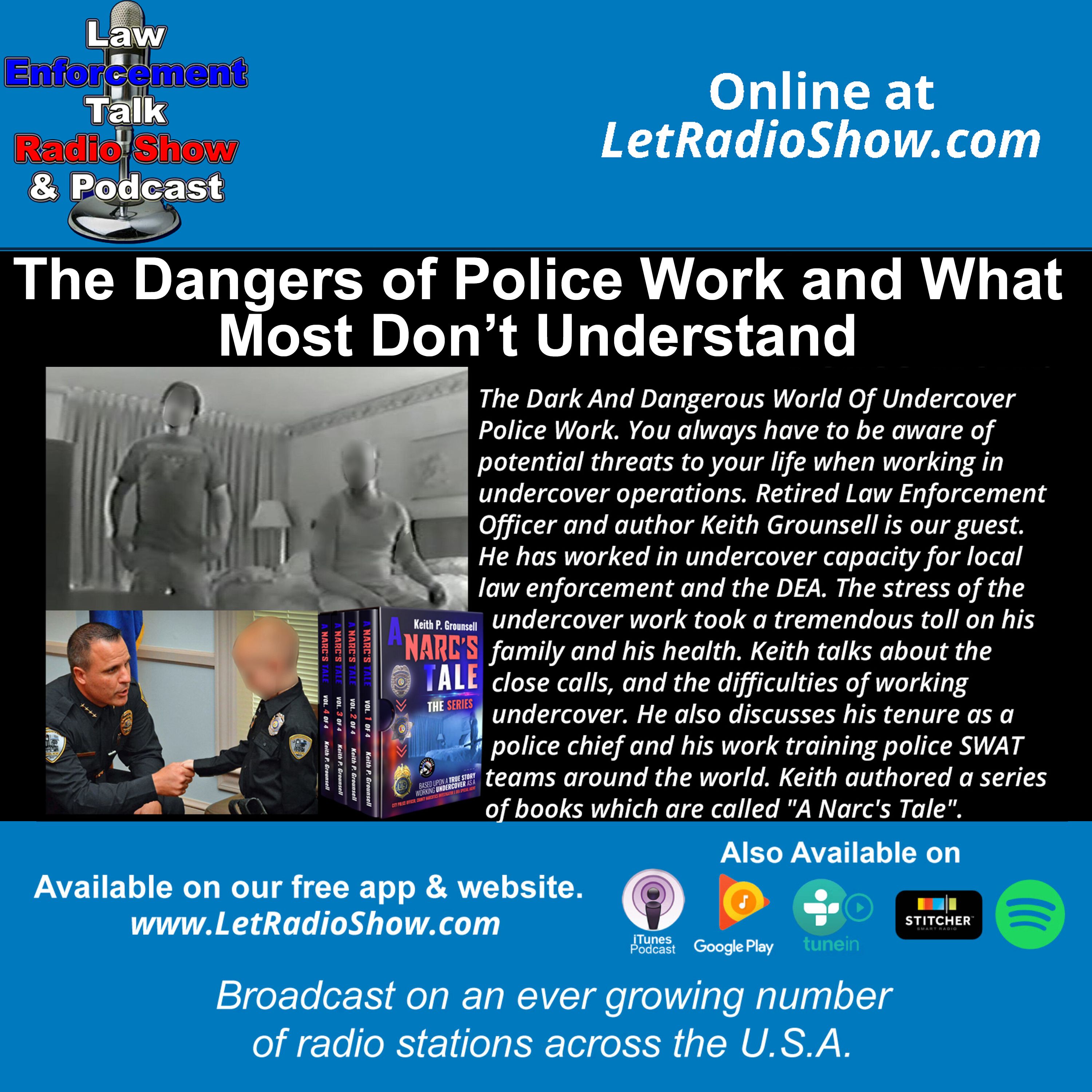
 The Dangers of Police Work and What Most Don’t Understand: his Powerful Journey Through Undercover Policing, Drugs, and Survival. Special Episode. Where many only see police work through headlines, television dramas, Facebook clips, Instagram reels, YouTube videos, or Spotify and Apple Podcasts, the true dangers of law enforcement often remain misunderstood. The Law Enforcement Talk Radio Show and Podcast social media like their Facebook , Instagram , LinkedIn , Medium and other social media platforms.
For retired law enforcement officer, police chief, and author Keith Grounsell, the realities of policing were far more dangerous, psychologically draining, and life-altering than most people will ever fully comprehend. His remarkable journey through narcotics enforcement and deep undercover operations reveals the hidden costs of protecting society from some of its darkest criminal threats. The Podcast is available for free on the Law Enforcement Talk Radio Show and Podcast website, also on Apple Podcasts, Spotify, YouTube, iHeartradio and most major podcast platforms. #Free #Podcast #Radio
“Undercover police work is one of the most dangerous and psychologically demanding assignments in all of law enforcement,” Grounsell’s story makes clear. “It is a profession where officers live double lives, often surrounded by violent criminals, drug traffickers, gang members, and murderers, while constantly balancing the razor-thin line between maintaining their cover and staying alive.” The Dangers of Police Work and What Most Don’t Understand: his Powerful Journey Through Undercover Policing, Drugs, and Survival. Supporting articles about this and much more from Law Enforcement Talk Radio Show and Podcast in platforms like Medium , Blogspot and Linkedin.
Keith Grounsell’s law enforcement career spanned more than 20 years, with over 26 years in the broader law enforcement and security field. His service included local policing, county narcotics operations, federal investigations with the DEA, and global security leadership. He served as Chief of Police in South Carolina, worked as a U.S. Drug Enforcement Administration Special Agent, advised international police organizations in Liberia, Nigeria, and Haiti, and consulted with more than 30 national police forces worldwide. Yet, despite his prestigious career, it was his six years deep undercover that would become the defining, and most dangerous chapter of his life.
As a young officer, Grounsell was unexpectedly thrust into undercover narcotics work with little formal preparation. “He had to quickly learn how to infiltrate dangerous drug circles, purchase narcotics, build criminal trust, and avoid exposure, all through trial and error.” This perilous learning process placed him in life-threatening situations early in his career, but he adapted rapidly, successfully removing more than 130 drug dealers within his first year alone.
His story is inspiring audiences through the Law Enforcement Talk Radio Show and Podcast Facebook, Instagram, YouTube, Apple, Spotify, iHeartradio and and many Podcast platforms.
His journey quickly escalated from city-level narcotics to county vice operations and eventually to federal DEA assignments, where the stakes became far deadlier. Grounsell infiltrated violent gangs, dealt directly with international drug cartels, purchased large quantities of narcotics, investigated murder-for-hire schemes, and confronted human trafficking networks, political corruption, and organized violence. “In this dark world, every interaction carried the possibility of death.” Guns were pointed at him, drugs were pushed on him to test his cover, and violent criminals constantly sought to expose or eliminate threats.
“The pressure was relentless,” his experiences reveal. “Any mistake in behavior, speech, or judgment could have exposed his identity instantly.” This level of risk was not just physical, it was emotional and psychological. The Dangers of Police Work and What Most Don’t Understand: his Powerful Journey. The episode is available across major platforms including their website, Apple Podcasts, Spotify, YouTube, with highlights shared across their Facebook, Instagram, and LinkedIn profiles.
While many associate police work primarily with physical danger, Grounsell’s journey exposes another side most people fail to recognize: the devastating toll on mental health, family relationships, and personal well-being. “The chronic stress, fear, and secrecy deeply impacted his health, strained his marriage, and affected his family life.” Long-term undercover officers often live in a state of constant paranoia, unable to fully share their experiences even with loved ones. The trauma can silently erode families while officers continue operating in silence.
Grounsell chronicled these extraordinary experiences in his acclaimed four-volume memoir series, A Narc’s Tale. Through these books, readers receive an unfiltered inside look into the brutal realities of undercover work at city, county, and federal levels. His memoirs expose not only dangerous drug operations but also the broader criminal underworld involving gangs, cartels, witness murders, corrupt officials, sex trafficking, and advanced surveillance technologies used in modern policing. His extensive documentation, including covert body camera images and investigative records, provides a rare authenticity that distinguishes his work from traditional crime stories. Available for free on the Law Enforcement Talk Radio Show and Podcast website, also on Apple Podcasts, Spotify, Youtube and most major Podcast networks.
“What makes Keith Grounsell’s story especially compelling is that it exposes both the professional triumphs and personal sacrifices of undercover service.” His story dismantles Hollywood myths and reveals that the badge often comes with hidden burdens far beyond public perception. While social media platforms like Facebook and Instagram often highlight moments of heroism or controversy, they rarely capture the years of sacrifice, fear, and personal loss experienced by officers working behind the scenes. The Dangers of Police Work and What Most Don’t Understand. The Law Enforcement Talk Radio Show and Podcast on social media like their Facebook , Instagram , LinkedIn , Medium and other social media platforms.
For listeners seeking authentic stories beyond surface-level true crime, Grounsell’s journey is available through Free podcast platforms including Apple Podcasts, Spotify, and YouTube, where audiences can hear firsthand accounts of what police officers endure while combating dangerous criminal enterprises fueled by drugs, violence, and corruption. His experiences serve as both a cautionary tale and an educational resource for those seeking to understand the realities of law enforcement beyond the badge.
Keith Grounsell’s journey is more than a police story, it is a profound testament to courage, resilience, and the unseen sacrifices made by those who enter the darkest corners of society to protect others. His life reminds the public that the dangers of police work extend far beyond what most understand, reaching into the personal, emotional, and psychological battles that officers carry long after their operations end. You can listen to the complete interview for free on our website, also on Apple Podcasts, Spotify, Youtube and most major podcast platforms.
Be sure to follow us on X , Instagram , Facebook, Pinterest, Linkedin and other social media platforms for the latest episodes and news.
Learn and get access to money saving tips and how to increase your net worth at www.LetSavings.com
Download the Free Ebook about ways and tips to improve your health. You can get the ebook for free at www.LetHealthy.com
Get the Free Clubhouse App, it is Drop In Social Audio. Think of it as your own talk radio show on your phone, and best of all it is free. Be sure to look for me and follow me, that’s John J Wiley or @letradioshow you can do all that here.
You can contact John J. “Jay” Wiley by email at Jay@letradio.com , or learn more about him on their website .
Find a wide variety of great podcasts online at The Podcast Zone Facebook Page , look for the one with the bright green logo.
Listen to the full story on the Free Podcast, available on the Law Enforcement Talk Radio Show and Podcast Website, on Facebook, Instagram, YouTube, Apple, Spotify, and more.
The Dangers of Police Work and What Most Don’t Understand: his Powerful Journey Through Undercover Policing, Drugs, and Survival.
Attributions
Amazon
Hosted by Simplecast, an AdsWizz company. See pcm.adswizz.com for information about our collection and use of personal data for advertising.
Unknown Speaker (0:00): The Army ten miler is on. Race in person at the Pentagon or go virtual from anywhere. Every mile supports US Army soldier and family programs. Register or volunteer now at army10miler.com. Run, volunteer, be part of something bigger.
Grainger (0:15): When you manage procurement for multiple facilities, every order matters. But when it's for a hospital system, they matter even more. Grainger gets it and knows there's no time for managing multiple suppliers and no room for shipping delays. That's why Grainger offers millions of products and fast, dependable delivery so you can keep your facility stocked, safe, and running smoothly. Call 1800, click grainger.com, or just stop by.
Unknown Speaker (0:40): Grainger, for the ones who get it done.
John Jay Wiley (0:45): He's got more than twenty two years experience in law enforcement, including working with the DEA and being a chief of police. He's trained police departments across the world, and he's the author of a series of books called Narc's Tales. Welcome to the law enforcement talk radio show. In the law enforcement talk radio show, we are joined by special guest talking about their experiences, their realities of investigating crimes. Plus, those who've experienced horrendous trauma, police, first responders, military, and victims of crime share their stories.
John Jay Wiley (1:16): Hi, I'm John Jay Wiley. In addition to being a broadcaster, I'm also a retired police sergeant. Be sure to check out our website, letradio.com, and also like us on Facebook. Search for the law enforcement talk radio show. Of all the radio stations in The United States, there are no other shows like the law Enforcement Talk Radio Show.
Unknown Speaker (1:36): And on Facebook, there's only one official page. Do a search on Facebook for the Law Enforcement Talk Radio Show and be sure to like the Law Enforcement Talk Radio Show Facebook page. Calling us from Greenville, South Carolina, we have Keith Groundsall on the phone. Keith, thanks for being a guest on law enforcement show. Very much appreciated.
Unknown Speaker (1:55): Hey, Jay. Thanks for having me.
John Jay Wiley (1:57): It's a pleasure to have you here. Keith has a wealth of experience in law enforcement. He's got more than twenty two years on the job at different levels, worked at DEA. He's been chief of police. He's worked with so many countries, training their departments.
John Jay Wiley (2:10): I can't even keep track of them. And he's an author of a series of books called Narc's Tales. How many books are in that series?
Keith Groundsall (2:18): It's a four book series called A Narc's Tale based upon six years of working deep undercover at the city, county, and federal levels.
Unknown Speaker (2:25): And where can people get more information? I mean, I know they're available on Amazon, but you have a website, don't you?
Keith Groundsall (2:30): Absolutely. My website is groundsoulbooks.com, and that's grounsellbooks.com. My last name is Ground, without the d, in cell. That's where that comes from. And there's an array of different videos and further information about the books on my website.
Keith Groundsall (2:50): You can also read Amazon reviews of A Narc's Tale, the series.
Unknown Speaker (2:55): Now the series is four books. Is it fiction based on, facts?
Keith Groundsall (3:01): It's it's based upon true stories. And, of course, we had to change the names and the locations to protect different individuals, including myself. So we had to classify it for legal reasons as a fiction story, but it's all based upon true stories. And there's over 350 photos and newspaper articles and different things to authenticate the different stories throughout the four book series.
Unknown Speaker (3:21): Well, that's the only way you can really do it. If you do it fact wise, you just open yourself up for so much civil liability. Even
Unknown Speaker (3:27): Absolutely.
John Jay Wiley (3:28): The thing about written words, I don't know if you do this, text and email, I always read something into it that's not intended to be there. And when I send something to someone, they always read something in there I don't intend. So, like, the spoken conversation seems to be so much better and so much more accurate.
Keith Groundsall (3:46): Absolutely. You know, the same the same thing. That's what my attorneys had said to me to speak on the side of caution, and I went ahead and went with their advice.
John Jay Wiley (3:53): The other thing too, by the way, for people on social media, if you learn one thing out of this show, social media, Facebook, Twitter, it doesn't matter. It doesn't capture sarcasm. So you may be joking. You may have a real tongue in cheek delivery when you type something. Everybody reads it as, oh my goodness.
John Jay Wiley (4:13): Did you see what Sozo said? So just don't do it. When we're talking, you can hear the tone of voice and all those things. I'm glad you're on the show. We've communicated a little bit beforehand.
Unknown Speaker (4:24): Your career, just a bird's eye view, start to where you're at now.
Keith Groundsall (4:28): Absolutely. I started my career back in 1998 and as a uniformed police officer through community patrol division under a federal grant back in the nineties. And quickly, I learned that I had a knack for, you know, going after drug cases. It started out obviously very small, and I always wanted to work undercover, and I always had that ambition there, but we didn't have a large enough agency. So I did a little bit of part time undercover here and there.
Keith Groundsall (4:54): And eventually, after three years on the force, I was recruited to go work for a much larger agency with a few 100 police officers. And I went to work there in about three couple days in orientation. They yanked me out of orientation and told me you're no longer going to be working on uniform patrol. We're gonna be signed undercover, working narcotics. And it was supposed to be a few months and ended up being a year long undercover operation doing two different operations.
Keith Groundsall (5:20): From there, I got recruited to go work for the sheriff's office. Pretty much the same thing. They wavered my time on the road and put me right into my narcotics. I continued working three years undercover for a large sheriff's office, one of the largest in the state of South Carolina. And from there, I had ambitions to achieve the highest level of drug enforcement, which at the time I believe was US Drug Enforcement Administration.
Keith Groundsall (5:42): And I applied. It took about two years to get hired on, got hired on with them and did that. I spent a couple years out in Western Kansas and under the St. Louis Field Division, the Kansas City District Office, I worked there. And, a lot of things happened, and it was, eye opening to say the least working with the different cartels and and different levels of drug enforcement that I had never seen on the East Coast.
Keith Groundsall (6:05): And after a couple years, you know, total of six years working undercover, I I was a little bit burned out, and I wanted to change. And that's when I resigned from the Feds, and I started doing, contracting with the US Department of State as a police adviser. I went straight to Afghanistan. And over there, I was a US commander over their special forces unit, their SWAT teams, the riot teams for a couple of years. Got injured over there, came back home, eventually worked my way back into being able to work again and became the the lead investigator for the largest prosecutor's office in the state of South Carolina.
Keith Groundsall (6:40): And did that until an opening came up to be chief of police in in the town that I was currently living in, which is right next door to my hometown. So I had applied for that. I had about 50 applicants from across the nation, and I was blessed enough to be picked for that position. And, went into that position, you know, very ambitious and and a little naive, thinking that I was gonna be able to make drastic changes to a culture, that went well beyond problems inside the police department. I uncovered some corruption, blew the whistle on it, lost my job initially, fought really hard for about fourteen months, was received.
Keith Groundsall (7:18): They reinstated me, got my job back. They had to give me full back pay for fourteen months. For about two and a half years, things were wonderful. We went from the number 28 safest city in the state to the number one safest city. We did community policing, drug enforcement, and that was that was how we were successful.
Keith Groundsall (7:36): I ended up being involved in some indictments with a corrupt mayor who was convicted in court.
Unknown Speaker (7:44): No. No. Wait a second. A corrupt politician? No.
Keith Groundsall (7:48): No. No way those exist around here. Not at all.
Unknown Speaker (7:52): I think they're everywhere, to be honest with you.
Keith Groundsall (7:54): I agree with you wholeheartedly. Well, then also there was, you know, some corruption involved. The police department members at the the high ranking members prior to my time there. We ended up indicting a couple of them, the chief before me, but he was acquitted on his charges. They were dismissed prior to trial on a technicality.
Keith Groundsall (8:11): And then the head of investigations was plagued guilty for tampering with evidence to cover up suspects in a murder and a rape. That was a cold case that we're about to solve. And so I basically kicked the hornet's nest and politically was under attack the entire time there, and eventually, I was forced to resign. And, I went back into contracting overseas. Went to
John Jay Wiley (8:32): the old saying we had in my department. It's a very short walk from being officer of the year to being on the unemployment line. One day you're a hero, the next day you're a zero, and especially when it comes to corruption. And when I say corruption, it's not always about money. Political corruption is more pervasive.
John Jay Wiley (8:51): Now when I say political corruption, what I'm referring to is a lot of areas. The powerful wealthy people command the mayor's attention, the city council's attention. They call the police commissioner or police chief, and it goes downhill. When you talk about the poorer areas, the the economically depressed areas, they don't have the same kind of poll, the same kind of clout, and that's where a lot of police get into conflicts and confrontations with command staff and city hall. Am I correct?
Keith Groundsall (9:21): Absolutely. As chief of police, my job was to ensure that my officers could do do their job without any interference. So that meant that I took all the from the politicians.
John Jay Wiley (9:31): Absolutely. And that was a sergeant. It's a little bit different. I'm sure you can relate to this. My job was to make sure the officers did their job to the best of their ability and protect them from heat from above.
John Jay Wiley (9:43): So you were kind of like the the wall between the lieutenants and captains and everybody else. And if everybody got yelled at, you did. So you made sure they treated everybody the best way possible. They did the best job possible, and they got everything they needed. This is the law enforcement show.
Unknown Speaker (9:56): We'll take a short break. We'll be right back.
Unknown Speaker (10:01): They say that it's not about how much you earn, it's about how much you save. And that is partially true. If you can take some of that savings and turn it into high yield investments, you are way ahead of the game. Get more details on how you can get started at letsavings.com. Letsavings.com.
Unknown Speaker (10:19): Again, that's letsavings.com.
Grainger (10:22): When you manage procurement for multiple facilities, every order matters. But when it's for a hospital system, they matter even more. Grainger gets it and knows there's no time for managing multiple suppliers and no room for shipping delays. That's why Granger offers millions of products and fast, dependable delivery so you can keep your facility stocked, safe, and running smoothly. Call 1800, click granger.com, or just stop by.
Grainger (10:47): Granger, for the ones who get it done.
John Jay Wiley (10:55): Return on conversation with Keith Groundsall on the law enforcement. Twenty two years experience in law enforcement from being chief of police training, international police departments, working with DEA and author of four books called The Narc's Tales. Get more information at his website, which I believe is groundsoulbooks.com. Keith, first of all, thank you for your service. Very much appreciated.
Unknown Speaker (11:20): Thank you.
John Jay Wiley (11:21): And in some ways, there's some similarities in my career and yours. I quickly began to gravitate from uniform patrol to what we call special operations or flex type unit, crime suppression, to drug enforcement, stolen cars, that sort of thing, armed robberies, men with guns, bad guys with guns. And I really developed the fondness for narcotics investigations. However, unlike what a lot of people think is, I was lousy undercover. There's plain clothes from people, there's undercover, and then there's deep cover.
John Jay Wiley (11:53): And part of your story sounds like it involved deep cover, didn't it?
Keith Groundsall (11:56): Absolutely. And that's, you know, a misconception amongst the community. People think you see an officer in plainclothes that are undercover. And as you said, there's plainclothes police officers that work surveillance, and then there's short time guys who go in and out and do a few buys here and there, part time undercover. Then there's guys that, you know, live a role.
Keith Groundsall (12:15): And not all the time that I actually live a role. A lot of times I did some part time stuff, but I was always alert because I was doing multiple operations for multiple different agencies at one given time. So therefore, you always had to be on your toes on duty, off duty. There was no such thing.
Unknown Speaker (12:29): We had
Unknown Speaker (12:30): All the time.
John Jay Wiley (12:30): Guys. I mean, men and women in the academy, and it wasn't in my class, but there were always a couple that like, the week before graduation, all of a sudden they get called out of the academy, and you're thinking, oh, there's another one lost. They got fired. And then you find out five, six years down the road, they've been working undercover. No one in you never saw them in police department.
John Jay Wiley (12:51): You never saw them in headquarters. No one knew where they were. You never knew what they're doing, but they had a job to do, and that's what we see like Donnie Brasco, those kind of stories that you see on television. Absolutely. What I did was totally different.
Keith Groundsall (13:05): Yeah. So for me, it was it was a little bit different. I I had already spent three years with one agency. I changed agencies. And at that time, unbeknownst to me, they yanked me out of the orientation, put me undercover, and they made up a scandal that I was fired for using excessive force on an old case, and I failed a drug test going in.
Keith Groundsall (13:22): The purpose was to be able to look at potentially any corrupt officers as well as people in the local community. Some of them knew who I was. I lived in an area that was pretty vibrant, that was growing, and multiple counties around it, you have close to a million people. So therefore, I was able to continue, you know, and still work undercover and not be burned.
John Jay Wiley (13:41): The story the cover story is the way they call it, well, about being fired for excessive force and all those other things. That also goes contrary to what a lot of people hear and think in the media. When when we had a bad officer, everybody knew it. Everybody knew who they were, and no one kept it quiet. Everyone talked to someone about it.
John Jay Wiley (14:02): Their problem is you have to go above and beyond to make sure you get evidence. You just can't take unilateral action on people.
Keith Groundsall (14:09): Exactly. You can't go based upon rumors. You better have something pretty substantial if you're choosing a public servant who dedicated their life to helping people of corruption. So, therefore, we got involved in cases where there were allegations made up against our officers. We made some arrests.
Keith Groundsall (14:24): We, you know, do undercover work for other agencies. I I assisted the Department of Corrections selling drugs to corrections officers to smuggle into prisons and going after dirty cops that are selling information and things like that. So, yeah, I was involved in an array of things from murders for hire all the way to purchasing children working undercover posing as a pedophile. So, I mean, it wasn't just drugs, you know, vice and narcotics or gambling operations but anytime anything popped up, if you specialize in undercover and somebody had a lead, whether it be setting up a fencing operation and buying stolen merchandise or, like I said, a murder for hire. We were there.
Keith Groundsall (15:03): We we enjoyed it, and there was a small niche group. There was only a couple of us at the entire agency of hundreds of officers that actually did the deep undercover stuff.
Unknown Speaker (15:13): It's a funny thing you brought up because you hear all the time about so and so looked for a hitman to kill their spouse. And lo and behold, guess who the hitman was? It was an undercover police officer. And and you'd think that people will get wise to that. That's a Hollywood myth that I don't even know where to begin to look for someone that's supposedly a hit man.
Keith Groundsall (15:36): What shocked me was the price which people felt they could get somebody killed for in lower socioeconomic status areas. You know, it wasn't anything to pay somebody a $100 to pop somebody, which is shoot them and not kill them. $500 to kill somebody. I'm like, wow. I wouldn't even blink an eye if somebody says something like that.
Keith Groundsall (15:54): You see these TV shows where they're paying tens of thousands of dollars, but the reality is who has tens of thousands of dollars, you know, readily available to give somebody other than if there's a life insurance policy involved, and these type of people did not have life insurance policies.
Unknown Speaker (16:10): So when you had these type cases, what was the average asking price, for lack of better words, or part of
Unknown Speaker (16:16): the It could be
Unknown Speaker (16:17): bargaining process?
Keith Groundsall (16:18): Yeah. It could be anywhere from $500 to, you know, a thousand, $2,000. You know, there were people willing and basically to shoot people for a $100. So we had to make sure our price was reasonable, and they didn't shop around and go to somebody else. Because once you interact with someone and they say they're willing to kill somebody and they make an overt act to meet with you, you know, you pretty much better do something about it because if you delay any and they go hire somebody else and they kill them, you had knowledge of it, then you're on the hook for some sort of liability.
Keith Groundsall (16:49): So Right. The pressure's on once you have knowledge.
John Jay Wiley (16:51): Well, I would imagine and like I said, I didn't do this type of work, but one doesn't hang out their shingle say hitman for hire or whatever it might be, whatever you're posing as. Most of these leads probably came to you from what we call confidential informants. Someone heard something about someone Absolutely. Doing this or that, and they approached the police.
Keith Groundsall (17:13): You're a 100% accurate. That's exactly how how it opens up. And and several cases, like one in particular, you read about in the books was a situation where we actually utilized a guy's reputation that we busted saying that we were hitmen for him in the past. And we sent him down the road to prison because people automatically feared that individual. And it was kinda funny how it worked out.
Keith Groundsall (17:36): We had direct knowledge of this whole organization in case they asked any questions. And that was only because we investigated, not because we were part of it. But they believe we are part of this other much larger organization.
Unknown Speaker (17:47): One of the things that that still amazes me is people will there's a court decision that we police can use reasonable subterfuge, meaning police can be dishonest. They don't have to tell you the truth. People always say, you see in Hollywood, if a guy's gonna go buy drugs or is a hitman or whatever he's posing as, and the customer will say to him, you're not the police, are you? Because I know you have to tell you.
Keith Groundsall (18:13): Yeah. Exactly. I I often laugh about that, and you'll read about that in multiple incidents throughout my books, especially the first book, where people so I even had the individual that asked me to commit a crime to do something because he believed that if I touched him or assaulted him, that he couldn't be charged because I committed a crime before he sold me to drugs. The mindset of these people is just is whacked. But, yeah, it's it's funny.
Keith Groundsall (18:40): It's comical. You you gotta laugh about it sometimes, but you always gotta be on your toes and be alert.
Unknown Speaker (18:46): The other thing I always get, and I see this on social media as well, and they'll say, the case against so and so, and just doesn't matter what it is. Let's just say murder. The case against so and so, the murder charges need to be dropped because they didn't read him as Miranda rights. And I'm saying I've been saying this for twenty years plus they don't have to read you your Miranda rights when you're arrested unless they're going to talk to you. This is a law enforcement show.
Unknown Speaker (19:13): We're talking with Keith Grounsel, author of four books. He's got twenty two plus years in law enforcement, including being chief of police, working in DEA, and training police departments across the world. Don't go anywhere. A lot of great stuff heading your way on the law enforcement show. We'll be right back.
Unknown Speaker (19:30): How would you like a free ebook on tips to improve your health? We're talking about tips you can use for free to add years to your life. Best of all, the ebook is free to download at lethealthy.com. When we say free, we mean free. So you can download the free ebook to improve your physical health all while preserving your financial health.
Unknown Speaker (19:50): Get the ebook for free today at lethealthy.com. That's at lethealthy.com. Again, the website is lethealthy.com.
Grainger (19:58): If you work in university maintenance, Grainger considers you an M V P because your playbook ensures your arena is always ready for tip-off. And Grainger is your trusted partner, offering the products you need all in one place from HVAC and plumbing supplies to lighting and more and all delivered with plenty of time left on the clock so your team always gets the win. Call 1800, visit granger.com, or just stop by. Granger, for the ones who get it done.
John Jay Wiley (20:33): Back to our conversation with Keith Groundsoul on the law enforcement show. In a nutshell, Keith has more than twenty two years experience on law enforcement from working with the DEA to being chief of police to training law enforcement agencies all throughout the world. He's also authored a series of books called Narc's Tales. Get more information on his website, groundsoulbooks.com. We're talking about your career, in particular, the undercover work because you spend a lot of time doing that.
John Jay Wiley (21:00): And you made a great point earlier, Keith. It's not always about drugs and narcotics. Sometimes it's advice. Sometimes it's sex crimes. Sometimes it's crimes against children.
John Jay Wiley (21:09): I understand human trafficking is now a big, big issue with the undercover work. And sometimes a small percentage of it because unlike what people think, the vast majority of police, I mean, all forms of law enforcement are great officers doing the best they can 99% of the time. When they're not and you get word of it, then you have to spring a trap for them.
Keith Groundsall (21:31): Yes. I mean, if there's one thing cops hate good cops is a bad cop.
Unknown Speaker (21:35): Absolutely.
Unknown Speaker (21:36): I'd rather take out one bad cop than a 100 drug dealers any day of the week.
Unknown Speaker (21:41): I've I've had the the experience and was not a good experience of having to arrest an officer when I was a sergeant, and it's for small charges. They were intoxicated. I had to take action against another officer who had a drinking problem and had to get a probation officer fired. And those are very unpleasant parts of the job, but they happen daily. I say daily somewhere across The United States.
John Jay Wiley (22:02): It doesn't happen daily in every department, but it's part of the job no one likes and no one is proud of.
Keith Groundsall (22:10): Absolutely. We make you know, in in America, we make about a million citizen contacts every single day, and you have such a small, small percentage that are negative or go array, and the officer actually does something wrong. But that's all we hear about in the news. We don't hear about, you know, the 900, 99,000, and some odd change, you know, other incidents that went textbook. We just hear about the bad ones, but we can always do better in policing ourselves.
Keith Groundsall (22:35): I think it's crucial. That's where as a supervisor, as a a officer, a coworker, it's your job to point out if something's wrong or to step in if you think it's about to go array and protect the other officer as well by doing the right thing. We did it. Making sure.
John Jay Wiley (22:51): We did it a long time ago. Here here's the real basic reason why. People and this includes law enforcement as well, people are basically self centered. We don't think about you all day long. What we think about is how things affect us.
John Jay Wiley (23:07): So for you to expect me to cover for you and put me, my wife, my kids at risk of losing health insurance, retirement benefits, and getting sued is something 99.995% of us are not willing to do.
Keith Groundsall (23:24): Absolutely. You know, it's very sad nowadays in law enforcement. You can be a police officer and do everything right and still be crucified by social media. And in the public's eye, they'll portray this image that you did all these bad things when in actuality, you did it textbook. And that's the hard pill for law enforcement to swallow nowadays and what makes it really difficult to be a law enforcement officer above and beyond what it used to be back in the days before social media.
John Jay Wiley (23:51): Absolutely. And I say this again. I I can't take credit for this. A good friend of the show, who's a lawyer, represents a police a lot of police in in Georgia. He said, if people don't like the first string, meaning the first law enforcement's on the scene now, what are you gonna do when a second string shows up?
John Jay Wiley (24:09): Because when we make life so difficult for the best of the best and I want when I called 911 for an emergency, I want the best available to show up. I don't want somebody that's horrible. If we make life miserable for those people, they have options. They can go elsewhere for more money, less stress, less physical danger, all those things. When they leave, who's gonna fill the void?
Keith Groundsall (24:33): Yeah. We're paid to intervene in the private private lives of individuals that are doing something wrong. And sometimes we get good information, and sometimes we get bad information. But we have to react, and we have to investigate. So people are gonna complain when you intervene and you kiss them dirty.
Keith Groundsall (24:49): That's a fact. So as a law enforcement officer, there's an old saying that, you know, you're not doing your job because you're not being complained on. That's somewhat true when it involves some people that don't wanna take responsibility for their actions, and they get busted.
Unknown Speaker (25:02): Absolutely. The first line of defense in in Baltimore, the drug lawyers was make a complaint of excessive force and discourtesy against us. That's the first thing they did. I wanna shift gears. A big part of your your career was involving undercover.
John Jay Wiley (25:16): Now the American population really and it's not their fault. What Hollywood puts out is horrible, what real life law enforcement is like in America. It doesn't show how violent our society really is. It doesn't show the traumas that they they experience. I've never met a cop who had a $1,000,000 luxury loft and drove a sports car.
Unknown Speaker (25:34): I've never seen it. And we don't get involved in shootings all the time and then go out drinking with the guys. The undercover part, I think, is so misunderstood because, well, quite honestly, no one's telling their stories.
Keith Groundsall (25:48): That's that's a 100% accurate. That's a lot of people you say, oh, that must have been so exciting working undercover. I said, well, have you ever done anything that's the coolest thing you've ever done in your life, like skydiving, cliff cliff diving, or something you always wanted to do. And what did you do immediately after you were done with it? You went and told people about it.
Keith Groundsall (26:05): Well, imagine doing something like that, but saying, hey, you can never you can't talk about it. Right now, you're still undercover. You can't talk. So for years and years and years, I didn't talk. So I wrote down notes.
Keith Groundsall (26:16): I started writing the stories. I kept my incident reports. And that was my form of therapy, and that's how I actually got into writing the book originally as a form of therapy and to show my kids one day why daddy's always gone.
John Jay Wiley (26:28): I'm sure you were gone a lot. It must have been really difficult on you and a family life.
Keith Groundsall (26:33): Absolutely. It's, mentally, the most stressful thing I've ever done. You know, you're living a life that nobody really understands. Your neighbors really don't know what you do. Your wife can't talk about it.
Keith Groundsall (26:47): For example, when I moved to Kansas with the DEA, you know, my wife couldn't make any friends because I worked undercover. That's what I did. That's what primarily what I did every single day. And when you're doing that, you don't wanna befriend somebody. You never know who knows somebody who knows somebody.
Keith Groundsall (27:02): And it it just became very stressful. The mental stress is overwhelming. You don't have any outlets for it. You know, I personally worked out. That was my thing.
Keith Groundsall (27:12): I had a home gym. I exercised, and it enabled me to be healthy, but the stress that I kept inside bottled up mentally affected me to where I would blow up at times at home, and I I just almost lose it. And I couldn't go talk to anybody about it because, you know, in the thin blue line, you don't wanna talk about your your mental stresses because you look weak, which is a misconception, you know, we had for many, many years. You don't wanna appear to be weak because you you have a badge and a gun and you don't want that taken from you. So, you have to hold in in it.
Keith Groundsall (27:46): I developed stomach problems over the years, a nervous stomach, and just a lot of, you know, physical things started happening to me because of the stress. And, you know, it took its toll on my marriage, you know, after many, many years. And and even later on, you know, fighting corruption as the chief of police, being deployed six years internationally, you know, traveling around the world, being in very hostile areas, you know, all that took its took its toll and, you know, my my wife was wonderful to to go through all the stuff she did and her friends would tell her, you you know, your boyfriend at the time when we were dating or your husband, he's a dirtbag, he's hanging out with drug dealers. We saw him at a strip club or we saw him here. Well, yeah, those things were true.
Keith Groundsall (28:28): But I was actually working undercover and they didn't know it. They were bad mouthing and she just kept her mouth shut. So mental stress wasn't just on me. It was on my wife. It was on my family.
Keith Groundsall (28:39): It was on my parents. You know, with the rumors going around that I was fired, you know, my my mother was just beside herself. And eventually, I had to tell her because she she just couldn't understand. You know, how somebody that she raised could could do these things. And and that added mental stress to my entire family.
Unknown Speaker (28:57): There were a lot of sacrifices that were made.
John Jay Wiley (29:00): I sit there, and I think and I hate to keep bringing this film up, but the the movie, the Donnie Brasco movie Absolutely. That I think Joppa Stone was the FBI agent went undercover and captured a a lot of, mafioso in in New York. And a big part of the movie, and I don't think they did credit to it because they go from being happily married couple to him doing his job, all of a sudden, the entire marriage is on the brink of collapse. And I don't think that tells a full story. We're gonna talk about what goes through the mind, the mindset, the preparation for serious undercover work.
Unknown Speaker (29:37): This is law enforcement show. Don't go anywhere. We'll be right back.
Unknown Speaker (29:44): Be sure to download the free Clubhouse app. It's like having your own talk radio station on your phone, and best of all, it is free. Be sure to follow John J. Wiley at LET Radio Show and look for major announcements. That's right.
Unknown Speaker (29:57): The Clubhouse app is free, and be sure to follow him for major announcements. That's John J. Wiley or at LET radio show. Did I mention that it is free?
Grainger (30:07): When you manage procurement for multiple facilities, every order matters. But when it's for a hospital system, they matter even more. Grainger gets it and knows there's no time for managing multiple suppliers and no room for shipping delays. That's why Grainger offers millions of products and fast, dependable delivery so you can keep your facility stocked, safe, and running smoothly. Call one-eight hundred Granger, click granger.com, or just stop by.
Grainger (30:32): Granger, for the ones who get it done.
Speaker 8 (30:36): I drive my bus in a busy city. That's why road safety is so important to me. I know that I must slow down and be extra careful when I make a wide turn. Buses need more room than cars. Everyone can help keep our roads safe.
Speaker 8 (30:52): Next time you're driving, remember to give buses plenty of time and space to finish turning before driving ahead. Let's all plan to share the road safely. Learn how at www.sharetheroadsafely.gov.
John Jay Wiley (31:11): Back to our conversation with Keith Groundswell calling us from, Greenville, South Carolina area just in a nutshell. And and this is a very small look at his career, more than twenty two years in law enforcement. He worked with the DEA. He has been a chief of police. He has trained law enforcement agencies in the most hostile environments in other countries across the world, and he's the author of a series of horror books called Narc's Tale.
John Jay Wiley (31:36): Get more information at his website, groundcellbooks.com. Before we went to break, Keith, we started talking about the effects on or we were talking about the effects on marriage and relationships or undercover work. One of the things that I don't think most people really comprehend, I'll work it this way. When we get a hot call in uniform in a patrol car, first of all, when you're in uniform, when I went from work in plain clothes, narcotics for years back to uniform because it get promoted, it was such a relief. But you're in a fishbowl.
Unknown Speaker (32:07): Everybody sees you. Everybody knows you. Everybody knows you, the police. But when you're, playing clothes and you say, okay, I gotta go do this. I'm a support role.
John Jay Wiley (32:15): I gotta follow this guy, whatever it might be. When you go in undercover, you've gotta have a mindset where you walk yourself through everything, and then, like, what's the red flags? What to watch out for? How do you keep your composure?
Keith Groundsall (32:27): Absolutely. I used to have a technique that when I used to teach at the Federal Undertover School, I I coined it as relaxed intensity. On the inside, you always gotta be intense and ready to pounce at any moment to fight for your life at any moment, but on the outside, you always need to appear relaxed. So for me, what I tried to do was I'm I'm not a heavy drinker. I'm not a big smoker, but when I worked undercover, I smoked.
Keith Groundsall (32:50): And a lot of people were like, oh, why did you smoke undercover? Because when you're blowing smoke, you're keeping people out of your face. People didn't wanna get up close to me when I was puffing on a cigarette and blowing smoke in their direction. So it kept people from trying to get close enough to get touchy feely, like they would send females in to touch you, to see if you have body wires on and things like that. It's nerve wracking working undercover.
Keith Groundsall (33:11): You have no radio, no bulletproof vest, no badge on you. All you got is a gun. And if something went array, you can't just say, I'm a police officer. They're not gonna believe you. They're gonna think they're being robbed.
Keith Groundsall (33:21): So they're gonna be fighting for their life thinking they're being robbed because that's their number one fear, not the police. And then you're fighting thinking that, oh, why why aren't they complying? Why don't why don't they stop? I'm I'm announcing I'm a police officer. You don't look like a police officer.
Keith Groundsall (33:35): You don't act like a police officer. You don't have any weapons. All you have is your mind. And and that's the most important thing. So, yeah, you're always one step ahead.
Keith Groundsall (33:43): You're always worried. You know, if you send an informant in to buy some drugs for you from somebody because you can't get in the door because they answered the door with a gun. And when they come back out, does the informant take the drugs as payment portion of the drugs, or do you pay the informant extra money? Because if you allow them to take it, then you're involved in the distribution. There's so many factors that come into play.
Keith Groundsall (34:03): You gotta prepare for an unknown event, which is almost So you gotta be innovative and willing to, on a split second, change up everything you're doing, make a call. My key was going with my gut instinct. If I felt like it was wrong, no matter what, I wouldn't allow the lust for the bus to get in the way. I would pull out and come back another day.
John Jay Wiley (34:23): Is there a scenario or do you remember in your experience where you're thinking, oh my this is gonna go horribly wrong. I'm gonna get killed here?
Keith Groundsall (34:31): Yeah. Quite a quite a few of them, actually. One in particular, I remember a guy, meth head. I was, you know, by, he was a meth cook. I was about a pound of crystal meth from the guy and I've been trying to get with him for quite some time.
Keith Groundsall (34:44): Finally got it all set up and we set up a meeting location. I call him. He'd say, I'm on my way. He wouldn't show up. You know, typical dopers time whenever they decide to arrive.
Keith Groundsall (34:54): Well, it went back and forth, back and forth, and my gut was just telling me, you know, this isn't normal from our previous smaller deal. And at the last minute, I decided I'm gonna pull out. What he calls me is like, I'm here. As I'm pulling out, I see him pulling in. And my gut told me, Go.
Keith Groundsall (35:11): Don't give a about the pound of meth. Go. We have enough evidence to stop him. So I did. I pulled out and the guy looked at me bug eyed, like, What the?
Keith Groundsall (35:19): So they pulled him over. What he did was he didn't have a pound of meth. He had a mini phone book, a duct taped up, sawed off shotgun sitting in the seat. He's gonna throw me the phone book when I started to field and question. He's gonna blast me in the face with a shotgun and he's gonna rob me.
Keith Groundsall (35:33): And the reason I know that is he got interviewed afterwards and see how was gonna rob and shoot a drug dealer. He thought I was a dealer. So, yeah, I mean, my gut saved me on many occasions, many, you know, incidents that went array going into fist fights to guns coming out. I mean, it's it's all in the books. It's it's crazy.
Keith Groundsall (35:52): You know, I didn't couldn't plan for those things. I just believe I have a guardian angel, but I also believe, you know, my gut instinct is the greatest trait that I have. When the hair on the back of the neck stands up and your stomach starts to bubble, you better listen to what your body
Unknown Speaker (36:07): Better pay attention to it
Unknown Speaker (36:08): for sure.
John Jay Wiley (36:09): I always tell people this. You know, if something makes the hair in back of your neck stand up, trust it. Whether it be God given, instinct, nature given, whatever you wanna think, trust it. If you're wrong, you can always apologize. How does one or I should say this, how do you after all those years of doing this, this high adrenaline work, this high danger work, how do you go back to just being like a married father afterwards?
Keith Groundsall (36:35): That was an excellent question. Well, I didn't. I went overseas, was in charge of national SWAT team in in Afghanistan, went to Haiti, was assigned to the Haitian National SWAT team there as a US contingent commander, went to Liberia, was a senior law enforcement adviser. Every place I went, I got involved in the drug nexus because it's in my blood. Taliban, we did poppy eradication fields in Afghanistan.
Keith Groundsall (36:57): In Haiti, the Colombian cartels, 10% of all US cocaine comes through Haiti as a transshipment point. We're involved in taking out the cocaine loads. In Liberia, the Nigerian cartels control most of the heroin trade and the drugs in Africa. We got involved in that. So I can't turn it off, and that's part of my dilemma.
Keith Groundsall (37:14): I was, you know, I would push in the fitness industry and just, you know, doing a lot of weightlifting and things like that, but, you know, I got injured in Afghanistan. I've had, you know, three shoulder surgeries, torn my bicep tendon twice, pectoral tendon, Achilles tendons. I've, you know, been injured doing stuff on the job. So it's hard. I'm being forced to slow down, and that's that's kind of been a a hard pill to swallow.
John Jay Wiley (37:36): I would imagine it would be because I'll just say from my experience, I got hurt and retired very young, very suddenly. My career was over at age 33. And you go from nonstop adrenaline daily to I'm bored out of my mind.
Unknown Speaker (37:52): And and
John Jay Wiley (37:53): if I if I wasn't challenged, I'd wind up thinking, and I wind up thinking about old stuff, and it usually was bad stuff. And usually Yeah. Would lead to depression and everything goes along with it.
Keith Groundsall (38:03): For me, writing the books was was absolutely crucial. I was in, Liberia as a senior law enforcement adviser to the inspector general there, and I got quarantined for twenty two weeks when COVID hit. And literally, every couple weeks, I go to the grocery store for thirty minutes, and I just hunkered down and finished out the books. And that time was a mental I could have mentally broke down, but I decided to be you know, make it productive. And I did the therapy, writing the books.
Keith Groundsall (38:33): I had to relive a lot of stuff and had to, you know, go back to old police reports, have people send me pictures of different things, the copies of police reports to refresh my memories and things. But, I mean, reliving all that. I forgot about a lot of things, to be honest with you. Then I'll see something, it'll trigger a memory. It's like, oh, I forgot about that.
John Jay Wiley (38:51): Exactly. You think it's conveniently put away and it's been replaced by something else and then some boom, out of nowhere, it pops up. A car looks similar to something you're involved in. It doesn't matter. And I'm still dealing with a lot of that, and I retired twenty nine years ago.
John Jay Wiley (39:05): Like I said, I was very young and retired. So this is part of how I have a mission to do things, and it keeps me occupied. You obviously running your books has been a big part of your recovery and healing process. Where again can people get more information about your books and everything you do?
Keith Groundsall (39:23): Yeah. They can go to my website at groundselbooks.com. That's grounsellbooks.com. That links also into my YouTube channel. My YouTube channel has fifty, sixty plus videos, different activities involved in my career of things that I've done.
Keith Groundsall (39:41): There's other information on there about the books. You can go on Amazon and go, it's A Narc's Tale, and just look that up, and there's four books. There's over 100 reviews on there, five star reviews, and read about it and see if it's something that interests you. Book number one covers all my time working, you know, building up to becoming an undercover, what made me interested in it, some trials and tribulations of my life, growing up, getting in trouble and different things that, you know, had good cops, cut me breaks, and things like that. And that's book one, Undercover with the City.
Keith Groundsall (40:12): Book two and three is Undercover as a County Sheriff's investigator, and that was where I grew so much. I finally got a lot of training and things like that. Book four is all my federal undercover time dealing with the high level cartels and wiretap investigations and big dope, you know, from renting planes to do dope deals, hundreds and hundreds of kilos of heroin to you you just name it. It's it's it was just at a totally different level that, you know, was opening to me. And what you think you know about the drug world, there's always something new to learn every single day.
Unknown Speaker (40:45): It's just like in law enforcement, if you're not learning, you need to get this out.
Unknown Speaker (40:49): And you're gonna keep it here. You know
Unknown Speaker (40:51): it all.
Unknown Speaker (40:51): Keith, I appreciate your service, and I really appreciate you spending time with us talking about it on the law enforcement show. Very much appreciated.
Keith Groundsall (40:58): Thank you very much. I appreciate all that you do to educate everyone in the community on what law enforcement actually does on a day to day basis, and God bless everyone that's listening.
Unknown Speaker (41:08): I'd like to thank our guests for coming on the law enforcement talk radio show. The law enforcement talk radio show is a nationally syndicated weekly radio show broadcast on numerous AM and FM radio stations across the country. We're always adding more affiliate stations. If you enjoyed the podcast version of the show, which is always free, please do me a favor and tell a friend or two or three. I'll be back in just a few days with another episode of law enforcement talk radio show and podcast.
Unknown Speaker (41:36): Until then, this is John Jay Wiley. See
Unknown Speaker (41:44): The Army ten miler is on. Race in person at the Pentagon or go virtual from anywhere. Every mile supports US Army soldier and family programs. Register or volunteer now at army10miler.com. Run, volunteer, be part of something bigger.
Speaker 9 (42:00): If you like the show, please take a moment to rate, review, and subscribe. It really does help the show to grow. Thank you for listening.