 Apple Podcasts Apple Podcasts
  Spotify Spotify
  Amazon Music Amazon Music
  Audacy Audacy
  Audible Audible
  Castbox Castbox
  Castro Castro
  Deezer Deezer
  Fountain Fountain
  Goodpods Goodpods
  iHeartRadio iHeartRadio
  PocketCasts PocketCasts
  Podcast Addict Podcast Addict
  Podchaser Podchaser
  Podverse Podverse
  Spreaker Spreaker
  Podurama Podurama Apple Podcasts Apple Podcasts Spotify Spotify Amazon Music Amazon Music Audacy Audacy Audible Audible Castbox Castbox Castro Castro Deezer Deezer Fountain Fountain Goodpods Goodpods iHeartRadio iHeartRadio PocketCasts PocketCasts Podcast Addict Podcast Addict Podchaser Podchaser Podverse Podverse Spreaker Spreaker Podurama Podurama
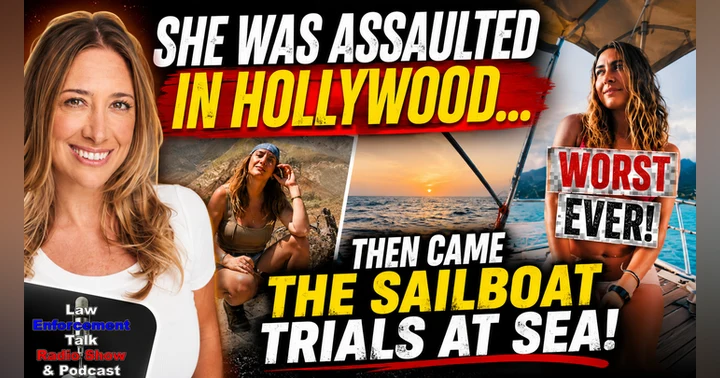
 She Was Raped in Hollywood. Then Sailboat Trials at Sea, the Book, and the Movie. How One Woman Turned Trauma, Survival, and Heartbreak Into a Story of Reinvention. Life rarely follows the script people imagine. The Law Enforcement Talk Radio Show and Podcast social media like their Facebook , Instagram , LinkedIn , Medium and other social media platforms.
For Angela Harger Thompson is our guest. What began as a promising life in Southern California became a journey marked by trauma, survival, adventure, heartbreak, and ultimately transformation. Her story now reaches audiences through a book, a documentary movie, social media, and appearances on Podcast and Radio platforms across the country. The Podcast is available for free on the Law Enforcement Talk Radio Show and Podcast website, also on Apple Podcasts, Spotify, YouTube, iHeartradio and most major podcast platforms. #LawEnforcementTalk #Free #Podcast #Radio
Today, Angela speaks openly about a devastating sexual assault that altered the course of her life and the extraordinary experiences that followed. Supporting articles about this and much more from Law Enforcement Talk Radio Show and Podcast in platforms like Medium , Blogspot and Linkedin.
Her story is one of resilience, truth-telling, and finding purpose after unimaginable pain.
She Was Raped in Hollywood
Before the sailboat adventures, before the documentary film, and before writing her memoir, Angela endured a traumatic experience that would leave lasting emotional scars.
She says she was drugged and sexually assaulted by someone she knew. The show is inspiring audiences through the Law Enforcement Talk Radio Show and Podcast Facebook, Instagram, YouTube, Apple, Spotify, iHeartradio and and many Podcast platforms.
Like millions of women across America, Angela found herself confronting the painful reality of sexual violence.
According to national studies, millions of women in the United States have experienced sexual assault while intoxicated, drugged, or otherwise incapacitated. In many cases, perpetrators use alcohol or drugs to make victims vulnerable, confused, unable to resist, or unable to remember what happened. She Was Raped in Hollywood. Then Sailboat Trials at Sea, the Book, and the Movie.
"The hardest part wasn't just surviving it," Angela has explained. "It was learning how to live afterward."
The emotional impact followed her for years.
The betrayal, loss of trust, and trauma shaped many of the decisions that came next in her life.
An Invitation That Changed Everything
As she struggled to rebuild, a friend offered what seemed like an incredible opportunity. The episode is available across major platforms including their website, Apple Podcasts, Spotify, YouTube, with highlights shared across their Facebook, Instagram, and LinkedIn profiles.
A sailboat voyage across the Pacific Ocean.
It sounded like adventure.
It sounded like freedom.
It sounded like a chance to start over.
Angela accepted.
What she couldn't know was that the journey would soon become one of the most challenging experiences of her life. She Was Raped in Hollywood. Then Sailboat Trials at Sea, the Book, and the Movie. Available for free on the Law Enforcement Talk Radio Show and Podcast website, also on Apple Podcasts, Spotify, Youtube and most major Podcast networks.
The Sailboat Trials at Sea
In March 2020, Angela boarded a sailboat in Panama alongside five crew members and one beloved sea dog.
The plan was simple: cross the Pacific Ocean and explore some of the world's most beautiful destinations.
Then the world changed.
Just one week into the voyage, news arrived through satellite communications.
COVID-19 had become a global pandemic.
Borders were closing.
Governments were implementing restrictions.
Ports were refusing entry.
Entire nations were shutting down.
Suddenly, the crew found themselves isolated in the middle of the Pacific Ocean with no clear destination and no certainty about what awaited them. She Was Raped in Hollywood. Then Sailboat Trials at Sea, the Book, and the Movie. The Podcast is available for free on the Law Enforcement Talk Radio Show and Podcast website, also on Apple Podcasts, Spotify, YouTube, iHeartradio and most major podcast platforms.
"It felt like the world disappeared overnight," Angela recalled.
As the pandemic spread, tensions aboard the vessel increased.
Relationships became strained.
What had begun as a dream adventure gradually evolved into a test of endurance, trust, and survival.
The relationship with her sailing companion deteriorated, creating additional emotional challenges while trapped thousands of miles from shore.
The experience would later become the foundation for a documentary film.
The Movie: Quarantine at Sea
Angela eventually transformed her extraordinary experience into a documentary movie titled Quarantine at Sea. The Law Enforcement Talk Radio Show and Podcast continues bringing listeners real conversations from the front lines of crime, policing, trauma, survival, and healing.
The film follows the crew's journey as they navigate the uncertainty of a world suddenly consumed by fear and restrictions.
Facing closed borders, changing government regulations, and limited options for safe harbor, the sailors were forced to make difficult decisions while isolated at sea. She Was Raped in Hollywood. Then Sailboat Trials at Sea, the Book, and the Movie.
The documentary resonated with audiences because it captured something universal.
Everyone remembers where they were when the world shut down.
Very few experienced it from the middle of the Pacific Ocean.
"People think it's a sailing story," Angela said. "But it's really a story about uncertainty, resilience, and what happens when everything you thought was stable suddenly disappears." The complete interview is available as a Free Podcast on Facebook, Instagram, YouTube, Apple Podcasts, Spotify, LinkedIn, and major podcast platforms.
The Book: Worst Tits Ever
Angela's story didn't end with the documentary.
She expanded her experiences into a deeply personal memoir titled Worst Tits Ever.
Released in 2026, the book chronicles her journey through trauma, heartbreak, faith, survival, loss, and personal reinvention.
The memoir explores not only her experience stranded at sea during COVID-19 but also the emotional battles that shaped her long before stepping aboard the sailboat.
Blending humor with vulnerability, the book offers readers an unfiltered look at how one woman confronted adversity and found strength in unexpected places. She Was Raped in Hollywood. Then Sailboat Trials at Sea, the Book, and the Movie.
"It isn't just about survival," she explained. "It's about learning who you are when everything familiar is stripped away."
Hear her story on:
Apple Podcasts
Spotify
YouTube
Facebook
Instagram
The memoir is available in print, digital, and audiobook formats.
Helping Others Tell Their Stories
Following the success of her documentary and memoir, Angela discovered a new mission.
Helping others tell their own stories.
Through her Storytell Initiative Course, she teaches aspiring writers, speakers, and creators how to transform personal experiences into meaningful artistic works.
Whether through books, documentaries, films, speaking engagements, or digital content, her goal is to help people find their voice. Listeners can hear the complete interview on Facebook, Instagram, YouTube, Apple Podcasts, Spotify, iHeartRadio, and other major Podcast, Radio, News, and Media platforms.
"Everyone has a story," she says. "Many people just need help discovering how to tell it."
Her work focuses on authenticity, healing, and connection.
She believes stories have the power to change lives.
Her own journey serves as proof.
Life After Trauma
Today, Angela lives in Southern California with her husband.
She enjoys acting, studying improv, rollerblading, hiking, and exploring the California coast.
Her life looks very different from the one she imagined years ago.
Yet every chapter, including the painful ones, helped shape the person she became.
From surviving sexual assault to navigating the uncertainty of the pandemic at sea, Angela's story demonstrates the remarkable resilience of the human spirit. She Was Raped in Hollywood. Then Sailboat Trials at Sea, the Book, and the Movie.
It is a story that continues to inspire audiences through Facebook, Instagram, YouTube, Apple Podcasts, Spotify, LinkedIn, and other Podcast and social media platforms.
Through her book, her movie, and her public speaking, she reminds others that even the most painful experiences do not have to define the future.
Sometimes the most powerful stories emerge from the darkest storms.
And sometimes surviving the storm becomes the story itself.
Find a wide variety of great podcasts online at The Podcast Zone Facebook Page , look for the one with the bright green logo.
Be sure to check out our website .
Listen to the full story on the Free Podcast, available on the Law Enforcement Talk Radio Show and Podcast Website, on Facebook, Instagram, YouTube, Apple, Spotify, and more.
Be sure to follow us on X , Instagram , Facebook, Pinterest, Linkedin and other social media platforms for the latest episodes and news.
Learn and get access to money saving tips and how to increase your net worth at www.LetSavings.com
Listen to this powerful #Free Podcast episode featuring Marci Hopkins on Facebook, Instagram, Youtube, Apple Podcasts, Spotify, and major Podcast platforms nationwide.
Download the Free Ebook about ways and tips to improve your health. You can get the ebook for free at www.LetHealthy.com
Get the Free Clubhouse App, it is Drop In Social Audio. Think of it as your own talk radio show on your phone, and best of all it is free. Be sure to look for me and follow me, that’s John J Wiley or @letradioshow you can do all that here.
The Law Enforcement Talk Radio Show and Podcast social media like their Facebook , Instagram , LinkedIn , Medium and other social media platforms.
You can contact John J. “Jay” Wiley by email at Jay@letradio.com , or learn more about him on their website .
She Was Raped in Hollywood. Then Sailboat Trials at Sea, the Book, and the Movie.
Attributions
Amazon
Hosted by Simplecast, an AdsWizz company. See pcm.adswizz.com for information about our collection and use of personal data for advertising.
Grainger (0:00): Grainger knows when you're a procurement manager for an office park, you're not managing one building. You're managing all of them. And to stay ahead, you need to see through walls and around corners. Lights about to fail, filters ready to clog, HVAC on its last leg. If you wait until something breaks, you're already behind.
Grainger (0:18): Count on Grainger for quality products, easy reordering, and 247 support. Call 1800, click grainger.com, or just stop by. Grainger, for the ones who get it done.
Ryan Reynolds (0:30): Ryan Reynolds here from Mint Mobile with a message for everyone paying big wireless way too much. Please, for the love of everything good in this world, stop. With Mint, you can get premium wireless for just $15 a month. Of course, if you enjoy overpaying, no judgments, but that's weird. Okay.
Ryan Reynolds (0:45): One judgment. Anyway, give it a try at mintmobile.com/switch.
Unknown (0:51): Upfront payment of $45 for three month plan equivalent to $15 per month required. Intro rate for three months only, then full price plan options available. Taxes and fees extra. See full terms at mintmobile.com.
John Jay Wiley (1:00): She was drugged and sexually assaulted. She turned to a friend, a Hollywood friend. They sailed around the world and that relationship deteriorated. She's here to talk about all that and more on the law enforcement talk radio show. Welcome to the law enforcement talk radio show.
John Jay Wiley (1:19): In the law enforcement talk radio show, we are joined by special guest talking about their experiences, their realities of investigating crimes, plus those who have experienced trauma, police, first responders, military, and victims of crime share their stories. Hi. I'm John Jay Wiley. In addition to being a broadcaster, I'm also a retired police sergeant. Be sure to check out our website, letradio.com, and also like us on Facebook.
John Jay Wiley (1:46): Search for the law enforcement talk radio show. Of all the radio stations in The United States, there are no other shows like the law enforcement talk radio show. And on Facebook, there's only one official page. Do a search on Facebook for the law enforcement talk radio show, and be sure to like the law enforcement talk radio show Facebook page. Joining us on the law enforcement talk radio show, we have Angela Harger Thompson, and Angela is an actor in California.
John Jay Wiley (2:15): And we've heard so many stories about the so called casting couch and all the things. She's gonna talk about what she went through. She was drugged, sexually abused as a result, and and for lack of better words, casting for, a Hollywood job. She was befriended by someone, took a long sailboat ride around the world, and that relationship deteriorated rapidly. She wrote a book which we can't tell you the name about the book because the best SEC rules apply.
John Jay Wiley (2:44): It sounds great. I love the title of the book, but you can get more details about her her book at angelahargerproductions.com. That's Angela Harger, harger,productions.com. Angela, thanks for being a guest on the Law Enforcement Talk Radio Show. Very pleased to have you.
Unknown Speaker (3:01): Thank you so much for having me, Jay.
John Jay Wiley (3:03): It's a pleasure. And by the way, I'm not going to minimize what you went through, but a lot of people that have been through similar, they're not alive to talk about this stuff. So the fact that you are alive and you're talking is a bonus. And I get to talk to you, my listeners get to hear your story. That's a double bonus.
John Jay Wiley (3:24): So thank you very much.
Angela Harger Thompson (3:26): It's my pleasure. I really believe in the power of healing through telling our stories, so it's important to me to do that.
John Jay Wiley (3:32): Now before we get into your story about what happened, where did you grow up and and and you wanted to to to go to Hollywood for for lack of better words?
Angela Harger Thompson (3:42): Yes. I grew up in Houston, Texas. I was doing community theater at my local theater and just loved performing, loved taking on new characters. And then I went to college, studied theater, went to the New York Film Academy and then spent some time in Austin in the film industry there in Austin, Texas but I told myself, you know, I don't want to be an 80 year old woman and regret that I never actually went to LA and gave it my all. So I packed my Honda Civic.
Angela Harger Thompson (4:10): My mom drove out there with me when I was 30 years old. A little bit late to be pursuing the dream, but that was my timing. And I went out there with silver screen dreams and whatever could fit in my car.
John Jay Wiley (4:21): And by the way, most people that go out there, I and I didn't. I was never struck him with this or stricken with this, but most people go out there, go out when they're much younger, and it's, they wind up waiting tables for a long time, and most never get a big break.
Angela Harger Thompson (4:35): That is true. I kind of did things on a later timeline. I was trying to build a little bit of a resume in Austin. There are a lot of TV shows in production there, some independent films. So I was able to get some things under my belt and have a little bit of experience on set before I made that giant leap out there to California.
John Jay Wiley (4:51): Do you ever look back and go by the way, I know ages can be verboten. How old of a person are you now?
Angela Harger Thompson (5:01): Oh, I never give my age, Jay. Okay. But I'm I'm past 30. But as an actress, that's the thing is that the casting directors will, if they know your age, then they'll decide what you can and cannot play.
Unknown Speaker (5:11): Well, that's one the reasons I love radio so much because it doesn't matter what it look like.
Angela Harger Thompson (5:16): Exactly. Exactly. But any good actor will put an age range on their resume rather than an age.
John Jay Wiley (5:22): I'm glad you you clarified that because, one point of contention I've had, and I tell people all the time, at this time of the recording, I'm 67 years of age. My mother is still 29. How I pastor, I'll never know. It
Angela Harger Thompson (5:37): is a special quality that women have for sure.
John Jay Wiley (5:41): But and I gotta ask you this too. As a woman, you went to Hollywood. You were gonna you had these dreams you wanted to chase, and I applaud you for that. Did you were you aware of the the potential bad side, the the hazards that that so many people have, or you aware of them and you thought, well, this never happened to me?
Angela Harger Thompson (6:04): It was more the latter. I was aware of the casting couch. I knew that that was how some people were breaking into the industry, but I was I knew that I can always have a choice in that and that I wouldn't choose that, and I was determined to make it by talent and hard work. What I didn't expect is what happened to me, and I would later come to find out that this is something that happens all too often in Hollywood. I didn't expect to have no choice in it and to still be taken advantage of and sexually assaulted.
John Jay Wiley (6:33): And and here's the reality. And we're we're gonna talk about some dark stuff, but we're not gonna talk about it in a dark way because it's really about overcoming and building the life that that Angela has today. But the reality is this has been an issue for Hollywood for a long time, and people that we are told we're supposed to admire are some of the biggest offenders. And that that is not is not something that's admirable, but it also happens in American society. And we're talking about slipping drugs into drinks and then taking advantage of incapacitated people.
John Jay Wiley (7:07): I don't get it.
Angela Harger Thompson (7:08): Yeah. I mean, it's it's a very evil thing. It's really predominant out in LA, and it it really blindsided me how it happened because I wasn't out at a club or a bar drinking when it happens. It was a dinner where I thought I was gonna be offered a job and we were going over the details of the job, so it really hit me out of left field.
John Jay Wiley (7:29): Can you go into some details? You're you're at a dinner. You didn't expect this. It it wasn't a typical club scene. What happened?
Angela Harger Thompson (7:38): Yeah. So I had been introduced to this producer, quote unquote, who had a studio, and everything he did was a little bit confusing. Every time I asked questions about what my role would be as his assistant, I wasn't really getting a lot of clear answers, but he kept meeting with me. I had just moved to LA, I was desperate for a job, I thought there would be nothing better than working with a producer being right there in the industry right away as soon as I arrived in LA. So, I would meet with him, try to get more details of the job, everything was a little bit sketchy in terms of just unclear And I remember him telling me at one of these meetings, he said, You know, it's a real issue out here that men are drugging women, so if you ever get into a situation where you feel unsafe, you give me a call, I'll be like your big brother and I'll take care of you.
Angela Harger Thompson (8:28): And I had no idea that at that time he was grooming me and trying to make me trust him in a very quick and not natural way. So I kind of was like, okay, that's strange. And then we were gonna, I was gonna start on like a Tuesday, so he took me out to dinner on Monday and we were gonna go over finally the details of the job where I was gonna hope to get an understanding of what my role would be. And that's when after dinner, I remember moving down to the bar downstairs because the upstairs closed and there was a show on TV, I was looking at the show on TV and that's the last thing that I remember until I woke up at 6AM the next day, naked and had been next to him in a locked room. So that's that's how that went from what I thought was a job interview to waking up the morning after my assault.
John Jay Wiley (9:21): And here's the the question. So a lot of people and this is from our police background. A lot of people don't wanna report that. Did you report it to authorities?
Angela Harger Thompson (9:33): Yes. Well, the first thing I did was wake him up and demand answers and demand that he let me go. And the door was actually dead bolt bolted, so he had to produce a set of keys and unlock it. I escaped out into the parking lot. The sun was rising.
Angela Harger Thompson (9:46): I was in such shock. I called my mom, I had no idea what had happened to me and my whole body was very much in shock and numb and she told me that I had to go to the hospital. And so I'm grateful that I called her to kind of get some grounding and direction for what I needed to do next. And when I went to the hospital, they called the police because they saw immediately that there were marks on my neck that I
John Jay Wiley (10:12): had They don't have a whole lot of choice in my head. We're talking with Angela Harger Thompson, And, we'll just say this. Go to her website because I she wrote a book about what her her journey, which we're talking about a few moments, but her website is angelahargerproductions.com. That's angelahargerproductions.com. Check it out.
John Jay Wiley (10:30): You'll find all the details there because quite honestly, you cannot say the name of the book on the radio. You can find us on Facebook. Look for and like the law enforcement talk radio show Facebook page. This is law enforcement talk radio show. Don't go anywhere.
Unknown Speaker (10:43): We will be right back.
Unknown (10:48): Be sure to download the free Clubhouse app. It's like having your own talk radio station on your phone, and best of all, it is free. Be sure to follow John J. Wiley at LET radio show and look for major announcements. That's right.
Unknown (11:02): The Clubhouse app is free, and be sure to follow him for major announcements. That's John J. Wiley or at LET radio show. Did I mention that it is free?
Grainger (11:13): Grainger knows when you're a procurement manager for an office park, you're not managing one building. You're managing all of them. And to stay ahead, you need to see through walls and around corners. Lights about to fail, filters ready to clog, HVAC on its last leg. If you wait until something breaks, you're already behind.
Grainger (11:31): Count on Granger for quality products, easy reordering, and 247 support. Call 1800, click Granger dot com, or just stop by. Granger, for the ones who get it done.
John Jay Wiley (11:48): Return conversation with Angela Harger Thompson on the law enforcement talk radio show. And her website, by the way, is angelahargerproductions.com. That's spelled hargerproductions.com. She wrote a book. I can't say the title of the book because of FCC regulations, but it's a great name.
John Jay Wiley (12:08): It's a really great name. You can get details about that on our website and find out about her story. In her story, she was drugged sexually assaulted, which we're turning to the conversation for few moments. I got to ask you this, Angela. You went to the hospital, which was a smart move.
John Jay Wiley (12:24): You got checked out, and they they notified the police because they really don't have a choice. What happened to you next?
Angela Harger Thompson (12:33): So the police came to the hospital. They weren't really able to treat me there, the doctors, because they don't do rape kits. So the police escorted me to the rape center and that's where I did all of my testing and interviews and just everything I needed to do. I got certain medications and such from the rape center. Then that same police officer took me to the police station.
Angela Harger Thompson (12:56): And so, I was interviewed by the police for six hours. At various times, I was alone while they had my phone and they were getting all the text messages off of my phone between myself and my attacker. And then at one point, and this is what took the most courage, was they had me call my attacker while they recorded it to try to get more information and a confession out of him. And so I had two police officers sitting across the table from me while I had to call him, ask him questions and me knowing it was all being recorded. Of course, he wouldn't admit anything on the phone and just kept laughing about it and telling me how drunk I'd gotten, which I had not gotten drunk.
Angela Harger Thompson (13:36): I know that I'd been drugged. I had an entire eight hours missing from my life. But yeah, it was a very long process and a lot of follow-up interviews with the police and drug testing. They were drug testing me to see if they could find any traces of the drug. So that process went on for nine months of investigation and me completely cooperating with the police.
Angela Harger Thompson (13:57): And my whole goal in doing that was, even though it was a lot to walk through that trauma and to sit there for six hours with the police, I wanted to help make sure that he could never do this again to another woman, and that was my motivation.
John Jay Wiley (14:10): I I get that. One of the things I I learned, and and by the way, I'm obviously male, and there there's a a line of thinking that that female officers were better equipped with, rape victims, and that was for me, that was not the case. It's one of the first things I always told victims was, I'm here to make sure that this never happens to you again, and you're safe with me. And it was and it it's it's you gotta get the evidence, but and and as a police officer, it's not you're doing the actual it's the hospital that's doing the rape kit. That's the term the term we use.
John Jay Wiley (14:45): But you've gotta get the evidence afterwards because, otherwise, you've got to build a case just like any case, and it's difficult. You gotta ask questions that you don't like, I'm sure.
Angela Harger Thompson (14:54): Yeah. And and to that point, there was a female officer who was actually very aggressive with me, and so I asked her to be taken off my case. And I worked very well with the other detective who was Emile. And he was very compassionate. He was very compassionate, very understanding, and I felt like I was in good hands with him.
John Jay Wiley (15:10): Well and the funny thing is, and I'm not saying funny in a sort of way, but there is a conception that women would would be more, let's just say, acclimated. They would be more welcome to the victims than the male officers, and that that was never the case for me.
Angela Harger Thompson (15:27): I don't know why that is. I feel like there that's very much reversed. I mean, there should be compassion towards any woman who's been through that situation, whether from a male or female police officer, but it is strange that it skews more heavily in that direction that the men are more compassionate.
John Jay Wiley (15:42): It's weird. And and part of this and I wanna get back to your story, Emma. I think part of it is that the for me, it's a natural protector. I want to to to do my role as a male to be a protector. And sometimes, I'm not saying that the other the other officers were not that way, sometimes they can come across as being judgmental, and that's not that's never needed.
Angela Harger Thompson (16:02): Mhmm. I think you're absolutely right, and I I really appreciated that in that as a male police officer.
John Jay Wiley (16:08): How did you go and I know this sounds like a a stupid question. It really but it's gotta be asked because I I'll I'll be honest with you. I don't get my soapbox a little bit. I hate the victim blaming. And and we seem to be gotten away from that in society for a long time, rightfully so, and now we're getting back into it.
John Jay Wiley (16:28): So I I don't do anything that way, at least purposely. But getting from point a to point b, you being raped to point c, you want to do something about it, that's a journey I can't wrap my head around.
Angela Harger Thompson (16:43): Yeah. I think I don't know where I found the courage to do it, but it was so important to me that this man never be able to hurt another woman and I had not really researched him or Googled him before I went into this interview which I deeply regret, but afterwards I did find an entire website that was dedicated towards women sharing their stories of abuse, assault, violence about this man who was my attacker. And so I immediately sent that to the detectives that were working on my case. And it was interesting, though. It was very much on me to do my own healing and it wasn't going to come from the results of the investigation or from my attacker being prosecuted.
Angela Harger Thompson (17:25): And that was something that was hard to come to terms with because I had such a desire for earthly justice and to stop him And I had to realize, you know, after the nine months they came back and said, there's really not enough evidence for us to convict rapists. He said she said we can't do anything about it.
John Jay Wiley (17:41): And that's not all through what happens quite often. And but I'll I'll be honest with you. There's people like that. And one of the first things I was always taught was you always believe what they say until you prove otherwise, never the other way around. You don't walk in with the, oh, they're lying again, blah blah blah.
John Jay Wiley (17:57): It's like, you've got to accept them on their word and then until it's proven otherwise. And sadly, with some of these cases, there's no evidence. There's nothing you can do.
Angela Harger Thompson (18:09): Mhmm. And that seemed unfair because I had gone through the rape kit. I had gone through six hours of the police investigation investigation where they're questioning me. I'd answered everything. I'd been so cooperative, but it it did just boil down to they weren't able to prosecute criminally.
John Jay Wiley (18:25): And part of what's unfair about it is you didn't volunteer for this.
Unknown Speaker (18:28): Right. I did not.
Unknown Speaker (18:31): I was You didn't able want this from jump street.
Angela Harger Thompson (18:34): Right. And I wasn't able to not only couldn't I not defend myself because I was drugged, but I couldn't help other women at that point, which was my whole desire.
John Jay Wiley (18:44): Did it become about how a change from becoming to help other women and prevent these bad things from happening to working on you?
Angela Harger Thompson (18:53): That's a great question, Jay, because I remember talking to my mom while I was in the police interrogation room and telling her how God was going to use this and I was going to be able to help other women and she said, Angela, stop. This just happened to you. This is very traumatic. You need to focus on yourself right now and heal. And it was like I got way ahead of myself for a second there and I think when it became a very practical thing where some days I couldn't get out of bed, I didn't want to shower, I didn't want to feed myself, I was so depressed and so anxious, I had an incredible, I never suffered from anxiety before that but I was having incredible anxiety attacks that for me looked like coughing, gagging, throwing up sometimes and I was still in LA having to hold down a job trying to go to these auditions and I would be throwing up in my car before I walked into the casting director's office because I was so anxious and had so much anxiety inside my body as a result of the trauma.
Unknown Speaker (19:53): So not
Unknown Speaker (19:53): And so I
John Jay Wiley (19:54): only were you performing for the audition, you're performing to get over By the way, I feel like a total wreck and I'm not gonna let you see it. We're talking with Angela Harger Thompson. She was drugged sexually assaulted in Hollywood. I'll let her tell you the rest of the story. She befriended someone that offered her a rail a sailboat ride around the world.
John Jay Wiley (20:15): Their relationship deteriorated. She's wrote a book, which I cannot tell you the name of because the FCC rules, but you can get details about it at our website, angelahargerproductions.com. That's Angela, harger,productions.com. This is law enforcement talk radio show. Don't go anywhere.
John Jay Wiley (20:30): We'll be right back. If you wanna be a guest on the law enforcement talk radio show, simply contact us. It couldn't be easier. You can send us a message on Facebook. Look for and like the law enforcement talk radio show page or email jay@letradio.com.
John Jay Wiley (20:53): That's jay@LETradio.com.
Unknown (20:58): American homeowners are sitting on $30,000,000,000,000 in home equity, but home insurance is up over 100% since 2010. Health care, childcare, property taxes, all up. The wages just stuck. Lots of equity, but feeling the squeeze. Every month, they wonder why it still feels so tight.
Unknown (21:19): Unlock thinks we need to talk about this more. Start at unlock.com/equity. Unlock home equity solutions and m 265-7081.
Speaker 7 (21:28): When you're a maintenance engineer in a beverage manufacturing plant, you keep production lines moving and quality on track because there is no room for slowdowns. With Grainger's vast selection of high quality motors, sensors, belts, and hard to find parts, you can get what you need fast and all in one place, so nothing gets in the way of getting the job done. Call 1800, click granger.com, or just stop by. Granger, for the ones who get it done.
John Jay Wiley (22:04): Return conversation with Angela Harger Thompson on law enforcement talk radio. This is context from California. She was, drugged and sexually assaulted, raped during the casting couch epidemic. She's written a book about it and her journey, which we'll talk about in a few moments. And the name of the book, cannot say because the FCC rules.
John Jay Wiley (22:29): However, it's a great title. You can get it details about the book on our website, Angela Harger Productions dot com. It's spelled h a r g e r. Angelahargerproductions.com. Angela, by the way, I I I know I said this before, but I'm I'm thrilled that you could get to talk about this because, a, it it it's got to serve as a little bit of a warning for you, but it's also gotta be, I would think, kind of healing for you to tell your story.
Angela Harger Thompson (22:56): It is. It's so healing, and I believe that I believe in that healing for others through telling their stories as well. So thank you for giving me this this platform and the opportunity to share about it.
John Jay Wiley (23:06): Earlier, you said that there you weren't gonna get earthly justice. And one of the things I always say, and I think it's overrated. It's used by Hollywood a lot, and I I know that's the industry you're in, but, at least they received justice. No. They didn't.
John Jay Wiley (23:22): No. They didn't because they didn't make the bad stuff go away. That that person who was killed is not alive. The person who was raped, you're not the same person. And they're going to, these casting calls, auditions for to pretend to be someone else using someone else's lines, and you are going through what you went through.
John Jay Wiley (23:40): I can't imagine that.
Angela Harger Thompson (23:42): You know, it was so important to me to not let my attacker take any more from me than he already had. And I think that that gave me the persistence to get through things. Even when, you know, I had a bartending job, would have 10 tickets print at one time and I get so overwhelmed. I would have to go into the back, have my anxiety attack, come back out and then work through all the drink tickets and I just kept going. And I think that it probably would have been crippling anxiety for a lot of people, but for me it was like my way to be strong and to fight back and to not let anything stop me.
Angela Harger Thompson (24:14): So even though I was having that incredible anxiety, I could barely get through each thing that I needed to do whether it be my bartending job or an audition, I still was forcing myself through it. And I know my parents had kind of wanted me to go back to Texas to heal during that time and I said, No, my trauma happened here, my healing has to happen here also or else I'll be afraid to ever come back out to LA. So, I persisted and I really plugged into the resources that I needed in order to heal. I had a therapist that was funded for me by the Victims Compensation Fund in California and so there were certain benefits that I was able to tap into even though they weren't able to prosecute my attacker criminally and I'm very grateful to the State of California for that. But I had a therapist I saw once a week, I was journaling through all of my emotions and thoughts, I was doing healing yoga that was helping my body to release the trauma that I was carrying.
Angela Harger Thompson (25:12): So it was very intentional, the things that I had to focus on and the self care I was doing for myself in that time.
John Jay Wiley (25:20): And here's I'd say this is $64,000 question. And before I ask you the question is I live by this principle of never let them see you sweat. And I get that you don't wanna to give up any more power to your attacker. I get that. As a matter of fact, I'm so old.
John Jay Wiley (25:38): When we're doing the interview, I had a cramp, a bad leg cramp, and I'm like, oh my god. I'm not going to let people know that. And so I I understand. And a part of me is kind of I wanna applaud you for that because I'm a continue on. But the question was, where do you get the strength to continue on to do the things you gotta do?
John Jay Wiley (25:57): Because, look. You you said you're a bartender. That's not an easy job. And by the way, being an actor in Hollywood, I'm sure is not easy either.
Angela Harger Thompson (26:06): My faith is honestly where I got the most strength. I spent so much time with God during that time just in prayer, reading my Bible, journaling, and I knew that there was light at the end of the tunnel because He is the Redeemer. And I knew that He would take that situation, that He would turn it around in my life and then I just had to go through that process even if on any certain day all I could do was take one step, that was enough for that day. So I think part of my personality trait also is just being very resilient and persistent and I don't give up even maybe sometimes when I should.
Unknown Speaker (26:38): Oh, yeah.
Unknown Speaker (26:39): For the club. That's served me well in life.
John Jay Wiley (26:41): Yeah. I'm I'm the type of guy that I'll get hammered by Mike Tyson multiple times, and I'll keep coming back for more. It just it it's it's a ridiculous way to be, but that's the way I am. So you're at where you're at today. And before we get into what you did to rebuild your life, this transition from and I don't wanna tell you a story.
John Jay Wiley (27:04): This transition from being, working in Austin and other areas to being recognized in Hollywood, how difficult was that?
Angela Harger Thompson (27:15): Well, it was it was a long journey and it's one that I'm still on. You know, even when you reach any kind of place of success, you can look ahead and see how much further of a road you have to go compared to others. And so what I I found is the most effective for me is to look behind and to see how much ground that I've covered. I think that before COVID-nineteen outbreak, I was very unempowered in that I was really auditioning for gigs and hoping that someone else was going to give me an opportunity, give me a job, discover me. But I had something happen during the COVID experience that really changed that for me and there was someone who was kind of an on again off again boyfriend who was a huge source of comfort for me as I walked that healing journey.
Angela Harger Thompson (28:02): And he went and he got a sailboat and he was gonna sail it from Panama to The Marquesas and invited me to go on this passage with him which would have been a quarter of the way around the world. And I was like, I don't want to leave LA, I'm nervous to miss the auditions that would happen while I'm gone. And so he said, Well, I'll buy you a nice camera and you can make a documentary about the experience. So then my tune changed and I said, Alright, when do we leave? I got on that sailboat 03/07/2020, we set sail, we're a week into the passage and then COVID breaks out across the world.
Angela Harger Thompson (28:36): So we get this email on the satellite email saying, Borders are closing, countries are closed, we can't go anywhere and we're just stranded in the middle of the ocean with no options at that point. And so I just kept the camera going. I kept shooting everything, interviewing our crew as we discussed options where we should go. Should we go to a desert island? Or what even were our options at that point?
Unknown Speaker (29:01): I I I've never thought of that. We think that being in the middle of the ocean would be a safe place to be, but I never thought that about borders in ports of entry being closed.
Angela Harger Thompson (29:11): Absolutely. That was the thing. We knew we were safe from the virus because of our location, but we were then in a precarious situation of no country wanting us to come in because we were foreign citizens or not citizens rather. So we had to, you know, it was constantly changing as well as we all remember during that time, you know, it's just two weeks for this and then this and it was constantly changing whether we could go on land when we got there, if we could get groceries. So we finally ended up landing in the Marches is twenty six days into the passage and they said you can get fuel, you can get food and then you have to leave.
Angela Harger Thompson (29:48): So we had three crew members, they were European, so they wanted to go on to Tahiti whereas my ex boyfriend and I realized we needed to go to Hawaii because that was what was best for us as American citizens. So they hitchhiked another sailboat to Tahiti and then just he and I filled sixteen days up to Hawaii which was very hurrying passage. We went through a lot of squalls, lightning storms, At one point, the boat was completely sideways in the water, and I'm looking out the kitchen windows and they're completely underwater.
Unknown Speaker (30:21): By the way, that's the point where I'd be going, we're gonna die. It's not good.
Angela Harger Thompson (30:27): There were several moments, but, you know, before I got on the passage, I had really prayed about it, and I felt God saying he'd be with me in the night watches. So when those things happen and we're in those storms, I really did have a supernatural peace. And I it was like watching a movie where you know that the characters make it, so you're okay.
John Jay Wiley (30:43): I I I don't have that kind of resilience. I look. I have a deep abiding faith. I really do. However, when life and death situation comes into it, I wanna take full control.
John Jay Wiley (30:53): And part of my part of my problem is, yeah, my wife I've been, with my wife for almost thirty years now. We we get along great. But one of the things we say is we'll never go on that show, the the amazing race, because we'll be divorced in three weeks. There's no way we could handle that, just being with each other all the time.
Angela Harger Thompson (31:12): Yeah. It was a very stressful situation. The relationship kinda started to dissolve on the ocean
Unknown Speaker (31:18): You think?
Angela Harger Thompson (31:19): As we were under that kind of anxiety and stress. And when we landed in Hawaii, you know, the first thing people did when they greeted us was hand us mask and tell us we had to wear them. And that was a total culture shock for us because we had left a very normal world on March 7. And on April 23, we landed in a completely changed world.
John Jay Wiley (31:39): I'm gonna say a short break. On that note, we're talking with Angela Harger Thompson, and her website is angelahargerproductions.com. It's spelled hargerproductions.com. This is law enforcement talk radio show. Don't go anywhere.
John Jay Wiley (31:51): We'll be right back.
Speaker 8 (32:00): Someone asked, what's the catch? What's the cost? There is no cost for anything on the law enforcement talk radio show and podcast website, letradio.com. Letradio.com. Again, that's letradio.com.
Grainger (32:16): Grainger knows when you're a procurement manager for an office park, you're not managing one building. You're managing all of them. And to stay ahead, you need to see through walls and around corners. Lights about to fail, filters ready to clog, HVAC on its last leg. If you wait until something breaks, you're already behind.
Grainger (32:34): Count on Granger for quality products, easy reordering, and 247 support. Call 1800, click granger.com, or just stop by. Granger, for the ones who get it done.
John Jay Wiley (32:52): Current conversation with Angela Harger Thompson on the Law Enforcement Talk Radio Show. Angela is well, she was drugged and sexually assaulted, raped, and we're talking about the sailboat ride with their on again, off again boyfriend that, let's just say, did not go as planned. She's written a book, which I cannot say the name of the book on the radio due to FCC regulations. However, you can get details about it at our website. That's angelahargerproductions.com.
John Jay Wiley (33:21): That's Angela, hargerproductions.com. First of all, it's amazing you've been through. Let's be honest. You went through being sexually assaulted, raped, drugged, you name it. Then you've got this trip with COVID and you've got I'm sailing in a sailboat with this guy and it's not working out well, and I'm not allowed to enter different ports and you're surviving storms.
John Jay Wiley (33:49): Did you ever think back and go, man, I lived a blessed life?
Angela Harger Thompson (33:52): Yes. I saw God's hand on me for sure the whole time.
John Jay Wiley (33:55): Yeah. Looking out for you because, otherwise, what normal person would go through all that?
Angela Harger Thompson (34:01): I know. I feel a little bit like Forrest Gump there.
John Jay Wiley (34:04): Yeah. I I hear you. So let let's talk about the the the sailboat ride. And and I don't I can't think of another term to use it, but that probably seemed like a gift in disguise, didn't it?
Angela Harger Thompson (34:17): It was. I mean, I was initially so worried for our family back home because I thought I'd be the only survivor to survive the zombie apocalypse because I was on this boat, but they were actually home way more worried for me being in the middle of the ocean during a worldwide And I think that when we're in a situation like that, any person, like you just rise to meet it with the strength that you need because there was no option but to keep sailing all the way to Hawaii with just two people which meant he would sleep, I would watch, I would sleep, he would watch for as long as we could, usually four to five hours for sixteen days.
Unknown Speaker (34:53): So it's not as glamorous as as the TV makes it out?
Angela Harger Thompson (34:57): It's it's definitely not as glamorous. And you have to keep a constant watch, look out every ten minutes for any floating shipping containers or boats or anything like that, of course, that you're not going to run into. So it a lot on our especially just our not knowing. There was so much not knowing, and that was collectively experienced by the whole world. But being in the ocean and not knowing was a whole another level of that uncertainty.
John Jay Wiley (35:24): I can't I'm I'm thinking of a pretty adventurous guy, but the reality is I'm not going on vacation unless I know where I'm gonna stay, and it's gonna be at a hotel. I'm not gonna be in a place where, oh, I can see the ocean underneath the window or the windows looking out and I'm seeing the ocean. It's not good.
Unknown Speaker (35:41): There's no Motel sixes out there to stop by. You gotta just keep going.
John Jay Wiley (35:45): Here's the other thing before I go into your story some more, and it's I I always hate to say this, but you're you're one of those Hollywood people that, that we'd love to criticize, but you've mentioned faith and religion many, many times. And I gotta applaud you for that because a lot of people from that industry don't.
Angela Harger Thompson (36:06): It's really the defining factor in my life, my relationship with Jesus, and he God is the greatest storyteller of all time. I think that's why I love storytelling so much and what first attracted me to film in the first place to be an actor, to tell those stories and jump into other characters' skin. And I love doing the process with them.
John Jay Wiley (36:25): Well, I'm glad you you do. So you you were promised the ability to make a documentary. Did that go as you thought it would?
Angela Harger Thompson (36:33): Yeah. So I kept the camera rolling. I feel like it got interesting once COVID happened and we had this worldwide conflict at the center of the film. When we landed in Hawaii, as I said, the relationship continued to disintegrate. We started kind of having different views about COVID and I found that he got upset when he couldn't control what I thought about it.
Angela Harger Thompson (36:55): And so eventually I returned back to LA and he got extremely aggressive once I did that. He told me that he wanted the documentary, that I had no rights to it and he actually came up to me with the legal team so I had to hire my own attorneys and fight for it and say, you know, just because you bought this camera doesn't mean that you have the creative rights to this. You know, I did everything, I filmed everything. And so, was a scary process and it was another thing where I had to like just trust God to get me through it and say, I'm not going to give up my creative baby, even though that would have been a much simpler and cheaper option.
John Jay Wiley (37:33): I'm sure. What you said lawyers you said lawyers are not cheap.
Angela Harger Thompson (37:37): They're not cheap, but they are worth every penny because in the end, I got my documentary back, I was able to finish it through post production and then distribute it. It's now on Amazon, Google Play, Apple TV called Quarantine at Sea and it just chronicles like everything that happened to us out there. So I'm so proud of that but there was really so much more to the story especially the evolution of the relationship and I really wanted to share it just to help other women who might find themselves in a similar situation. So I went back to Texas, stayed with my parents for a while during COVID to write it out and I just sat there at my computer and I typed out the story until four a. M.
Angela Harger Thompson (38:18): Every morning and each chapter that I wrote was like a new layer of my heart that was healed. It was absolutely cathartic. And when I was done, I had this memoir which we can't say the title and I was so, so proud of it. So that was just published on April 14.
John Jay Wiley (38:36): That's a great title by the way, I wish we could say that, and this it's ridiculous. When you go to our website, angelahargerproductions.com, you will see the ridiculousness of the title why we can't say it. However, here here's the my bird's eye view of this, and I've not read the book. I've not seen the documentary. I wanna see the documentary, because I had in my mind an image, and I I'm I I could apologize in advance of a dingbat as I thought I was gonna be talking, and you are far from that.
John Jay Wiley (39:08): And you're obviously very resilient and a person of faith and all that stuff. Do you feel like you get to help people with your story now?
Angela Harger Thompson (39:19): Yes. I've been so blessed to help with I partnered with Wholeness Journey, which is a nonprofit that does workshops with women rescued out of sex trafficking and we've been able to go to Costa Rica, they go to Thailand. I've worked in here in California with girls as young as 11 all the way up to age 25 and I lead a storytelling workshop where I really help them to discover their own stories, their why for sharing it and the importance of healing through the power of storytelling and then we give them time to share their stories, whatever they want to say and I've been so honored to see them talk about some of the things, the worst things that we can't even imagine and just watch them heal and gain worth and confidence as they get to share their story. And then as they're surrounded by the other girls and women around them, it builds such community because we identify, we connect when we hear these stories and say, okay, I'm not alone in my experience like others have watched this as well. So it's been such an incredible honor and I just believe so much in the power of storytelling that I've created a workshop as well.
Angela Harger Thompson (40:23): It's a course that you can find on my website and it helps people to find their story and to be able to share it and get it all away from an idea in their head to a movie that somebody is watching on the screen or a book that they're reading. By the way, think believe in that.
John Jay Wiley (40:40): If you're listening and you have any connections to Hollywood with producers or directors or whatever, and you're interested in Angela, just send me an email and and I'll I'll send it to her and we'll arrange an introduction. Angela, I I gotta tell you, I'm pretty amazed at I'm very amazed at the progress you've made. And here, you're you're definitely not the same person you were when you were 30.
Angela Harger Thompson (41:02): Absolutely not. And it goes back, Jay, to what we were talking about where I was sitting there waiting for someone to hand me an opportunity. And after walking through all of this and the character that I forged, the persistence that I have had to find within myself, I'm someone who's making my own opportunity. That's right. You know, I self distributed the documentary, I self published the book, I did work with a hybrid publisher, but it takes so much momentum to get your projects off the ground and to believe in yourself instead of asking someone else to believe in yourself.
Angela Harger Thompson (41:31): And I have become so empowered as a result and someone who can create a film set and invite others onto it instead of waiting to be invited onto theirs.
Unknown Speaker (41:39): I'm so glad you
Unknown Speaker (41:40): better way.
John Jay Wiley (41:41): Told your story on our show. By the way, the website is angelahargerproductions.com. That's harger, angelahargerproductions.com. Angela, thanks so much for being a guest on the show. Very much appreciate it.
Unknown Speaker (41:53): Thank you so much, Jay.
John Jay Wiley (41:54): Of all the radio stations in The United States, there are no other shows like the Law Enforcement Talk Radio Show. And on Facebook, there's only one official page. Do a search on Facebook for the Law Enforcement Talk Radio Show and be sure to like the Law Enforcement Talk Radio Show Facebook page. Be sure to check out our website, letradio.com. That's letradio.com.
John Jay Wiley (42:19): There you'll find episodes of the show available as a podcast after airing on radio, and they're always free. There's 700 plus episodes on there right now. There's blogs. Get information about our sponsors. All that and much more at letradio.com.
John Jay Wiley (42:35): Again, the website is letradio.com. I'd like to thank our guests for coming on the law enforcement talk radio show. The law enforcement talk radio show is a nationally syndicated weekly radio show broadcast on numerous AM and FM radio stations across the country. We're always adding more affiliate stations. If you enjoyed the podcast version of the show, which is always free, please do me a favor and tell a friend or two or three.
John Jay Wiley (43:03): I'll be back in just a few days with another episode of the law enforcement talk radio show and podcast. Until then, this is John Jay Wiley. See you.
Grainger (43:16): Grainger knows when you're a procurement manager for an office park, you're not managing one building. You're managing all of them. And to stay ahead, you need to see through walls and around corners. Lights about to fail, filters ready to clog, HVAC on its last leg. If you wait until something breaks, you're already behind.
Grainger (43:33): Count on Granger for quality products, easy reordering, and 247 support. Call 1800, click granger.com, or just stop by. Granger, for the ones who get it done.
Unknown Speaker (43:46): If you like the show, please take a moment to rate, review, and subscribe. It really does help the show to grow. Thank you for listening.