

 Apple Podcasts Apple Podcasts
  Spotify Spotify
  Amazon Music Amazon Music
  Audacy Audacy
  Audible Audible
  Castbox Castbox
  Castro Castro
  Deezer Deezer
  Fountain Fountain
  Goodpods Goodpods
  iHeartRadio iHeartRadio
  PocketCasts PocketCasts
  Podcast Addict Podcast Addict
  Podchaser Podchaser
  Podverse Podverse
  Spreaker Spreaker
  Podurama Podurama Apple Podcasts Apple Podcasts Spotify Spotify Amazon Music Amazon Music Audacy Audacy Audible Audible Castbox Castbox Castro Castro Deezer Deezer Fountain Fountain Goodpods Goodpods iHeartRadio iHeartRadio PocketCasts PocketCasts Podcast Addict Podcast Addict Podchaser Podchaser Podverse Podverse Spreaker Spreaker Podurama Podurama
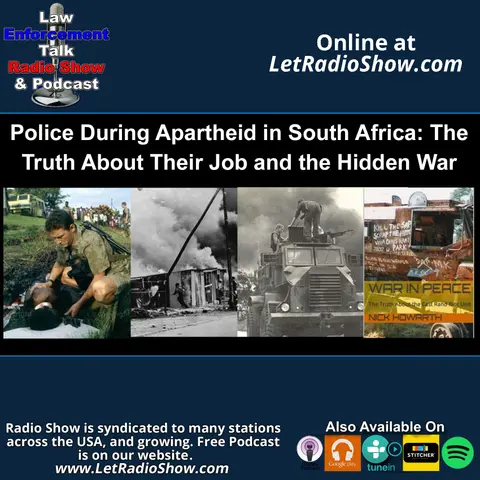
 Police During Apartheid in South Africa: The Truth About Their Job and the Hidden War. Former South African police sergeant Nick Howarth reveals the violence, trauma and political warfare he witnessed as a teenage officer in his book, War in Peace: The Truth About the South African Police’s East Rand Riot Unit, 1986–1994. The Podcast is available for free on the Law Enforcement Talk Radio Show and Podcast website, also on Apple Podcasts, Spotify, YouTube, iHeartradio and most major podcast platforms. #LawEnforcementTalk #Free #Podcast #Radio
Nick Howarth was not merely an observer during one of the most turbulent periods in South Africa’s history. He was on the ground, wearing the uniform and confronting violence that would leave permanent scars on his life. Supporting articles about this and much more from Law Enforcement Talk Radio Show and Podcast in platforms like Medium , Blogspot and Linkedin.
Howarth joined the South African Police Force in 1986. He was only 17 years old, fresh out of high school, when he entered a world of burning barricades, political unrest, tribal warfare and mass casualties. The Law Enforcement Talk Radio Show and Podcast social media like their Facebook , Instagram , LinkedIn , Medium and other social media platforms.
He eventually served as a section commander in the Internal Stability Division, a specialized anti-terrorist and riot-control unit. During nine years of police service, Howarth witnessed scenes of violence and suffering that most people could scarcely imagine.
His experiences are detailed in his gritty firsthand memoir, War in Peace.
“It is the story of a man, a uniform, a fractured nation, and the impossible task of keeping the peace when peace had already broken down.”
A Teenage Police Officer Thrust Into Warfare
At an age when many teenagers are still deciding what they want to do with their lives, Howarth was beginning a dangerous career as a police officer in South Africa. Police During Apartheid in South Africa: The Truth About Their Job and the Hidden War.
The former athlete joined the police believing he was entering a profession devoted to maintaining law and order. Instead, he was quickly thrust into a conflict that often resembled urban warfare.
Howarth and the other officers in his unit patrolled townships in armored Casspir vehicles. They responded to burning barricades, bombings, massacres, shootings and widespread political violence.
The officers frequently found themselves caught between heavily armed groups while attempting to protect residents, recover victims and prevent further bloodshed.
“Bombs, massacres, the murdering of women and children, courage, cowardice, heartache, defeat and victory became part of Howarth’s life.”
The constant violence eventually took an enormous psychological toll. After nine years in the specialized unit, Howarth left police work because of the accumulated stress and trauma. The Law Enforcement Talk Radio Show and Podcast, is available on Apple, Spotify, YouTube, and other major podcast platforms. The interview is also featured across Facebook and Instagram.
The uniform was gone, but the memories remained.
The Hidden War During Apartheid in South Africa
During the final years of apartheid, a brutal conflict was raging inside many of South Africa’s townships.
The violence was driven in part by a struggle for political influence between supporters of the African National Congress, led by Nelson Mandela, and the Inkatha Freedom Party, led by Mangosuthu Buthelezi. The conflict unfolded as the National Party government gradually relinquished power and South Africa moved toward democratic rule. Police During Apartheid in South Africa: The Truth About Their Job and the Hidden War.
More than 20,000 people reportedly died during approximately four years of extreme political and tribal violence.
Yet much of the bloodshed remained hidden from South Africa’s population and the international community. Strict restrictions on journalists and news organizations limited what the local and foreign media could report.
According to Howarth’s account, people outside the townships had little understanding of the daily brutality taking place there.
It was “a brutal African war” that remained largely outside the view of much of the world.
Police During Apartheid in South Africa
Discussions about police during apartheid in South Africa are inseparable from the oppressive system they served and the documented abuses committed under that system. Howarth’s book does not erase that history. Instead, it presents one officer’s firsthand account of working inside a specialized unit during the country’s violent transition. The episode is available across major platforms including their website, Apple Podcasts, Spotify, YouTube, with highlights shared across their Facebook, Instagram, and LinkedIn profiles.
War in Peace: The Truth About the East Rand Riot Unit focuses on ordinary law enforcement officers caught in the middle of political upheaval, community unrest and open warfare.
Howarth describes officers confronting attacks from armed self-defense units, responding to scenes of mass violence and attempting to protect civilians in an environment where the source of the next attack was often impossible to predict.
The book offers a perspective that Howarth believes has been overlooked in sanitized historical accounts and traditional news coverage.
His story raises difficult questions: What was the job really like for the police officers sent into those townships? How did repeated exposure to mutilations, murders and mass casualties affect them? And what happens when a teenage recruit is expected to function like a soldier in a conflict with no clearly defined battlefield? Police During Apartheid in South Africa: The Truth About Their Job and the Hidden War.
Violence That Left Permanent Scars
Howarth describes a world in which women, children and elderly residents were not spared. Race, religion, language, age and gender offered no guaranteed protection from the violence.
He witnessed sacrificial mutilations, symbolic killings and tremendous suffering among township residents. He also saw courage and compassion emerge under the most horrific circumstances.
The violence became so common that it threatened to destroy the humanity of everyone exposed to it.
Howarth watched himself drift into what he described as “the dark depths of hell” while trying not to show fear or emotional weakness. The Podcast is available for free on the Law Enforcement Talk Radio Show and Podcast website, also on Apple Podcasts, Spotify, YouTube, iHeartradio and most major podcast platforms.
He spent nine years working in that environment.
They were “nine years that changed his life forever and left scars that not even time can heal.”
The emotional consequences did not disappear when his shifts ended. Eventually, the stress and violence convinced him that he could no longer continue as a police officer.
Why Nick Howarth Wrote War in Peace: The Truth About the East Rand Riot Unit .
For decades, Howarth carried these experiences privately.
He said that writing War in Peace: The Truth About the East Rand Riot Squad gave him an opportunity to document what he saw and explain how the conflict affected the officers and civilians trapped inside it.
The memoir is graphic because the reality was graphic. Howarth does not attempt to soften the violence or present a comfortable version of events.
The book explores bloodshed, political manipulation, endurance and the psychological cost of repeatedly confronting death.
It is also the autobiography of a young man forced to grow up inside an environment defined by fear, hatred and uncertainty.
“This is a story that has never been told before and is so incredible that it is hard to believe it actually happened.”
The first paperback edition became a bestseller, leading to the release of an e-book edition. However, readers should understand that the subject matter is disturbing. Police During Apartheid in South Africa: The Truth About Their Job and the Hidden War. The Law Enforcement Talk Radio Show and Podcast continues bringing listeners real conversations from the front lines of crime, policing, trauma, survival, and healing.
As its description warns, “This book and his story are not for the fainthearted.”
The Truth About Their Job
The truth about their job, according to Howarth’s account, was that these officers were expected to operate as policemen, soldiers, rescuers and witnesses to history, all at the same time.
They were policing communities overwhelmed by political instability and armed conflict. Their decisions were often made in seconds, under attack and surrounded by civilians.
Howarth’s story does not offer simple answers or attempt to settle the larger historical debate surrounding apartheid. Instead, it provides one man’s personal testimony about what he witnessed, what he was ordered to do and what nine years of relentless violence did to him.
His experiences demonstrate that surviving physical danger does not mean escaping unharmed. Some wounds remain invisible, emerging through stress, traumatic memories and the struggle to rebuild a life after leaving law enforcement.
Nick Howarth Shares His Story
Today, Nick Howarth lives in South Africa. He joins the Law Enforcement Talk Radio Show and Podcast to discuss his police career, his specialized unit and the experiences that inspired War in Peace: The Truth About the East Rand Riot Unit. Supporting articles about this and much more from Law Enforcement Talk Radio Show and Podcast in platforms like Medium, Blogspot and Linkedin.
During the interview, Howarth talks about becoming a police officer at 17, spending nine years in an anti-terrorist and riot unit, confronting warfare in the townships and ultimately leaving law enforcement because of the violence and stress. Police During Apartheid in South Africa: The Truth About Their Job and the Hidden War.
His account offers listeners a rare glimpse into police work during apartheid in South Africa and the hidden conflict that accompanied the nation’s transition to democracy.
The interview also examines the personal consequences of serving in a violent environment and why Howarth felt compelled to finally put his memories into a book.
Listen to the free podcast interview with Nick Howarth on the Law Enforcement Talk Radio Show and Podcast. It is available through the website and on major platforms, including Apple Podcasts, Spotify and YouTube.
Follow and share the episode on Facebook, Instagram and other social media platforms to help bring attention to this extraordinary story of police work, political warfare, trauma and survival.
His website is townshiptales.com
This episode of the show is brought to you in part by Mars Men. You hit your 30s and 40s, and things start to feel different. Now that I’m in my 60s, I’ve really noticed the change. My energy drops faster. Recovery takes longer. Workouts don’t have the same impact they once did. Most importantly, what worked for me in my 20s simply doesn’t work anymore. So, I started looking for answers. Honestly, the testosterone-support space can be confusing, and much of it sounded sketchy. I don’t want to become a professional bodybuilder. I just want to look and feel more like the old me. Thankfully, I found Mars Men, and I couldn’t be more grateful. Mars Men is made in the USA, third-party tested, and formulated to support healthy testosterone levels, energy and stamina. It’s now available at GNC stores nationwide.
For a limited time, our listeners get 50% off for life plus Free Shipping AND 3 Free Gifts at Men Go To
Mars dot com. That’s MenGoToMars.com for 50% Off AND 3 Free Gifts when you checkout. After you
purchase, they will ask you where you heard about them. PLEASE support our show and tell them our
show sent you.
Please listen, follow and share this remarkable story.
Listeners can find the show across Apple, Spotify, YouTube, Facebook, Instagram, and other podcast and social media platforms.
Learn and get access to money saving tips and how to increase your net worth at www.LetSavings.com
For a community of like minded individuals from all over the planet that want to improve their lives, relationships and business. Learn what they need, and develop the life that they’ve always wanted.
We host weekly rooms on the Clubhouse Drop In Social Audio App. The App and Your Confident Life rooms are free of charge. You can get more information about Clubhouse and Your Confident Life for free here.
Download the Free Ebook about ways and tips to improve your health. You can get the ebook for free at www.LetHealthy.com
Listen to the Law Enforcement Talk Radio Show and Podcast on their website, Facebook, Instagram, YouTube, Apple Podcasts, Spotify, iHeartRadio, and most major podcast platforms.
Get the Free Clubhouse App, it is Drop In Social Audio. Think of it as your own talk radio show on your phone, and best of all it is free. Be sure to look for me and follow me, that’s John J Wiley or @letradioshow you can do all that here.
The Law Enforcement Talk Radio Show and Podcast social media like their Facebook , Instagram , LinkedIn , Medium and other social media platforms.
You can contact John J. “Jay” Wiley by email at Jay@letradio.com , or learn more about him on their website .
Find a wide variety of great podcasts online at The Podcast Zone Facebook Page , look for the one with the bright green logo.
Listen to the free Podcast on the Law Enforcement Talk Radio Show website and through major platforms, including Apple Podcasts and Spotify.
Listen to the Show, share the episode, and follow the latest Radio, Podcast, and News content from the Law Enforcement Talk Radio Show and Podcast.
Be sure to check out our website .
Be sure to follow us on X , Instagram , Facebook, Pinterest, Linkedin and other social media platforms for the latest episodes and news.
Follow the show on Facebook, Instagram, YouTube and other Social Media platforms for more real stories about trauma, survival and transformation.
Police During Apartheid in South Africa: The Truth About Their Job and the Hidden War.
Attributions
Amazom
Hosted by Simplecast, an AdsWizz company. See pcm.adswizz.com for information about our collection and use of personal data for advertising.