Apple Podcasts
 Spotify
 Amazon Music
 Audacy
 Audible
 Castbox
 Castro
 Deezer
 Fountain
 Goodpods
 iHeartRadio
 PocketCasts
 Podcast Addict
 Podchaser
 Podverse
 Spreaker
 Podurama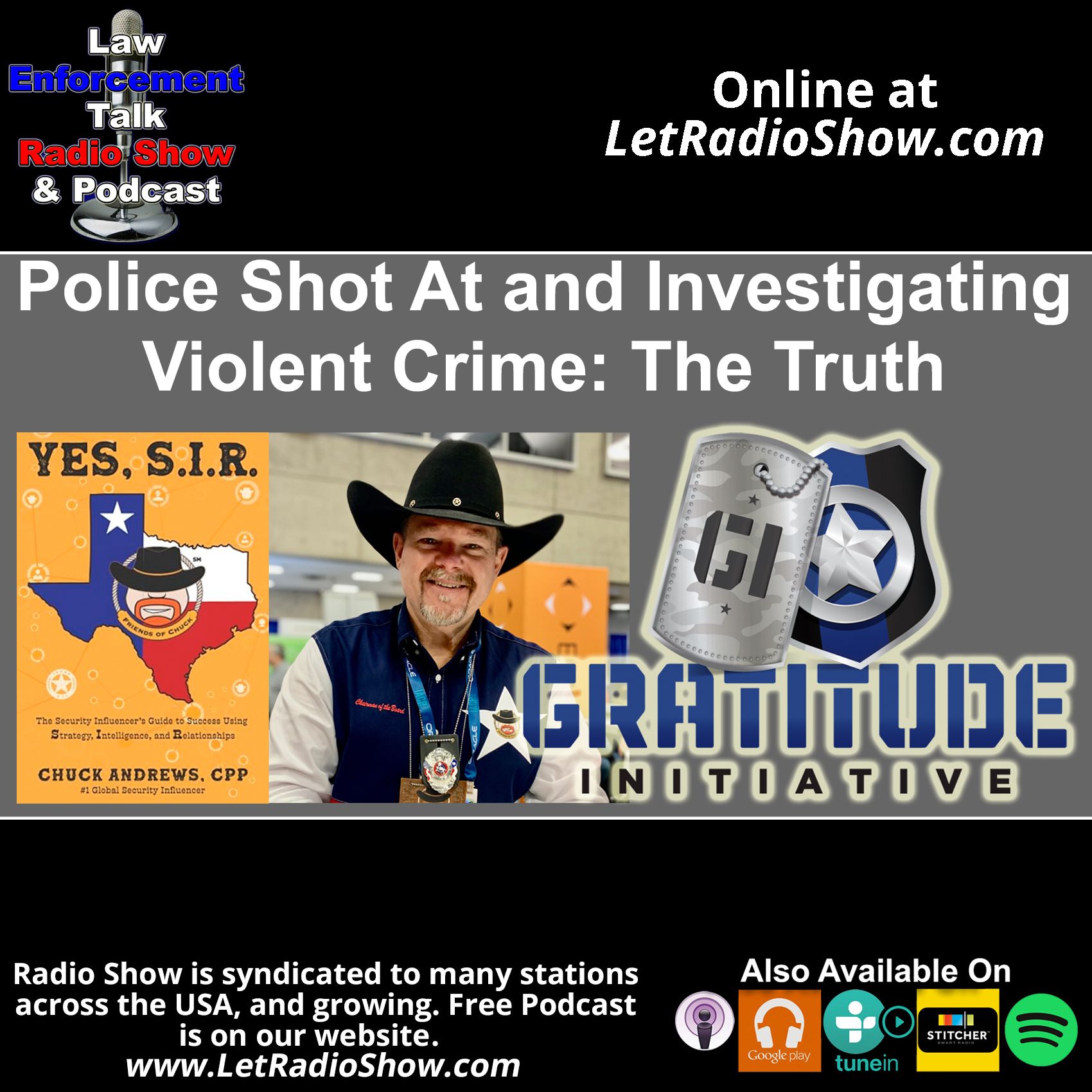



Police Shot At and Investigating Violent Crime: The Truth. In today’s nonstop Social Media environment, from Facebook, Instagram, and LinkedIn to YouTube, Apple, and Spotify podcasts, conversations about policing often focus on headlines rather than reality. Viral clips and breaking News stories frequently highlight moments when officers fire their weapons or when suspects are shot. Far less discussed, however, is a critical perspective: what happens psychologically and physically when police are shot at. The Podcast is available and shared for free on the Law Enforcement Talk Radio Show and Podcast website, also on Apple Podcasts, Spotify, YouTube and most major podcast platforms.
That is exactly the conversation explored in this Podcast episode featuring retired Texas law enforcement leader Charles “Chuck” Andrews, a former chief of police who spent decades handling violent incidents, including shootings where victims were struck multiple times. The Law Enforcement Talk Radio Show and Podcast social media like their Facebook , Instagram , LinkedIn , Medium and other social media platforms.
“The public often sees the final seconds,” Andrews explained. “They see the moment an officer fires. What they don’t see is everything leading up to it, especially the reality of being shot at and having to make decisions in fractions of a second.” Supporting articles about this and much more from Law Enforcement Talk Radio Show and Podcast in platforms like Medium , Blogspot and Linkedin .
The Reality Officers Face When Bullets Fly
Discussions surrounding use of force typically center on policy, legality, and accountability. Andrews says those discussions are necessary, but incomplete. Police Shot At and Investigating Violent Crime: The Truth.
“We talk a lot about when officers fire their weapons,” he said. “We also talk about when officers are shot and wounded. But rarely do people talk about what it’s actually like when rounds are coming toward you.”
According to Andrews, the experience is both physiological and psychological. Officers must process threat recognition, environmental awareness, and survival instincts simultaneously while protecting others nearby. Available for free on the Law Enforcement Talk Radio Show and Podcast website, also on Apple Podcasts, Spotify, Youtube and most major Podcast networks.
“When you’re being shot at, your brain is processing danger faster than conscious thought,” he said. “Training takes over because there isn’t time for debate.”
The Science Behind Being Shot
Understanding shootings requires understanding what a bullet actually does to the human body, a topic often misunderstood in movies and online debates. Police Shot At and Investigating Violent Crime: The Truth.
A gunshot wound involves a rapid transfer of kinetic energy from a projectile into human tissue. The damage is determined largely by velocity, not simply size.
Energy Transfer: Because velocity is squared in physics calculations, faster rounds deliver exponentially greater destructive potential.
Permanent vs. Temporary Cavities: A bullet crushes tissue along its direct path while also creating a temporary cavity, a shockwave that stretches surrounding tissue. High-velocity rounds can cause severe internal damage far beyond the visible wound.
The Momentum Myth: Contrary to Hollywood portrayals, bullets do not knock people backward. The momentum transfer is minimal compared to body mass, meaning individuals typically collapse due to physiological failure, not impact force.
“People expect dramatic knockdowns,” Andrews said. “In reality, incapacitation usually comes from blood loss, nervous system disruption, or organ damage, not from being thrown backward.” Look for The Law Enforcement Talk Radio Show and Podcast on social media like their Facebook , Instagram , LinkedIn , Medium and other social media platforms.
Different tissues respond differently to ballistic trauma. Elastic tissues such as muscle may stretch and recover, while organs like the liver or brain are far more vulnerable to catastrophic damage. Bone impacts frequently result in fragmentation, creating secondary projectiles inside the body. Police Shot At and Investigating Violent Crime: The Truth.
Bullets may also yaw or fragment after entering tissue, increasing injury severity.
Supersonic Reality: Why You May Never Hear the Shot
One of the lesser-known truths Andrews discusses involves sound and perception during shootings.
Most modern rifle rounds, and many handgun rounds, travel faster than the speed of sound. These supersonic projectiles create a sonic crack as they break the sound barrier. Available for free on their website and streaming on Apple Podcasts, Spotify, Youtube and other podcast platforms.
“If a round is supersonic, it hits before you hear the gunshot,” Andrews explained. “That surprises people, but physics doesn’t wait for perception.”
Rifle rounds commonly travel thousands of feet per second, well beyond the speed of sound.
Many handgun rounds, including common 9mm ammunition, are also supersonic.
Subsonic ammunition travels slower than sound, meaning the gunshot may be heard before impact. Police Shot At and Investigating Violent Crime: The Truth.
Because of this, officers under fire often react to impacts, debris, or instinct, not sound.
“That’s part of why these encounters are so chaotic,” Andrews said. “Your senses don’t behave the way people expect.”
Investigating Violent Crime: Complexity Behind the Scenes
Beyond the moment of force, Andrews emphasized the intricate and often misunderstood process of investigating violent crime. It is discussed across News platforms and shared on Facebook, Instagram, LinkedIn, Apple, and Spotify, where true crime audiences continue to get their content.
Every officer-involved shooting triggers layers of examination, forensic analysis, witness interviews, ballistic reconstruction, and policy review.
“The Truth is investigations are extremely detailed,” he said. “Every movement, every decision, every angle gets analyzed. It’s not quick, and it shouldn’t be.”
He noted that investigators must balance objectivity with the realities of human performance under extreme stress. Police Shot At and Investigating Violent Crime: The Truth.
“You’re analyzing decisions made in milliseconds with the benefit of months of hindsight,” Andrews said. “That’s why experience matters.”
From Policing to Influence: A Career Beyond the Badge
Today, Andrews applies his law enforcement and security expertise globally as a security strategist and influencer. His Book, Yes S.I.R.: The Security Influencer’s Guide to Success Using Strategy, Intelligence, and Relationships, outlines how professionals can build careers through networking, leadership, and collaboration.
The book has earned praise across the security and law enforcement communities, with industry leaders describing Andrews as a pioneer and connector within the profession.
“Relationships are everything,” Andrews said. “Whether you’re investigating crime or building a career, success comes from strategy, intelligence, and trust.”
Changing the Conversation
As discussions about policing continue across digital platforms and Social Media, Andrews believes education is key to bridging public understanding. Police Shot At and Investigating Violent Crime: The Truth. You can find the show on Facebook, Instagram, Pinterest, X (formerly Twitter), and LinkedIn, as well as read companion articles and updates on Medium, Blogspot, YouTube, and even IMDB.
“People deserve transparency,” he said. “But they also deserve context, the science, the psychology, and the reality officers face.”
In an era where viral clips can shape public perception within minutes, deeper conversations, through podcasts, long-form discussions, and educational content, may help audiences better understand the complexities behind deadly force encounters.
“The goal isn’t to justify or criticize,” Andrews added. “It’s to understand. Because understanding is where better conversations begin.”
Charles is also heavily involved with a 5019(c3) charity that helps children of Law Enforcement Officers and Military. It is called Gratitude Initiative.
Established in 2013 they honor the sacrifices of our Military and Law Enforcement families by helping their children succeed in college, their career, and life. His message is available across The Law Enforcement Talk Radio Show and Podcast website, their facebook, Instagram, and LinkedIn, where professionals related to his honest discussions.
You can contact John J. “Jay” Wiley by email at Jay@letradio.com , or learn more about him on their website .
Find a wide variety of great podcasts online at The Podcast Zone Facebook Page , look for the one with the bright green logo.
Be sure to check out our website .
Be sure to follow us on X , Instagram , Facebook, Pinterest, Linkedin and other social media platforms for the latest episodes and news.
Background song Hurricane is used with permission from the band Dark Horse Flyer.
Police Shot At and Investigating Violent Crime: The Truth.
Attributions
Amazon
Hosted by Simplecast, an AdsWizz company. See pcm.adswizz.com for information about our collection and use of personal data for advertising.