
 Apple Podcasts
 Spotify
 Amazon Music
 Audacy
 Audible
 Castbox
 Castro
 Deezer
 Fountain
 Goodpods
 iHeartRadio
 PocketCasts
 Podcast Addict
 Podchaser
 Podverse
 Spreaker
 Podurama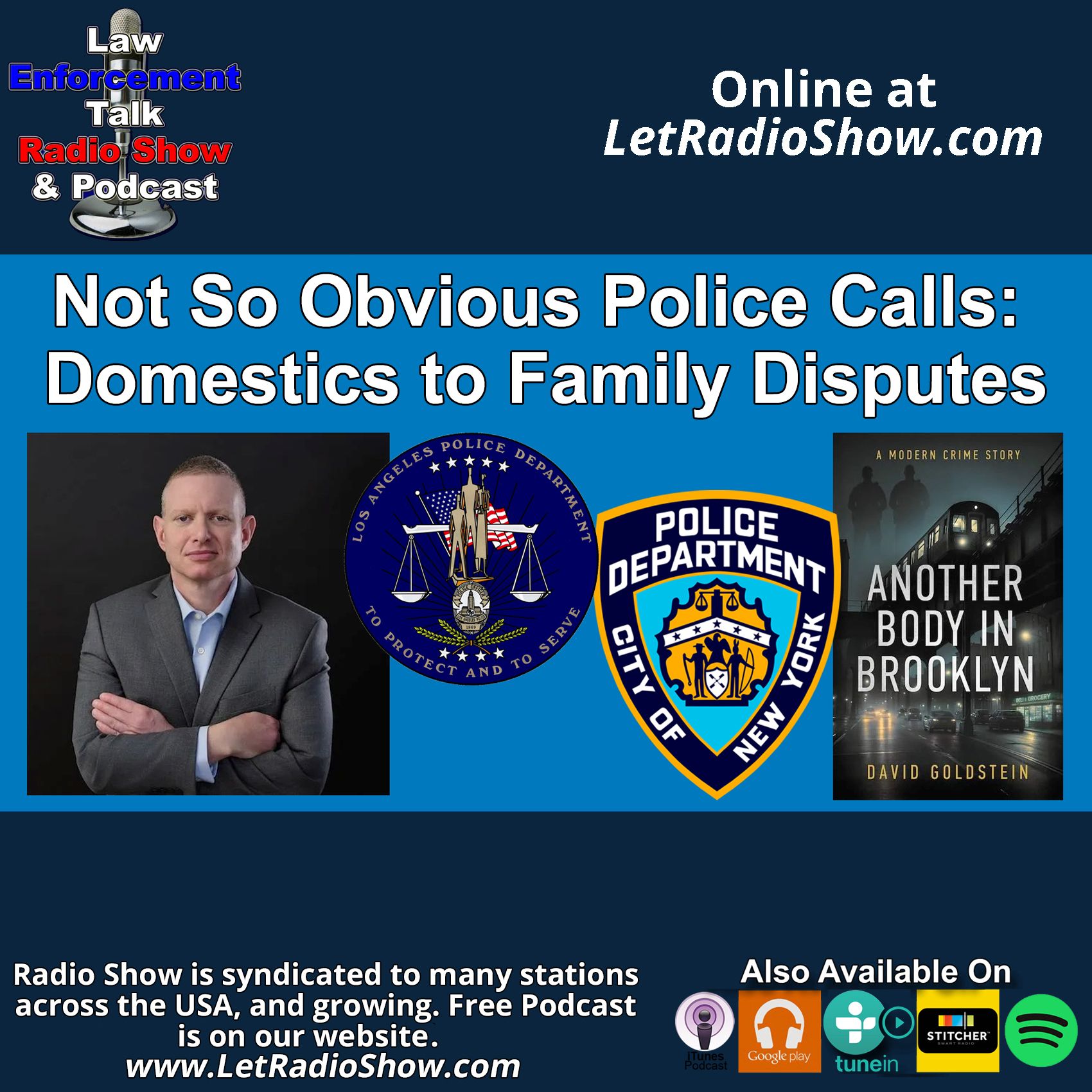


Not So Obvious Police Calls: From Domestics to Family Disputes. Many people imagine police work as a constant stream of violent crime, flashing lights, and clear-cut arrests. But according to retired NYPD Lieutenant David Goldstein, the reality of policing is far more complicated. The Law Enforcement Talk Radio Show and Podcast social media like their Facebook , Instagram , LinkedIn , Medium and other social media platforms.
“Most police calls are not obvious crimes,” Goldstein explains. “They’re messy, emotional, and often fall into gray areas, especially domestics and family disputes.” The Podcast is available and shared for free on the Law Enforcement Talk Radio Show and Podcast website, also on Apple Podcasts, Spotify, YouTube and most major podcast platforms.
A Career Shaped by Urban Policing
Goldstein is a retired Lieutenant from the NYPD who spent his career working busy urban precincts across New York City. Before returning home to New York, he served for two and a half years as an officer with the Los Angeles Police Department. He later retired from the NYPD at the rank of Lieutenant, went on to serve as a University Police Officer, and eventually left law enforcement entirely. Supporting articles about this and much more from Law Enforcement Talk Radio Show and Podcast in platforms like Medium , Blogspot and Linkedin .
He grew up in New York, served as a U.S. Marines officer, and earned a degree in Criminology from Florida State University, a background that gave him both academic and street-level insight into Crime and policing.
From Domestics to Family Disputes
Throughout his career, Goldstein saw firsthand that many 911 calls are far from straightforward. Domestics and family disputes, in particular, often blur the line between criminal and civil matters.
“People call the police because they’re scared, angry, or overwhelmed,” he says. “But when we arrive, we often find that no crime has actually been committed.”
He recalls a disturbing attempted child abduction investigation in Bedford-Stuyvesant. Although the suspect was ultimately convicted, Goldstein says the punishment felt inadequate given the seriousness of the crime.
“That case stuck with me,” he notes. “It showed how the system doesn’t always match the gravity of what officers and families experience on the ground.”
He also describes a family dispute call involving a young child, the kind of situation where officers must balance enforcement, empathy, and restraint in a matter of seconds.
The Reality of Not-So-Obvious Police Calls
The concept of Not So Obvious Police Calls refers to the large number of incidents that do not involve active violence or serious crimes in progress. Research shows that more than 95% of police calls do not involve violence.
Many calls fall under what officers refer to as “order maintenance”, noise complaints, suspicious behavior, public intoxication, or emotionally charged disputes. Dispatch information is often incomplete or subjective, making the response even more challenging.
“We’re sent in with limited information,” Goldstein explains. “By the time you arrive, the situation may be completely different than what was described.”
An increasing number of calls also involve mental health crises or substance use, areas where police are frequently expected to act as first responders despite limited specialized training.
Civil Cases vs. Criminal Cases
Goldstein emphasizes that many domestics and family disputes ultimately turn out to be civil matters rather than criminal ones.
“People assume police can ‘fix’ everything,” he says. “But a lot of what we deal with are civil disputes, and no laws were broken.”
Civil cases involve disagreements between private parties and are decided by a lower burden of proof, while criminal cases are prosecuted by the government and require proof beyond a reasonable doubt. Understanding this distinction is critical to understanding why officers sometimes leave scenes without making arrests.
The Cost to Officers and Communities
Responding to a constant stream of complex, non-clear-cut calls places a heavy burden on police departments. Goldstein notes that it strains resources, contributes to community confusion, and leads to officer burnout.
“When you’re constantly dealing with chaos that isn’t criminal, it wears on you,” he says. “That stress follows officers home.”
From the Streets to the Page
Goldstein channels these experiences into his writing. He is the author of Another Body in Brooklyn, a gritty crime novel inspired by real police experiences in Bed-Stuy, Brooklyn. The book follows Police Sergeant Joshua Rothchild as he navigates violence, bureaucracy, and moral conflict while investigating a forgotten New Year’s Day murder.
“The book is fiction,” Goldstein says, “but the emotions, the confusion, and the pressure are all real.”
He is also the author of Back Alleys and Unauthorized Donut Shops, a collection of short crime fiction, and writes science fiction as well.
Goldstein frequently discusses these topics on Podcast platforms including Apple and Spotify, and across Facebook, Instagram, News outlets, and Youtube, continuing the conversation about the realities of policing long after leaving the NYPD.
As Goldstein puts it, “If people understood how few police calls are actually clear-cut, they might better understand the impossible decisions officers face every day.”
Be sure to check out our website .
Be sure to follow us on X , Instagram , Facebook, Pinterest, Linkedin and other social media platforms for the latest episodes and news.
Background song Hurricane is used with permission from the band Dark Horse Flyer.
You can contact John J. “Jay” Wiley by email at Jay@letradio.com , or learn more about him on their website .
Check out the Show "Cops Under Fire". Good stuff and it is part of the TruBlu Streaming Network.
Find a wide variety of great podcasts online at The Podcast Zone Facebook Page , look for the one with the bright green logo.
Not So Obvious Police Calls: From Domestics to Family Disputes.
Attributions
Amazon
Hosted by Simplecast, an AdsWizz company. See pcm.adswizz.com for information about our collection and use of personal data for advertising.